
Introduction: The Real Game Has Changed
Low Competition AI Side Hustles for Beginners (2026 Strategy)
The AI side hustle space in 2026 is no longer early-stage. It has entered a phase where access is easy, but results are uneven.
Low competition AI side hustles in 2026 are not about finding hidden ideas — they are about execution, positioning, and system design.
AI adoption is accelerating across industries, as highlighted in research on the state of AI.
Anyone can generate content, build pages, or launch ideas using AI. That is no longer the advantage.
The advantage now lies in how you structure execution. This is where low competition AI side hustles create a real advantage for beginners.
Most beginners enter this space with the wrong assumption: that choosing the “right idea” is enough. In reality, the idea matters far less than positioning and system design.
Low competition AI side hustles offer a more practical entry point for beginners who want results without competing in saturated markets.
This is why many people take action but see no results. They operate at the surface level of opportunity, where competition is highest and differentiation is lowest. This is exactly why low competition AI side hustles outperform saturated approaches.
Low competition AI side hustles exist — but not where most people are looking.
The Reality of AI Side Hustles in 2026
Why Most AI Side Hustles Fail (Structural Breakdown)
The majority of AI side hustles do not fail because the opportunity is gone. They fail because the execution model is flawed from the beginning.
There is a clear pattern across beginners entering this space. They focus heavily on tools and output, but very little on structure and outcomes.
At a surface level, their workflow looks productive.
They generate content, experiment with tools, and publish consistently. But despite the activity, there is no meaningful return.
This happens because they are operating without a system.
Most beginners follow a linear approach:
Tool → Output → Expectation
They discover a tool, create something with it, and expect results to follow. When results do not appear, they switch tools and repeat the process.
This creates movement, but not progress.
In contrast, structured operators follow a different model:
Problem → System → Traffic → Conversion → Monetization
The starting point is not the tool. It is the problem being solved.
From there, a system is built to attract the right audience, guide them through relevant content, and connect them to a solution that generates revenue.
This difference is subtle, but it completely changes outcomes.
There are three common failure patterns that appear repeatedly:
1. Tool Dependency Instead of Strategy
Many beginners believe the advantage comes from using better tools. In reality, tools only increase output. They do not improve direction.
Without a clear system, better tools simply produce more low-value content at a faster rate.
2. Lack of Niche Clarity
Broad positioning creates immediate competition. When content is not targeted toward a specific audience or problem, it blends into the existing noise.
This leads to low visibility, weak engagement, and poor conversion.
Clarity reduces competition. Vagueness increases it.
3. No Monetization Alignment
A large portion of beginners create content without a defined monetization path. They focus on traffic first, assuming income will follow.
In practice, traffic without intent alignment rarely converts.
If the content does not lead naturally toward a product, service, or solution, it remains informational rather than transactional.
The key insight is this:
Failure in AI side hustles is rarely about effort. It is about misalignment.
When the problem, content, and monetization are not connected, the system cannot produce results — no matter how consistent the effort is.
Low competition opportunities still exist, but they require structured execution.
Without that structure, even the best ideas fail to convert.
The market is saturated at the surface, but inefficient underneath.
There is no shortage of content, tools, or tutorials. What is missing is structured execution. Most participants produce output, but very few build systems that convert that output into results.
This creates a gap.
On one side, there are high-activity users generating content with little return. On the other, there are structured operators who produce less, but build systems that compound.
The opportunity has not disappeared — it has shifted.
Low competition now exists in execution quality, positioning, and consistency, not in the idea itself.
What “Low Competition” Actually Means
Most beginners interpret low competition incorrectly.
They assume it means finding an idea that no one else is doing. In reality, those opportunities are either non-existent or not profitable.
Low competition is not about absence of competitors.
It is about weak execution within a defined segment.
The difference becomes clear when you look at how markets are structured.
At the top level, competition is always high.
For example:
- AI content writing → extremely saturated
- AI blogging → highly competitive
- Make money with AI → overcrowded
But competition does not distribute evenly. It compresses at the broad level and weakens as specificity increases.
This creates an entry point.
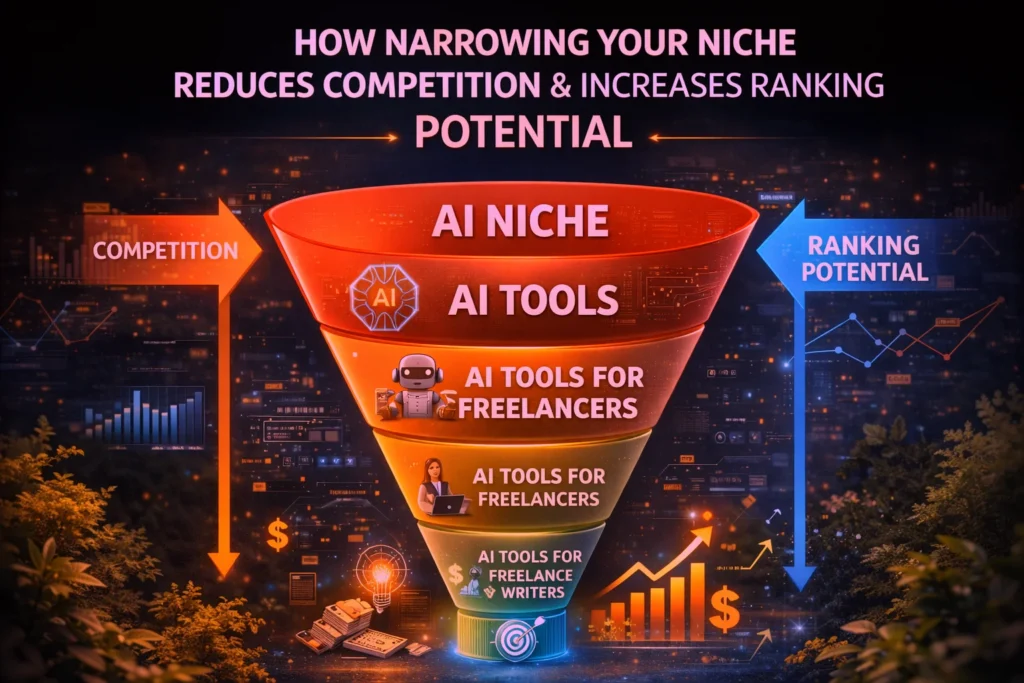
Consider this breakdown:
- Broad: AI content writing
- Niche: AI content for real estate businesses
- Micro-niche: AI-generated property descriptions for Airbnb hosts
Each step reduces competition while increasing relevance.
At the micro level, fewer creators are targeting the exact problem, and fewer solutions are optimized for that intent.
This is where beginners gain leverage.
File name: low-competition-niche-breakdown.webp
Why Specificity Reduces Competition And Why Low Competition AI Side Hustles Work in 2026
Search behavior is intent-driven.
Broad keywords attract traffic but lack clarity.
Specific keywords reflect a defined problem.
For example:
- “AI writing tools” → high traffic, low conversion
- “AI tools for real estate listing descriptions” → lower traffic, higher intent
From an SEO perspective, low competition often exists in:
- Long-tail keywords
- Problem-specific queries
- Audience-defined searches
These areas are typically ignored because they appear smaller.
In reality, they convert better and compound faster.
Strategic Interpretation
Low competition is not about discovering hidden ideas.
It is about entering visible markets with narrow positioning and clear intent alignment.
Instead of asking:
“What is no one doing?”
The better question is:
“Where is execution weak, and how can I be more specific?”
That shift alone moves you out of saturated layers and into areas where results are still achievable.
The AI Side Hustle System (What Actually Works)
A functional AI side hustle is not a task. It is a system. This is especially true for low competition AI side hustles, where structure determines results.
At a basic level, it has three layers:
- Traffic generation (content or distribution)
- Conversion (intent-driven structure)
- Monetization (offers aligned with problems)
If one of these layers is missing, the system produces activity but not income.
This is where most beginners fail. They create content but don’t structure it. They generate traffic but don’t convert it. They promote tools without aligning them to user intent.
The result is effort without outcome.
Low competition opportunities work only when they are placed inside a functioning system.
System Breakdown With Example
A system becomes clear only when you see it in execution.
Consider a simple example using AI blogging — one of the most practical models for beginners.
At a surface level, blogging looks like content creation. In reality, it is a structured flow designed to convert attention into income.
The system operates in four connected stages:
1. Traffic (Discovery Layer)
This is where visibility comes from.
You target specific keywords that reflect real user intent. Instead of writing broadly, each article is designed to answer a defined query.
Example:
“Low competition AI side hustles for beginners”
The goal is not just traffic, but relevant traffic.
2. Content (Positioning Layer)
Once the user lands on the page, the content must do more than inform.
It must:
- Clarify the problem
- Build trust through structure
- Position solutions logically
This is where most content fails. It provides information but does not guide decision-making.
Structured content moves the reader forward.
3. Conversion (Decision Layer)
Conversion is not a button. It is a transition.
You guide the reader from understanding the problem to considering a solution.
This is done through:
- Internal linking (to deeper guides)
- Tool recommendations
- Comparisons and frameworks
At this stage, intent becomes actionable.
4. Monetization (Outcome Layer)
Monetization works only when it aligns with intent.
If the reader is looking for solutions, you provide:
- Affiliate tools
- Relevant services
- Targeted digital products
There is no forced selling. The structure naturally leads to the outcome.
How the System Connects
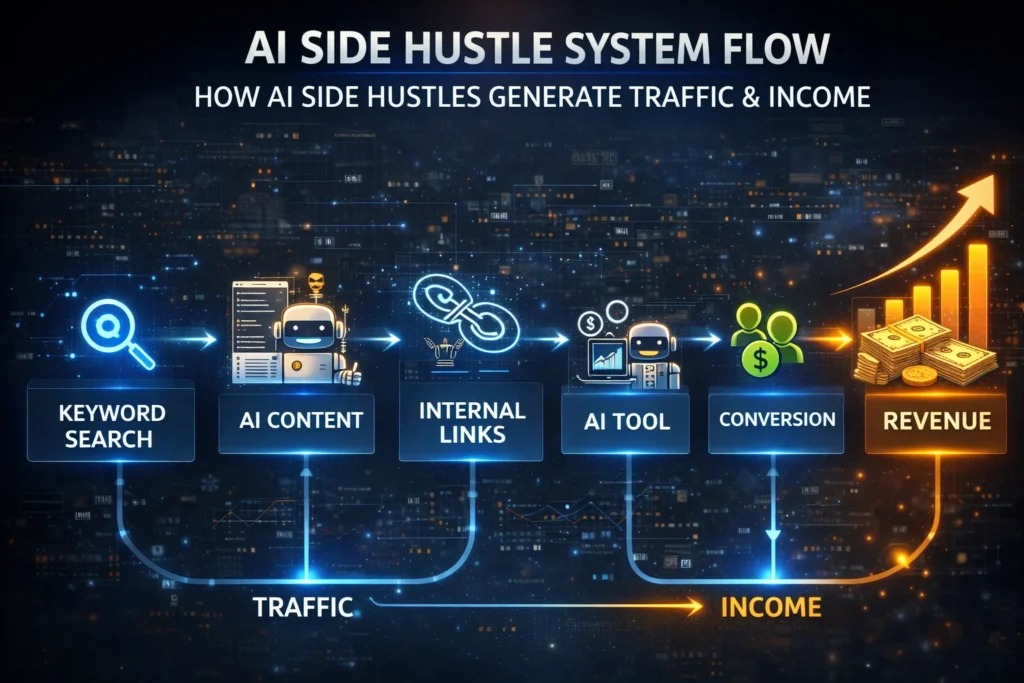
When simplified, the flow looks like this:
Keyword → Article → Internal Link → Tool → Click → Commission
Each step supports the next. This structured flow is what makes low competition AI side hustles effective.
If one part is missing, the system weakens:
- No keyword strategy → no traffic
- No structure → no conversion
- No alignment → no revenue
Most successful creators are now focusing on low competition AI side hustles because they align better with intent and conversion.
Choosing low competition AI side hustles reduces risk and improves early traction.
Key Insight
Most beginners focus on individual actions:
Writing articles
Trying tools
Posting content
But results come from connected systems, not isolated efforts.
The system, not the task, is what produces income.
Comparing AI Side Hustles (Strategic Breakdown)
Different models behave differently.
Content-based models such as blogging and Pinterest are slower to start but scale over time. Each piece of content becomes an asset that continues to generate traffic.
Service-based models such as automation or freelancing generate faster income but are limited by time. They require continuous input to maintain output.
Platform-based models such as TikTok or YouTube offer high upside but depend on consistency and algorithm behavior.
From a strategic perspective, the trade-off is clear.
Fast income comes with limited scalability. Scalable income comes with delayed results.
Choosing the right model depends less on preference and more on your current constraints. For beginners, low competition AI side hustles offer a more stable starting point.
Comparing AI Side Hustles (Strategic Breakdown)
Not all AI side hustles behave the same. Each model has a different trade-off between speed, effort, and scalability.
| Model | Speed | Difficulty | Scalability | Income Potential |
|---|---|---|---|---|
| AI Blogging | Slow | Medium | High | High (long-term) |
| Pinterest + AI | Medium | Low | Medium | Medium |
| AI Freelancing | Fast | Medium | Low | Medium–High |
| AI Automation Services | Fast | High | Medium | High |
| AI Digital Products | Medium | Medium | High | High |
Strategic Interpretation
- Fast income models (freelancing, automation) require continuous effort. Income is directly tied to time.
- Scalable models (blogging, digital products) take longer to build but compound over time.
- Low-barrier models (Pinterest) are easier to start but require consistency to sustain results.
Key Trade-Off
Speed vs Scalability
- If you need immediate income → service-based models
- If you want long-term assets → content/product-based models
Most beginners fail because they expect fast results from slow models.
Choosing the right model is less about preference and more about your current situation.
Low Competition AI Side Hustles (Ranked by Practicality)
Micro-Niche AI Blogging
This is one of the most reliable long-term models.
Instead of targeting broad topics, you focus on specific problems or audiences. This reduces competition and allows faster authority building.
The advantage is compounding. Each article strengthens the system, increasing both traffic and monetization potential over time.
For a full system breakdown, see How to Start an AI Side Hustle in 2026
Low competition AI side hustles create faster traction.
AI-Powered Pinterest Strategy
Pinterest remains structurally underutilized.
Unlike traditional SEO, visibility is not entirely dependent on domain authority. AI can be used to generate visual content and descriptions at scale, creating a consistent traffic stream.
This model works particularly well for beginners due to lower entry friction.
AI Ebook and Digital Assets
Instead of creating long-form products, you focus on solving specific problems through small, targeted resources.
This allows faster creation and clearer monetization. The value comes from specificity, not volume.
Niche AI Prompt Products
Generic prompts are saturated. Niche prompts are not.
When prompts are aligned with specific use cases, they become tools rather than ideas. This increases both demand and perceived value.
AI Automation for Small Businesses
This model operates differently.
Instead of building content assets, you provide direct value. Many small businesses lack basic automation systems, creating immediate opportunities.
The trade-off is scalability, but the advantage is faster income.
How to Start (Simple Execution Model)
The starting point is not choosing multiple ideas, but committing to one narrow direction.
Begin with a clearly defined niche and one traffic channel. Create 5–10 focused articles targeting specific problems within that niche. Each article should answer a clear question and connect to the next through internal linking.
Once traffic begins to appear, introduce tools or solutions that directly align with user intent. This is where monetization starts.
The objective is not volume, but structure. Each piece of content should serve a role within a connected system, guiding the reader from problem to solution. This is how low competition AI side hustles are built for long-term growth.
Realistic Earning Expectations
There is a clear timeline most beginners experience.
In the first one to two months, income is typically zero. This phase is focused on setup, learning, and initial content creation.
Between months three and six, small earnings begin to appear. These usually range from $50 to $300, depending on consistency and execution.
Beyond that, scaling becomes possible. At this stage, income can reach $500 to $1500 or more, depending on how effectively the system is built.
The key point is not speed, but progression. This is why low competition AI side hustles tend to scale more efficiently over time.
This is why low competition AI side hustles tend to perform better than saturated ideas over time.
Example Breakdown
If one article brings 50 visitors per month and around 2–3% click on a recommended tool, that results in 1–2 clicks. If one of those converts, it can generate $10–$30.
As your content grows, the numbers scale. With 30 articles, traffic compounds, increasing both clicks and conversions over time.
This is why results appear slow initially but accelerate once the system is in place.
Income is a lagging indicator of structured execution.
Monetization Mechanics (Why People Actually Earn)
Monetization is not driven by traffic alone.
It is driven by alignment between problem, content, and solution.
When a user searches with intent, your content must guide them toward a relevant outcome. This is why tool-based content and comparison content convert more effectively than general information.
See Best AI Tools for Freelancers in 2026 for tool-based monetization strategies.
Without intent alignment, traffic produces activity but not revenue.
30–60 Day Execution Blueprint
The first phase should focus on building assets.
During the first two weeks, the goal is to establish your foundation. This includes choosing a model, defining a niche, and publishing initial content.
In the following two weeks, structure becomes the priority. Content should be connected, optimized, and aligned with search intent.
By the second month, monetization is introduced. At this stage, consistency becomes more important than expansion.
This process is simple, but it requires discipline.

Common Failure Points
Most failures are not due to bad ideas.
They are due to poor execution patterns.
Switching between models resets progress. Over-focusing on design delays output. Ignoring SEO limits visibility. Misusing AI reduces quality.
These are small issues individually, but together they prevent systems from forming.
Strategic Reality
The biggest mistake is not choosing the wrong side hustle.
It is expecting results without building a system.
Most people operate at the level of action. Few operate at the level of structure.
That difference determines outcomes.
If you stay consistent with low competition AI side hustles, growth becomes predictable instead of random.
FAQ
What is the best low competition AI side hustle?
Micro-niche content models such as blogging or Pinterest offer the best balance of low competition and long-term scalability.
This is where low competition AI side hustles create an advantage by focusing on specific problems instead of broad markets.
How long does it take to earn?
Most beginners see initial results within 3–6 months, depending on consistency and execution.
Is AI enough to succeed?
No. AI increases output, but results depend on structure, positioning, and execution.
Low competition AI side hustles are ideal for beginners because they reduce competition while improving conversion potential.
Final Perspective
Low competition opportunities still exist in 2026.
But they are no longer obvious.
They exist in how you position yourself, how you structure your work, and how consistently you execute.
The advantage is no longer access.
This is the core advantage of low competition AI side hustles in 2026.
It is clarity.