
The Reality Most Beginners Don’t See
AI freelancing in 2026 is not difficult to start.
Choosing the right AI freelancing niche 2026 is what determines whether you succeed or stay stuck.
If you want to understand how all these strategies connect, explore the complete system on our homepage.
Most beginners spend weeks learning tools, experimenting with prompts, and exploring different services. On the surface, this feels like progress. In reality, it creates confusion.
They move between content writing, social media management, design, and automation without committing to any one direction. As a result, nothing compounds.
This leads to a predictable outcome: no clear offer, no positioning, and no client trust.
The uncomfortable truth is simple.
Most beginners are not failing because the market is saturated. They are failing because they are indistinguishable.
What is the best AI freelancing niche in 2026?
The best AI freelancing niche is not the highest-paying one. It is the niche that is easiest to sell, solves a clear business problem, and allows beginners to get their first client quickly.
In most cases, this includes services like content writing, social media management, and basic design before moving into higher-value services like automation and AI systems.
If your direction is still unclear, it helps to step back and understand [how to choose the right online income model in 2026] before committing to a niche.
What Changed in 2026: The Real Market Shift
Artificial intelligence did not remove competition. It redefined it.
In previous years, the main barrier to freelancing was skill. Fewer people could produce high-quality work, which limited competition. Today, AI has lowered that barrier significantly. Execution is easier, but differentiation is harder.
Freelancers using AI can now increase their output by 30–50%. At the same time, businesses are actively shifting toward AI-assisted services to reduce costs and increase efficiency.
In addition, freelance marketplaces are already reflecting this shift. AI-assisted freelancers are increasingly able to handle more clients with the same time investment, which is changing how services are priced and delivered across the market.
This creates a paradox.
There is more opportunity than ever before, but also more noise.
Two types of freelancers now exist in the market.
The first group uses AI tools to generate outputs. They produce content, designs, or automation without clear positioning. These freelancers often compete on price and struggle to stand out.
The second group uses AI to solve specific business problems. They focus on outcomes such as traffic, leads, or operational efficiency. These freelancers compete on value.
The difference between these two groups is not skill.
It is positioning.
And that positioning starts with niche selection.
According to industry research from McKinsey, AI adoption is rapidly increasing across businesses, improving productivity and changing how services are delivered.
The Core Mistake: Choosing Based on Income Instead of Execution
Most beginners approach niche selection the wrong way.
They ask, “Which niche makes the most money?”
This question feels logical, but it leads to poor decisions. High-paying niches require trust, experience, and proof. Without those, beginners struggle to get traction.
A better question is:
What can I realistically sell in the next 30 days?
This shift changes everything.
If you are ready to move from theory to action, this guide on how to get your first AI freelance client in 2026 explains the exact execution process.
The goal in the beginning is not to maximize income. It is to enter the market.
The fastest way to do that is by choosing a niche that is easy to explain, easy to demonstrate, and already understood by businesses.
This is where most beginners get stuck. They aim for high-value services too early, without understanding how difficult those services are to sell without credibility.
How to Choose the Right AI Freelancing Niche in 2026
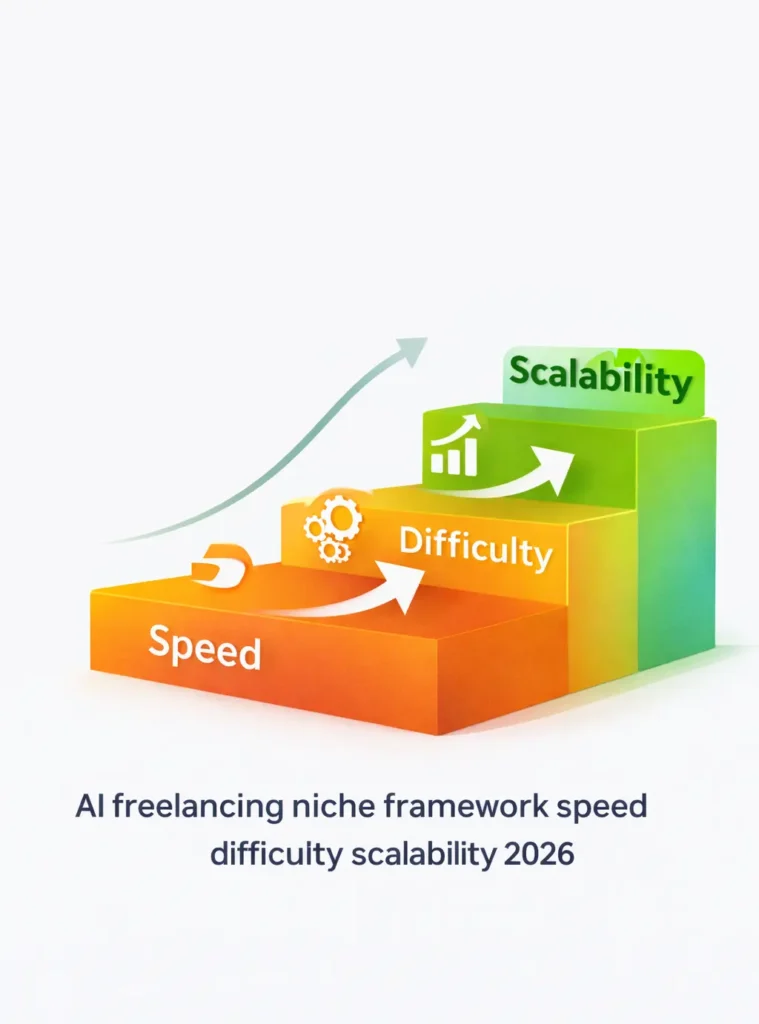
Not all AI freelance niches are equal. Some generate income quickly but have limited scalability. Others take longer to establish but offer higher long-term potential.
To evaluate a niche properly, it helps to look at four factors: how quickly it can generate income, how difficult it is to deliver, how scalable it is, and how competitive the market is.
When these factors are considered together, a clear pattern appears.
Services that generate income quickly are usually easier to deliver and easier to sell. However, they tend to have more competition and lower pricing in the beginning.
More advanced services—such as automation or systems building—are harder to enter but offer significantly higher earning potential over time.
Understanding this trade-off allows you to make a strategic decision instead of a random one.
To simplify this decision, here is a realistic comparison of common AI freelance niches:
| Niche Type | Speed to Income | Difficulty | Scalability | Risk |
|---|---|---|---|---|
| AI Content Writing | Fast | Low | Medium | Medium |
| AI Social Media | Fast | Low | Medium | Low |
| AI Design Services | Medium | Medium | Medium | Medium |
| AI Research Services | Medium | Low | Medium | Low |
| AI Automation | Slow | High | High | Low |
This comparison makes one thing clear:
Faster niches are easier to start but harder to scale.
Slower niches require more skill but offer higher long-term income.
What Actually Works: A Three-Level Progression Strategy
Instead of trying to choose the “perfect” niche, it is more effective to think in stages.
Most successful freelancers do not start at the top. They progress through levels.
The first level is focused on entry and speed. This includes services like content writing, social media content, and basic design. These are easy to understand, easy to demonstrate, and already in demand.
The second level focuses on growth. At this stage, freelancers begin to specialize. They move into areas like copywriting, video editing, or structured research. These services require more skill but allow for better differentiation and higher pricing.
The third level is where real leverage is built. This includes automation systems, funnels, and AI workflows. These services directly impact business outcomes and therefore command higher fees. However, they require experience, trust, and deeper understanding.
The key insight is this:
Most successful freelancers move through all three levels over time.
Trying to skip this progression often leads to frustration.
At this point, the question is no longer which niche exists.
The real question is which niches are actually working in the current market conditions.
Breaking Down the Niches That Actually Work
AI content writing remains one of the fastest ways to enter the market. Despite increasing competition, demand is still strong because businesses constantly need written content. However, the real value is no longer in writing itself. It lies in delivering structured, SEO-focused content that drives traffic.
Social media content services are another strong starting point. Businesses struggle with consistency, and freelancers who can create repeatable systems for posting and engagement often secure ongoing clients. This makes it one of the most stable entry points.
Design services, powered by AI tools, continue to grow as visual content becomes more important across platforms. While AI can generate visuals quickly, businesses still rely on freelancers for direction, branding, and refinement.
Research services are often overlooked but highly valuable. Companies are overwhelmed with information and need structured insights rather than raw data. Freelancers who can interpret and present information clearly can position themselves effectively in this space.
Automation services represent the highest leverage opportunity. These services focus on saving time and improving efficiency. While they require more learning upfront, they offer stronger long-term scalability and pricing power.
This progression from simple execution to system-level thinking is what separates beginners from long-term operators. If you want a deeper breakdown of each service and how to position it, read this guide on best AI freelance services to offer in 2026.
What Does Not Work in 2026
Understanding what to avoid is just as important as knowing what works.
Many beginners are drawn to low-effort opportunities such as generic AI content selling, reselling tools, or positioning themselves as “AI experts” without clear specialization. These paths are heavily saturated and offer little room for differentiation.
Markets that require no real skill tend to collapse quickly because anyone can enter them.
If a service can be replicated instantly with no experience, it is unlikely to provide sustainable income.
Realistic Income Expectations
One of the biggest misconceptions in AI freelancing is how quickly income grows.
In the first one to two months, most beginners earn little or nothing. This phase is focused on learning and building samples.
Between months two and three, initial clients begin to appear. Income may range from a few hundred dollars to around $800, depending on effort and consistency.
By months three to six, freelancers who stay consistent often reach a more stable range between $800 and $3000 per month.
These numbers are not fixed, but they reflect realistic progression.
The key factor is not the niche itself.
It is consistent execution.
How Long It Actually Takes to Get Your First Client
Most beginners underestimate how quickly results can happen when they focus.
Within the first two weeks, a clear niche can be selected and basic skills can be learned. The following one to two weeks are usually spent creating sample work.
Outreach typically begins in the third or fourth week. For those who remain consistent, the first client often appears within four to six weeks.
This timeline is not guaranteed, but it is realistic.
If you need a step-by-step execution plan, follow [how to get your first AI freelance client in 2026].
Common Mistakes That Keep Freelancers Stuck
The most common mistake is switching niches too early. When results do not come immediately, beginners assume the niche is wrong and move to something else. This resets progress and prevents momentum.
Another issue is focusing too much on tools. Learning multiple AI platforms feels productive, but without a clear service, it does not lead to income.
Waiting for perfection is another trap. Many freelancers delay outreach until they feel “ready,” which slows down progress significantly.
In most cases, the real issue is not skill.
It is lack of consistent action.
A Simple 30–60 Day Execution Plan

The first ten days should be focused on choosing one niche and understanding how the service works in practice. The next ten days should be spent creating sample work that resembles real client projects.
From day twenty onward, outreach becomes the priority. This includes sending proposals, contacting businesses, and refining messaging based on responses.
Between days thirty and sixty, the focus shifts toward closing clients and improving delivery systems.
This process is simple, but it requires consistency.
Frequently Asked Questions
Why do most AI freelancers choose the wrong niche?
Because they prioritize income potential instead of ease of selling and client demand.
What is the easiest niche to start with?
Content writing and social media services remain the most accessible due to existing demand.
Which niche has the highest long-term potential?
Automation and AI systems offer the highest scalability and pricing power.
Is AI freelancing saturated?
It is competitive, but most freelancers lack clear positioning, which creates opportunity.
What Separates Freelancers Who Succeed
The difference is rarely skill in the beginning.
It comes down to three factors:
Clarity — choosing one direction and sticking to it
Consistency — taking action daily instead of overthinking
Positioning — focusing on outcomes instead of tools
Freelancers who combine these three elements tend to see results within weeks.
Those who don’t remain stuck in learning mode.
Strategic Closing
AI freelancing in 2026 is not about learning everything.
It is about choosing one direction and committing to it long enough for results to compound.
The right niche simplifies everything. It makes it easier to explain your offer, attract clients, and improve your workflow.
The wrong niche creates friction at every step.
Opportunity is not hidden.
It is structured.
And those who understand how to position themselves within that structure are the ones who move forward.