A complete AI side hustle 2026 guide for beginners to build scalable online income.

Introduction: Why AI Side Hustles Are the Biggest Opportunity Right Now
An AI side hustle 2026 strategy is one of the most practical ways to start making money online today. This is why understanding how an AI side hustle 2026 works is critical before you start
Starting an AI side hustle 2026 is no longer a niche opportunity — it is a competitive environment. The difference between those who succeed and those who don’t is no longer access to tools, but how effectively they use them.
While many people are entering this space, most approach it without structure. As a result, they produce content, try multiple models, and see little to no results. The advantage now comes from building a system — not just taking action.
You’re no longer just competing with other people — you’re competing with people who are using AI to move faster, produce more, and scale their efforts. That shift is what makes starting an AI side hustle today one of the most practical decisions you can make.
This is especially true if you want to earn online, feel stuck in your current job, are looking for a scalable income stream, or have already started building something like a blog and want to take it further.
The advantage is that the barrier to entry is lower than most people assume. You don’t need technical skills, coding knowledge, or a large investment to get started. What actually matters is having a clear system — and that’s what you’re going to build step by step.
Before committing to a specific AI side hustle, it helps to understand how different digital income paths work. The framework explained in How to Choose the Right Online Income Model in 2026 (Skill, Time & Risk Framework) helps evaluate which model fits your skills, available time, and risk tolerance
This is exactly how you build a sustainable AI side hustle system that actually works.
The Reality of AI Side Hustles in 2026
AI side hustles are no longer a hidden opportunity — they are a competitive space. More people are entering this space every day, and the volume of content and services has increased significantly.
This means low-effort approaches no longer work. Generic content, inconsistent execution, and lack of direction are quickly ignored.
What still works is structured execution. When your approach is built around a clear system — combining content, SEO, and monetization — results become predictable over time.
The opportunity is still real, but it now favors those who approach it strategically rather than casually.
This is where a structured AI side hustle 2026 approach creates a clear advantage.
Understanding this shift is critical if you want your AI side hustle 2026 to succeed in a competitive market.
In simple terms, an AI side hustle 2026 rewards structure, not random effort.
What is an AI Side Hustle? (Simple Explanation)
An AI side hustle is any way of making money by using artificial intelligence tools to work more efficiently and at scale. Instead of relying on manual effort, AI allows you to create content faster, automate repetitive tasks, deliver services more efficiently, and increase your output without needing to hire a team.
This shift is not theoretical. AI adoption is accelerating across industries, as highlighted in recent research on the state of AI, which is why individuals who understand how to use these tools are gaining a clear advantage.
In practical terms, an AI side hustle can take several forms. You might build an AI-powered blog, offer freelance services using AI tools, automate content creation processes, sell AI-generated digital products, or use AI to support affiliate marketing strategies
Not sure which AI side hustle to choose? Read our complete guide on Best AI Side Hustles for Beginners in 2026 . Choosing the right model early makes your AI side hustle 2026 much easier to scale.
This is the core foundation of building a successful AI side hustle 2026.
Every model you choose ultimately fits into a broader AI side hustle 2026 system.
Why AI Side Hustles Are Exploding in 2026
Massive Time Leverage
AI fundamentally changes how time is used. Tasks that once required several hours can now be completed in a fraction of that time, and work that used to take an entire day can often be finished within a few hours. This compression of time directly translates into higher output, which increases your overall earning potential without requiring more effort.
At the same time, the barrier to entry has become significantly lower. You can start with nothing more than a laptop, an internet connection, and access to free or low-cost tools. There is no need for an office, a formal degree, or a team, which makes this model accessible to almost anyone willing to learn and execute.
On the demand side, the market is actively paying for AI-driven work. Businesses are already investing in AI content creation, automation systems, SEO-focused content, and digital marketing support. This creates a clear opportunity for individuals who can use AI tools effectively and position their services or content in the right way.
If you want to speed up your workflow and increase your income, explore our full list of Best AI Tools for Freelancers in 2026 and start using them today.
This shift is exactly why an AI side hustle 2026 has become one of the most scalable online models.
Step-by-Step: How to Start an AI Side Hustle
Step 1: Choose ONE AI Side Hustle (Critical Decision)
Most beginners don’t fail because the model doesn’t work — they fail because they split focus. Trying blogging, freelancing, YouTube, and other models at the same time leads to no real traction.
In 2026, attention is limited. Every model requires time, consistency, and a learning curve. When you switch too often, you reset progress before it compounds. Growth in online business is not linear — it builds over time, but only if you stay in one system long enough.
The practical approach is simple: commit to one model for at least 60–90 days. Evaluate it based on how quickly it generates income, how well it scales without your time, and whether it depends on clients, platforms, or assets.
AI blogging is slower to start but builds long-term assets and scalable income. Freelancing generates faster cash but remains tied to your time. YouTube automation offers high upside but depends heavily on consistency and algorithms. AI-based micro-services are easy to start but have limited long-term scale.
The key is not choosing the “best” option, but choosing one and executing it long enough for results to compound.
Short-term income, not long-term leverage.
This decision defines the direction of your AI side hustle 2026.
Without focus, your AI side hustle 2026 will struggle to gain traction.
Step 2: Pick a Profitable Niche (This Determines Your Ceiling)
Your niche is not just a topic — it is your position in the market. It directly shapes your traffic potential, monetization options, and level of competition.
In 2026, there are no hidden niches. What matters is how you position yourself within a niche, how your content is structured, and how well your monetization aligns with user intent. Two websites in the same niche can produce completely different results based on positioning alone.
High-performing niches like AI tools, make money online, SaaS and automation, health and productivity, and tech tutorials all have strong demand and monetization potential. The difference is not the niche itself, but how you approach it. Broad positioning leads to high competition, while focused positioning increases relevance and improves your chances of ranking and converting.
Instead of targeting something general like AI tools, narrowing it down to a specific audience or use case makes your content more effective. This reduces competition and creates clearer intent.
The principle is simple: be specific first, then expand.
Choosing the right model defines your direction. Choosing the right niche defines your ceiling. Consistency determines whether you reach it.
Your niche selection directly impacts how fast your AI side hustle 2026 grows.

Step 3: Use AI Tools to Multiply Output
You should not be working manually anymore. The goal is to use AI as a leverage system that increases your output without increasing your effort.This leverage is what makes an AI side hustle 2026 scalable without increasing workload.
A simple and effective setup includes using ChatGPT for content creation, AI tools for image generation, keyword tools for SEO research, and automation platforms like Zapier to streamline repetitive tasks. Each of these tools plays a role in reducing time while increasing consistency.
For a deeper breakdown of how this translates into actual income, refer to How to Make Money with ChatGPT in 2026, where the full monetization system is explained.
The key insight is this: AI is not replacing you — it is multiplying your output.
The more effectively you use tools, the faster your AI side hustle 2026 scales.
How to Choose the Right AI Tools (Beginner Framework)
Choosing the right tools can either accelerate or slow down your AI side hustle 2026, depending on how you use them. Most beginners slow themselves down by using too many tools, switching constantly, and never mastering any of them.
A more effective approach is to keep your setup simple. Start with a small core system that covers content creation, SEO, and basic automation. For example, you can use ChatGPT for writing, a keyword tool for research, and later introduce automation tools like Zapier as your workflow grows.
This works because it reduces complexity, keeps your process consistent, and allows you to focus on execution instead of constantly learning new tools. The real advantage comes from mastering a few tools deeply, not from using many superficially.
Step 4: Content Strategy (This Determines Whether You Grow or Stay Invisible)
Most beginners think blogging is about writing articles.
It isn’t.
It is about building a content system that captures traffic and converts it into revenue over time.
If your content is random, your results will be random.
If your content is structured, your growth becomes predictable.
This is the foundation of a scalable AI side hustle 2026 system.
The Real Problem with Most Blogs
Most beginners publish like this:
- One article about AI tools
- One about freelancing
- One about passive income
There is no connection between them.
No structure. No authority.
From Google’s perspective, this looks like:
A general blog with no clear expertise.
And general blogs rarely rank in competitive niches. Without structure, an AI side hustle 2026 cannot compete in search results.
The System That Actually Works: Topic Clusters
Instead of publishing isolated articles, you should build content around a core topic using a cluster approach. This means creating a central piece of content, such as AI side hustles, and supporting it with related articles like guides, tool breakdowns, comparisons, and monetization strategies.
Each supporting article reinforces the main topic, making your site more structured and easier for search engines to understand. This improves internal linking, strengthens topical authority, and increases your chances of ranking.
The key shift is this: Google no longer prioritizes individual articles in isolation — it favors well-connected content systems.
Your Content Framework (Execution Model)
Your blog should not produce random content — it should operate on a structured system with clear roles for each type of article.
At a practical level, your content should cover four key areas. Beginner-focused guides bring in broad search traffic and introduce new users to your site. Tool-based content targets users with commercial intent, making it ideal for affiliate monetization. Comparison content captures high-intent visitors who are already evaluating options and are close to making a decision, which makes it your strongest conversion layer. Monetization-focused guides build trust by explaining how the system works, encouraging deeper engagement and repeat visits.
If you want to explore broader income strategies beyond AI, you can refer to Top Passive Income Ideas for Beginners in 2026, where different scalable models are explained in detail.
The key distinction most beginners miss is that not all content serves the same purpose. Some content is designed to bring traffic, while other content is designed to generate revenue. Traffic-focused content increases visibility but may not convert immediately, while monetization-focused content attracts fewer visitors but produces higher-value actions.
A functional system requires both. Traffic without monetization does not generate income, and monetization without traffic does not scale. When combined correctly, they reinforce each other.
In terms of performance, comparison content tends to deliver the highest return because it targets users who are already in a decision-making stage. Tool-based content follows closely due to its strong affiliate potential. How-to guides are essential for building trust and consistent traffic, while list-style content supports reach and internal linking.
A practical balance is to maintain a content mix where the majority focuses on traffic generation, while a smaller portion is designed specifically for monetization. This creates a system where growth and revenue develop together instead of separately.
The underlying principle is simple: content should not be published in isolation. Each article should have a defined role, connect to other content, and guide the reader deeper into your ecosystem. That is how blogs grow sustainably in 2026.
Content structure is what separates a successful AI side hustle 2026 from one that stays invisible.
Step 5: SEO Strategy (Your Traffic Engine)
Without SEO, your content won’t get discovered — no matter how good it is.
In 2026, SEO is not about tricks.
It’s about structure, clarity, and matching search intent.
The Foundation (Non-Negotiable Basics)
Every article must have:
- Primary keyword in the title
- Clean URL with the keyword
- Keyword naturally in the first 100 words
- Proper H2/H3 headings
- Internal links to relevant content
- Optimized images (alt text + compression)
If these are missing, your article is already at a disadvantage.
SEO is what drives long-term traffic to your AI side hustle 2026.
What Actually Improves Rankings
Beyond basics, three things matter most:
Topical Authority
Google evaluates how well you cover a topic — not just one article.
Interlinking
Your articles should connect logically to build structure and authority.
Consistency
Publishing regularly signals activity, depth, and reliability.
Reality Check
If your content is random and disconnected, it’s hard for Google to understand your site — and your rankings stay low.
When your content is structured and interconnected, your site becomes clearer, more authoritative, and easier to rank.
Without SEO, an AI side hustle 2026 cannot generate consistent traffic.
Beginner SEO Mistakes That Kill Growth
Most blogs fail because of poor SEO decisions — not poor writing.
Mistake 1: Targeting the Wrong Keywords
- Too competitive
- No clear intent
Fix: Focus on low-competition, long-tail keywords with clear search intent.
Mistake 2: No Internal Linking
Articles stay isolated → no authority builds.
Fix: Link every new post to 2–4 relevant existing articles.
Mistake 3: Ignoring Search Intent
Example:
Keyword: AI tools for freelancers
User expects: list + explanation
If you give random content → no ranking.
Fix: Match exactly what the user is searching for.
Mistake 4: Publishing Without Optimization Missing:
- Meta description
- Proper headings
- Image SEO
Fix: Before publishing, ensure everything is optimized.
Think of this as your final quality check.
Bottom Line
SEO is not about ranking one article.
It’s about building a system where:
- Content is structured
- Articles support each other
- Authority grows over time
Do this consistently, and traffic becomes predictable.
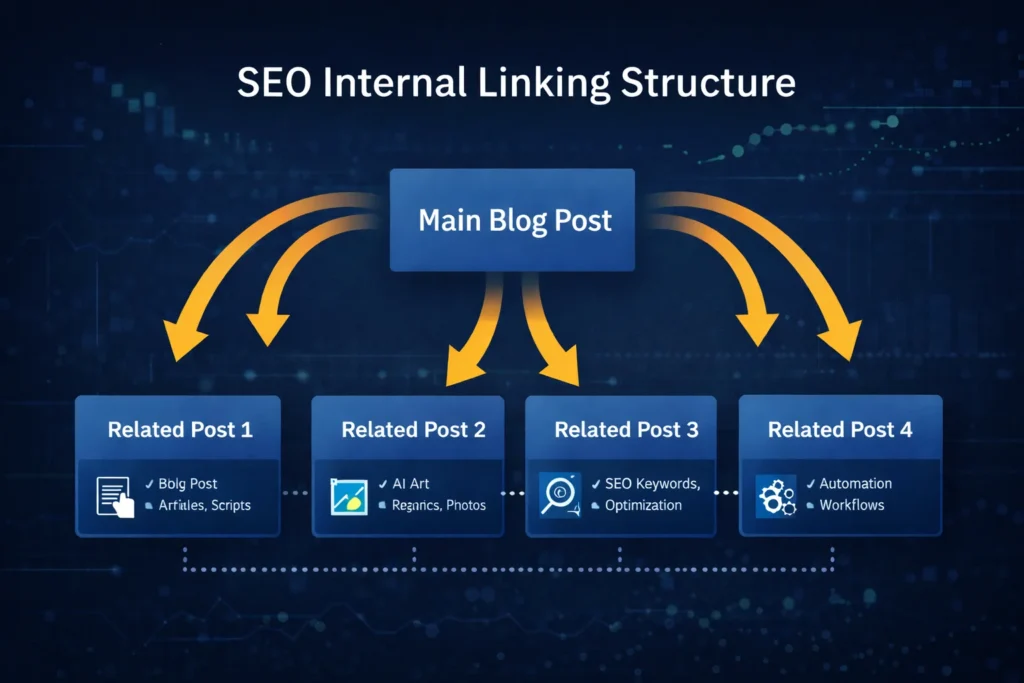
Step 6: Internal Linking Strategy (Authority Booster)
This is where most beginners fail — but you won’t.
Link Your Articles Like This
To build authority and improve rankings, your articles should be connected in a smart way.
For example, when discussing tools, it makes sense to guide the reader toward a deeper breakdown such as Best AI Tools for Freelancers in 2026, where specific tools and use cases are covered in detail.
Similarly, when the focus shifts toward earning, a more targeted resource like How to Make Money with ChatGPT in 2026 helps the reader move from understanding to execution.
For broader income strategies Top Passive Income Ideas for Beginners in 2026 provides additional context beyond AI-specific methods.
And for readers still evaluating their direction, Best AI Side Hustles for Beginners in 2026 offers a clearer comparison of available paths.
consistently rather than randomly.
Why It Matters
Internal linking is not just about connecting pages — it directly impacts how your site performs in search.
When your articles are linked strategically:
- Search engines understand your site structure better, which improves your chances of ranking
- Authority flows between pages, helping newer or weaker articles perform faster
- Users stay longer on your site, increasing engagement and trust signals
Instead of treating each article as separate, internal linking turns your content into a connected system — and that’s what allows your blog to grow consistently rather than randomly.
Internal linking strengthens your AI side hustle 2026 by building authority across your site.
Step 7: Monetization Step (Start Early, Not Later)
One of the most common mistakes beginners make is delaying monetization until traffic arrives.
This approach is flawed.
Monetization should not be treated as a later stage — it should be integrated from the beginning, even at low traffic levels. The reason is simple: early monetization forces you to align your content with intent, not just volume.
If your content attracts visitors but does not guide them toward a decision, it generates activity — not income.
In your niche, the most natural starting point is affiliate-based monetization. AI tools, SaaS platforms, and blogging-related products already have built-in demand and clear use cases. When your content solves a problem and recommends a relevant tool, monetization becomes a byproduct of value — not a forced layer.
As your content base grows, monetization should evolve.
Affiliate income builds the foundation, but long-term leverage comes from controlled assets such as digital products. Guides, templates, or structured resources allow you to move from commission-based earnings to direct revenue, where margins and control are significantly higher.
At the same time, service-based monetization can be used selectively. Offering content writing, SEO, or AI automation services can generate immediate cash flow, but it should be treated as a supporting layer rather than the core model, since it does not scale efficiently.
Advertising, on the other hand, is a late-stage addition. It requires volume, and its impact is limited compared to intent-driven monetization.
The key shift is this:
Monetization is not something you “add later.”
It is something you design into your content from the start.
The most effective approach is to begin with affiliate integration, then gradually expand into products and services as your traffic and authority increase. This creates a system where revenue grows alongside your content, instead of lagging behind it.
Monetization should be built into your AI side hustle 2026 from the beginning.
Step 8: Publishing Strategy (Consistency Beats Talent)
In content-based models, success is rarely determined by talent — it is determined by consistency.
Most beginners underestimate how much volume is required before results begin to appear. A few articles do not create momentum. They create a starting point.
In practical terms, publishing three to five articles per week is a strong pace for beginners, not because of speed alone, but because it accelerates learning, indexing, and feedback. The real shift happens when your site reaches around 30 articles — this is where early signals begin. At 50 or more, patterns become clearer, and growth starts to compound.
The gap between those who succeed and those who don’t is simple: most people stop early. Many quit after publishing 10 articles, long before the system has enough data to produce results.
Consistency is what carries a site through the phase where nothing appears to be working — until suddenly, it does.
Consistency is what turns an AI side hustle 2026 into a long-term asset.
Step 9: Mistakes That Quietly Kill Growth
Most blogs don’t fail dramatically. They fail slowly, through small but repeated strategic errors.
Trying to pursue multiple models at once is one of the fastest ways to lose momentum. Every shift resets your progress, making it difficult to build depth in any one direction.
Over-focusing on design is another common trap. A well-designed site without traffic has no leverage. Content and distribution drive growth — not aesthetics.
Inconsistent publishing breaks the system entirely. Without regular output, there is no accumulation, no authority, and no compounding effect.
Ignoring SEO limits visibility from the start. Even strong content cannot perform if it is not aligned with how search works.
Finally, underusing AI defeats the purpose of this model. If you rely entirely on manual effort, your output remains limited, and in a competitive environment, slow execution quickly becomes a disadvantage.
The pattern is clear: these are not major mistakes in isolation, but together they prevent the system from ever reaching the point where it starts working.
Avoiding these mistakes can significantly improve your AI side hustle 2026 results.
How Much Can You Earn with an AI Side Hustle?
Let’s be realistic.
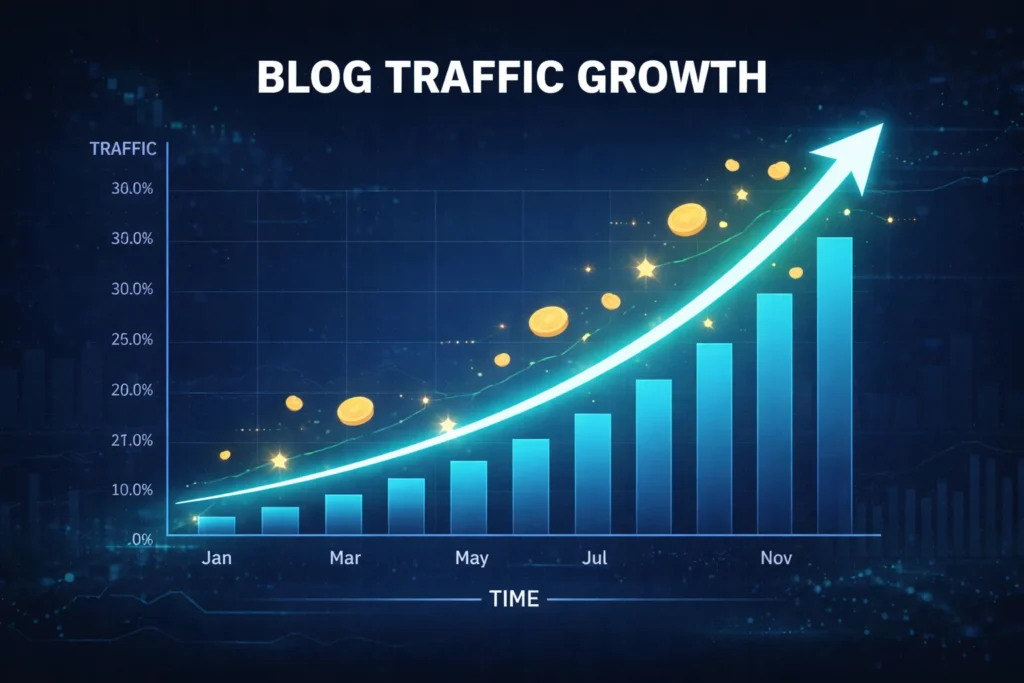
In the early stages, results are slow. Most beginners earn nothing in the first one to two months. As content starts getting indexed and traffic builds, small earnings may appear within three to six months. With consistent execution, income can grow to a few hundred dollars and eventually scale beyond that over time.
The outcome depends on consistency, content quality, SEO execution, and niche positioning.These factors ultimately determine how successful your AI side hustle 2026 becomes.
Income from an AI side hustle 2026 grows gradually, not instantly.
A Practical Action Plan
In the first two weeks, focus on publishing multiple foundational articles around AI and making money online. The goal is to build initial content and start indexing.
Over the next two weeks, improve internal linking and refine your SEO structure so your content begins to connect as a system.
By the second month, start integrating affiliate links where relevant. From the third month onward, shift focus toward consistent publishing and scaling your content output.
Following a structured plan is essential for building a successful AI side hustle 2026.
The Strategy Most Beginners Miss
Instead of covering random topics, focus on building depth in one area. Whether it’s AI tools, AI blogging, or AI income strategies, consistent coverage of a focused topic helps build authority.
Search engines prioritize sites that demonstrate depth and consistency, not scattered content.
Realistic Expectations
This is not a fast result model. Early articles often bring little to no traffic. Around 20 articles, you may start seeing impressions. Real growth typically begins after 30 or more well-structured posts.
Most people quit before reaching this point, which is why they never see results.
Final Perspective
An AI side hustle is simple to start, but results depend on focus, consistency, and execution over time.
In the end, an AI side hustle 2026 is less about tools and more about execution.
The opportunity exists, but it rewards those who stay consistent long enough for the system to work.This is what separates a working AI side hustle 2026 from one that never gains traction.
Success in an AI side hustle 2026 comes down to execution, not information.