The Hard Truth About Making Money Online
In 2026, making money online is not rare.
It is common.
What is rare is choosing the correct online income model in 2026 and staying with it long enough to build momentum. Choosing the right income model determines whether your effort compounds or collapses.
The wrong model wastes time, while the right one builds leverage.
There are more opportunities than ever: AI-driven freelancing, digital products, affiliate systems, automation services, content platforms, consulting, and scalable online businesses. The barrier to entry has collapsed. Almost anyone with internet access can start.
But access is not advantage.
The market is saturated with beginners who chose a model because it looked easy, popular, or trending. Most of them quit within months, not because the internet is overcrowded, but because they selected an income path that did not match their skill level, time availability, or risk tolerance.
The problem in 2026 is not lack of opportunity.
It is misalignment.
This article gives you a structured decision framework so you choose correctly before you invest months in the wrong direction.
This article gives you a structured decision framework so you choose correctly before you invest months in the wrong direction.
If you want a complete overview of all income paths and strategies, explore our main guide on making money online.
If you need a complete execution roadmap after choosing your direction, follow the structured breakdown in How to Make Money Online in 2026 (Beginner to Advanced Roadmap).

Market Context: Why Choosing the Right Model Matters More Than Ever
The online income model in 2026 is shaped by three structural realities.
First, AI has compressed execution time. Tasks that once required five hours can now be completed in one or two. This increases output capacity for individuals. It also increases competition. More people can produce. Fewer people can differentiate.
According to recent global AI adoption research published by McKinsey, organizations are rapidly integrating AI to increase productivity and operational efficiency.
Second, entry-level income models are crowded. Generic dropshipping, low-effort blogging, and surface-level freelancing still exist, but margins are thinner. The easy angles are saturated.
Third, the internet now operates on an outcome-based economy. Clients and customers pay for results, not effort. Speed is expected. Quality is assumed. What remains valuable is positioning, specialization, and structured execution.
This means your income model must align with who you are and what you can realistically execute. Otherwise, friction will eliminate you before growth begins. Understanding how income models work requires more than copying trends.
Each model operates under different economic pressure, competition levels, and scalability ceilings.

The Core Decision Framework: Skill × Time × Risk
Every online income model can be evaluated across three variables:
- Skill requirement
- Time to monetization
- Financial and strategic risk
Your optimal model sits at the intersection of these three factors.
Most people analyze only one of them. That is why they choose poorly.
Step One: Assess Your Skill Position Honestly
Before choosing any model, you must assess your real skill level—not your ambition.
If you are a beginner, you likely have limited monetizable skills. You are learning while attempting to earn. In this position, low-risk execution models are optimal. AI-assisted freelancing, micro-services, and task-based income allow you to generate revenue while building competence.
If you are intermediate, you possess usable digital ability. You can deliver value without constant supervision. At this stage, system-based models become viable: niche freelancing, affiliate-driven content platforms, or structured digital products.
If you are advanced, you combine execution ability with strategic thinking. Here, scalable systems such as automation services, consulting, authority platforms, or product ecosystems offer greater upside.
Choosing above your skill level creates frustration. Choosing below it creates stagnation.
Alignment reduces friction.
Step Two: Evaluate Your Time Constraint
Time is the most underestimated variable in online income.
Many people select a model without considering whether they can sustain its execution rhythm.
If you have only one hour per day, your strategy must favor compounding models. Blogging, affiliate content, educational platforms, or skill stacking are viable because they reward consistency over months. They do not produce fast cash, but they build assets.
If you can dedicate three to four hours daily, client-based freelancing becomes realistic. AI-assisted services, content execution, design, or automation services can generate faster income because they directly exchange value for money.
If you can commit full-time, you can build scalable assets. Authority websites, digital products, automation agencies, and structured online businesses require more upfront effort but offer higher long-term leverage. If your goal is to build long-term compounding systems rather than short-term cash flow, review Top Passive Income Ideas for Beginners 2026 for structured asset-based approaches.
Misalignment between time and model creates burnout.
Burnout creates quitting.
Step Three: Define Your Risk Tolerance
Risk in online income is rarely just financial. It includes psychological pressure, delayed gratification, and opportunity cost.
If you prefer low financial risk and immediate feedback, service-based income is logical. Freelancing and AI-driven execution models allow you to generate revenue without significant upfront investment.
For a structured beginner entry into service-based execution, see AI Side Hustle 2026: How to Start (Beginner Guide), which breaks down how to turn AI-assisted skills into real client income.
If you can tolerate moderate delay and small financial input, asset-based systems such as blogging or affiliate platforms offer scalability.
High-risk, high-reward paths—such as building software, automation agencies, or digital ecosystems—require capital, advanced skill, and patience. The upside is substantial. The failure rate is also higher.
Choosing a model beyond your risk tolerance creates stress. Stress reduces consistency. Without consistency, no model works.
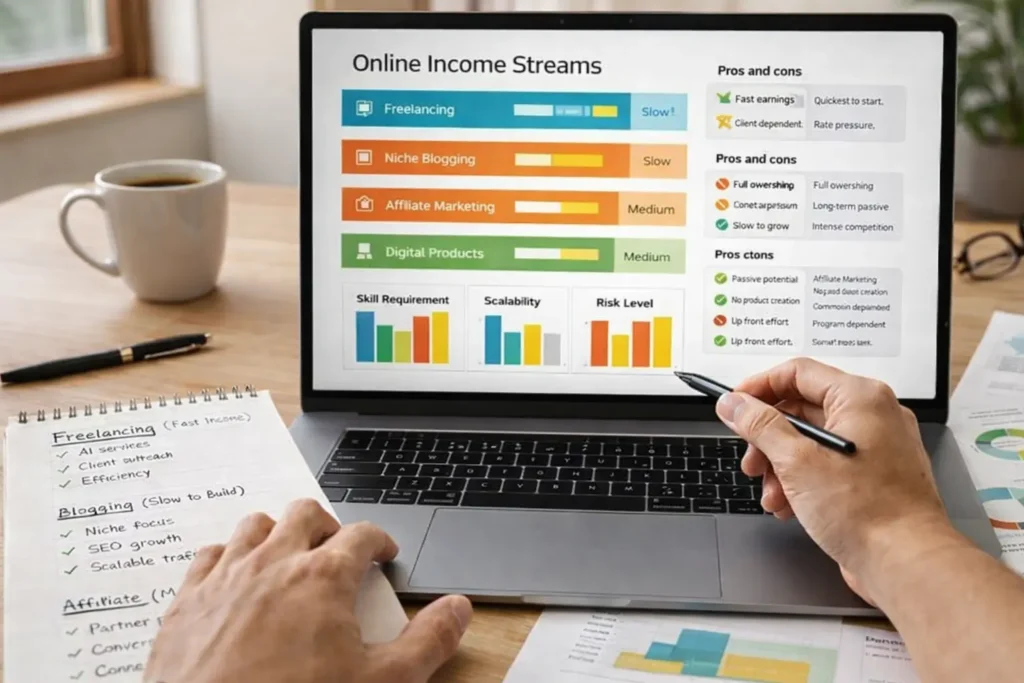
To evaluate the right income model, you must compare speed, skill requirements, scalability, and risk.
How to Evaluate an Online Income Model in 2026
To evaluate an income model, you must analyze skill alignment, time availability, and realistic risk exposure.
Every model behaves differently under competition pressure.
AI-Based Income Opportunities
Artificial intelligence has created an entirely new category of online income opportunities. Many beginners start by exploring structured AI side hustles that combine automation, content production, and freelance services.
Several practical entry points include:
• AI freelance services for businesses
• AI-powered content creation
• automated research and marketing systems
• freelance automation consulting
If you want to understand these opportunities in more detail, the following guides explain each path step-by-step:
- AI Side Hustle 2026: How to Start
- How to Start AI Freelancing With No Experience
- Best AI Freelance Services to Offer in 2026
- Best AI Tools for Freelancers
Comparing Online Income Models in 2026
Below is a realistic comparison of common online income paths.
| Model | Speed to Income | Skill Level Required | Scalability | Risk Level |
|---|---|---|---|---|
| AI Freelancing | Fast | Low–Medium | Medium | Low |
| Niche Blogging | Slow | Medium | High | Medium |
| Affiliate Marketing | Medium | Medium | High | Medium |
| Digital Products | Medium | Medium–High | High | Medium |
| Automation Services | Slow | High | Very High | Low–Medium |
If your priority is avoiding oversaturated paths, explore Low Competition AI Side Hustles for Beginners in 2026.
No single model dominates across all variables.. The best online income model in 2026 depends entirely on your personal constraints and long-term objectives.
Fast income rarely scales automatically.
Highly scalable income rarely starts fast.
Understanding this trade-off prevents unrealistic expectations.
This comparison makes one thing clear:
No single model dominates across all variables.
The best online income model in 2026 depends entirely on alignment.
Realistic Earning Expectations (No Illusions)
Income potential varies significantly depending on the online income model in 2026 you choose.
Let’s remove exaggeration.
AI-assisted freelancing can generate income within the first month if executed consistently. Realistically, beginners may see $500–$1,500 in early stages. With improved positioning and repeat clients, this can rise to $2,000–$4,000 per month within six months.
Blogging and affiliate systems usually produce minimal results in the first three to six months. Many earn little or nothing during this phase. However, once traffic compounds, income can move into the $1,000–$5,000 range or higher depending on niche and execution.
Digital products depend heavily on audience positioning. A validated product can produce four-figure launches. Without audience, it produces nothing.
The key insight is this:
Income follows positioning and consistency—not tool access.
Signs You Chose the Right Online Income Model in 2026
One of the most common concerns beginners face is uncertainty after choosing a direction. Because most online income models take time to produce results, it is easy to mistake normal early-stage friction for failure.
In reality, the correct model usually shows a few predictable signals within the first one to two months of consistent effort.
First, the learning curve begins to flatten. Early confusion gives way to clearer execution. Tasks that originally took hours become faster and more structured.
Second, feedback from the market appears. Freelancers begin receiving responses to outreach. Content creators see small traffic increases or early engagement. Product creators receive early validation signals such as comments, shares, or pre-sales.
Third, the work becomes easier to repeat. Even if income is still small, the process begins to feel systematic rather than chaotic.
These signals indicate that the underlying model aligns with your skills and execution capacity.
The opposite pattern is also easy to recognize. If progress requires constant reinvention, produces no measurable feedback, and creates persistent friction despite consistent effort, the model may be misaligned with your constraints.
Choosing the right online income model in 2026 does not eliminate difficulty. It simply ensures that effort produces signals of progress rather than constant resistance.
The goal during the first few months is not perfection or rapid income.
The goal is evidence that the system can work.
Timeline Expectations in 2026
Every online income model in 2026 follows a predictable timeline if executed properly.
Online income follows a pattern when executed properly.
Month one is learning and setup.
Month two and three generate early feedback and inconsistent income.
Month six is optimization phase, where systems improve.
Month twelve is where scalable models begin compounding meaningfully.
Any model promising immediate passive income without skill or structure is misaligned with market reality.
Many people fail not because the online income model in 2026 is flawed, but because they abandon it before optimization.
For practical execution examples, see Best AI Side Hustles for Beginners 2026.

Why Most People Choose the Wrong Model
Failure is rarely about intelligence.
It is about impatience and misalignment.
Many beginners switch models every 30 days. They mistake slow growth for failure. They chase trends instead of building skill. They underestimate competition. They build traffic without a monetization plan.
Switching resets progress.
Consistency compounds it.
30–60 Day Execution Blueprint
Days 1–7:
Choose one model based on skill, time, and risk alignment. Study competitors deeply. Identify gaps in positioning.
Days 8–15:
Build a minimal viable version. For freelancing, create sample services. For content, publish structured posts. For products, validate demand.
Days 16–30:
Launch publicly. Begin outreach, publishing, or promotion. Focus on data collection, not perfection.
Days 30–60:
Optimize based on results. Improve positioning. Increase output. Do not pivot unless data clearly proves structural failure.
Sixty days of focused execution reveal more truth than twelve months of indecision.
Strategic Connection to Your Broader Income System
If your alignment favors service-based execution, structured AI side hustles are a logical entry.
If you prefer scalable long-term models, passive income systems and authority-driven platforms offer compounding potential.
If you need a broader roadmap of all major income paths, consult a complete 2026 make-money framework before committing.
This article is your decision layer.
Your other resources become execution layers.
Frequently Asked Questions
What is the best online income model in 2026?
There is no universal best model. The correct choice depends on your skill level, available time, and risk tolerance. AI freelancing offers faster income; scalable assets offer long-term leverage.
How long does it realistically take to make money online?
Most legitimate models require one to three months for initial results and six to twelve months for stable growth.
Should beginners start with passive income?
Beginners should generally start with active income models like freelancing before transitioning to asset-based passive systems.
Strategic Closing
Choosing the correct online income model in 2026 is more important than chasing the fastest opportunity.
The right model compounds over time when aligned with skill, time, and risk.
Attention is not scarce.
Tools are not scarce.
What is scarce is disciplined alignment.
Choose a model that matches your skill, respects your time, and fits your risk tolerance. Commit to it long enough to collect real data. Improve systematically.
Online income compounds through consistency, not novelty.
Build the right system once.
Then optimize it.
That is how money online actually scales.