
The Reality of AI Freelancing in 2026
Most people entering AI freelancing with no experience in 2026 are making the same mistake.
They believe learning tools will make them money.
It won’t.
Artificial intelligence has made it easier than ever to produce content, automate tasks, and deliver digital services. But it has also made one thing harder: standing out.
Because now, everyone has access to the same tools.
The freelancers who succeed are not the ones who know the most tools. They are the ones who understand how to turn those tools into clear, valuable outcomes for businesses.
When I first explored AI freelancing, I assumed writing prompts and generating outputs would be enough. It wasn’t. What actually mattered was packaging that output into something a client could use and pay for.
This shift is what defines AI freelancing with no experience in 2026.
It is not about tools.
It is about outcomes.
My Perspective as a Business Owner
Although I entered the online world much later, I have spent years running an embroidery business. One lesson became obvious very quickly.
Customers never paid me for thread, machines, electricity, or labor hours. They paid for the finished result.
AI freelancing works exactly the same way.
Clients do not pay for ChatGPT subscriptions. They do not pay for prompts. They do not pay for technology.
They pay for outcomes.
This simple realization completely changed the way I looked at AI freelancing. Instead of asking, “Which tool should I learn next?”, I started asking, “Which problem can I solve better and faster?”
That shift is often the difference between beginners who remain stuck and beginners who start earning.
If your goal is to start AI freelancing with no experience, the most important skill isn’t mastering dozens of AI tools—it’s learning how to turn one valuable service into results that businesses are willing to pay for.
Before committing to freelancing as a path, it is useful to understand how different digital income systems operate. If you’re still evaluating online paths, this guide on how to make money with ChatGPT in 2026 explains practical ways to start earning and choose the right direction based on your skills, time, and risk tolerance.
Your First 30 Days: A Beginner Roadmap
Starting AI freelancing with no experience can feel overwhelming, especially when social media makes it seem like everyone else already knows what they’re doing. The reality is much simpler. Most successful AI freelancers didn’t begin with advanced technical skills or dozens of AI tools. They started with one service, built a small portfolio, and improved through real client work.
Instead of trying to learn everything at once, focus on making steady progress during your first month.
Week 1: Choose One Service
The fastest way to slow your progress is by trying to offer every AI-related service you see online.
Businesses aren’t looking for someone who can “do AI.” They are looking for someone who can solve a specific problem.
Choose one beginner-friendly service such as:
- SEO blog writing
- Product descriptions
- Social media content creation
- LinkedIn posts
- Email copywriting
- AI research assistance
Sticking to one service allows you to learn faster, create better portfolio samples, and position yourself as a specialist instead of a generalist.
Week 2: Learn One Workflow
Many beginners spend weeks comparing AI tools instead of learning how to deliver results.
You don’t need ten different platforms to start freelancing.
One reliable AI assistant, combined with good editing and research skills, is enough to complete many beginner-friendly projects.
During this week, focus on creating a repeatable workflow. Learn how to research a topic, generate a first draft, improve the output, fact-check important information, and prepare work that is ready for a client.
Clients pay for reliable results—not for the number of AI tools you own. As your workflow improves, learning how to price your services correctly becomes just as important as delivering quality work. This guide on AI Freelancing Rates for Beginners explains how beginners can set competitive prices without undervaluing their skills.
Week 3: Build Your Portfolio
A lack of experience doesn’t mean you can’t build credibility.
Instead of waiting for your first client, create three realistic portfolio projects that demonstrate the service you want to sell.
For example:
- Write a complete SEO blog article for a fictional business.
- Create five social media posts for a local restaurant.
- Write product descriptions for an online store.
Treat every sample like a paid project. Use professional formatting, check for errors, and present your work clearly.
A small portfolio with high-quality examples is far more valuable than dozens of average samples.
If you’re unsure how to organize your samples or present them professionally, read How to Build a Strong AI Freelancing Portfolio With No Experience in 2026 for a complete step-by-step framework.
Week 4: Start Finding Clients
Once your portfolio is ready, it’s time to put your work in front of potential clients.
Create a professional profile on platforms like Fiverr or Upwork, but don’t rely on those marketplaces alone.
Build a simple daily routine:
- Apply for five relevant freelance jobs.
- Send ten personalized outreach messages to small businesses.
- Improve one portfolio sample or profile section.
- Study successful freelancers offering similar services.
Finding your first client often takes persistence rather than luck. Consistent daily action usually produces better results than making hundreds of applications in a single day.
Keep Improving After Every Project
Your first project won’t be perfect, and it doesn’t need to be.
Every completed project teaches you something about communication, pricing, client expectations, and workflow efficiency.
Rather than constantly switching niches or chasing the latest AI tools, focus on improving the service you’ve already chosen.
Small improvements made consistently will help you complete projects faster, increase your rates, and build long-term relationships with clients.
Remember What Clients Actually Pay For
The goal isn’t to become an expert in every AI platform.
The goal is to solve one real business problem well enough that a client is happy to pay for the result.
Once you can consistently deliver value through one service, expanding into additional services becomes much easier.
Why AI Freelancing Is Growing So Fast
Freelancing has always evolved with technology, but AI has accelerated that evolution dramatically.
Businesses today need more digital output than ever before.
Websites need constant content updates. Social media requires daily posting. Marketing campaigns demand continuous testing and optimization.
At the same time, companies are under pressure to reduce costs.
This creates a gap.
Hiring full-time employees for every digital task is expensive. But ignoring these tasks slows growth.
AI-assisted freelancers fill this gap.
They allow businesses to:
- Produce more content
- Automate repetitive work
- Reduce operational costs
This is why demand is increasing.
Research from McKinsey’s State of AI survey shows that organizations are increasingly redesigning workflows and integrating AI into their operations, creating growing demand for professionals who can help businesses apply AI effectively rather than simply use AI tools
Not because of AI itself — but because businesses need faster and more efficient execution.
Freelancers starting AI freelancing with no experience can position themselves as problem-solvers instead of simply promoting AI tools.
Can Beginners Start AI Freelancing With No Experience?
A common misconception is that AI freelancing requires advanced technical expertise.
Understanding how AI freelancing with no experience works helps beginners focus on real market demand instead of simply experimenting with tools.
In practice, many AI freelance services focus on workflow management rather than deep programming knowledge.
What matters more than technical skill is understanding how services create value for businesses.
For beginners, the main barriers to entry are relatively moderate.
- Skill requirement: manageable with focused learning
- Financial investment: extremely low compared to traditional businesses
- Competition: increasing but still fragmented
- Scalability potential: moderate to high depending on the service
Because of these factors, AI freelancing has become one of the most accessible entry points into digital income. Many beginners discover their first opportunities through structured AI side hustle models that combine freelancing with AI-assisted productivity systems.
The Simple Framework Behind AI Freelancing
Many beginners overcomplicate AI freelancing because they focus on learning software instead of understanding how freelance businesses actually work.
In reality, almost every successful AI freelance service follows the same simple framework.
Business Problem → AI-Assisted Workflow → Better Outcome → Client Payment
Here’s what that looks like in practice.
| Business Problem | AI-Assisted Service | Outcome the Client Pays For |
|---|---|---|
| The company needs more website traffic | SEO blog writing | Published articles that attract visitors |
| Social media is inactive | Content creation | Consistent posting and audience engagement |
| Product pages don’t convert | Product descriptions | Better product listings that improve sales |
| The team spends hours on repetitive work | Workflow automation | Time savings and improved efficiency |
| Marketing emails take too long to write | Email copywriting | Faster campaigns and improved communication |
Notice that clients are never paying for ChatGPT, Claude, or any other AI platform.
They are paying for the final business result.
This is one of the biggest mindset shifts new freelancers need to make. Learning AI tools is important, but tools alone don’t create value. Value comes from using those tools to solve a real business problem more efficiently than traditional methods.
Once you understand this framework, choosing services, creating portfolio samples, and marketing yourself becomes much easier because every decision starts with the client’s goal rather than the software you’re using.
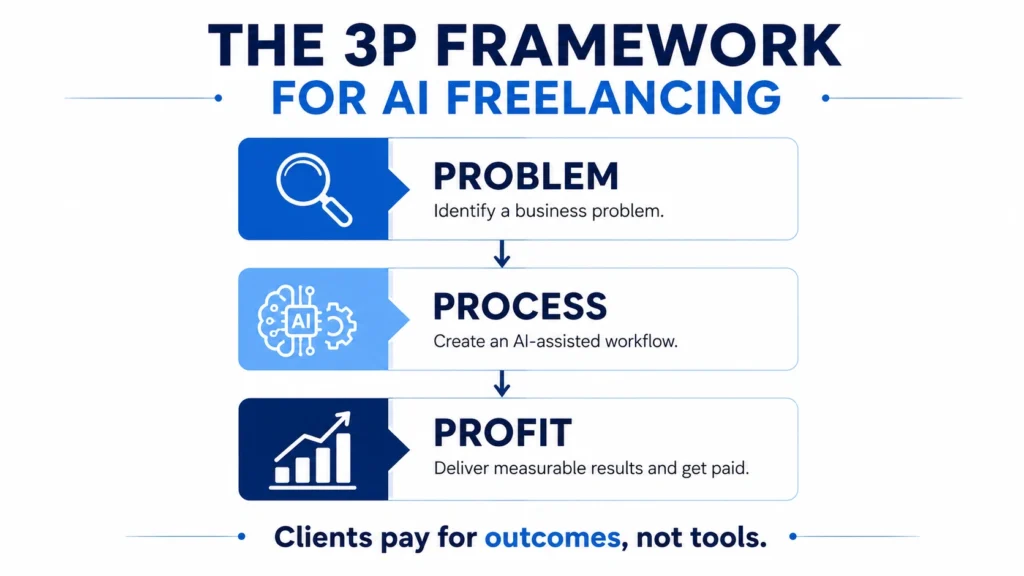
The 3P Framework
Over time, I developed a simple framework that explains AI freelancing more clearly than hundreds of YouTube videos.
P1: Problem
Identify a business problem.
P2: Process
Create a repeatable AI-assisted workflow.
P3: Profit
Deliver measurable results and get paid.
Most beginners start with software.
Successful freelancers start with problems.
Why Businesses Are Hiring AI Freelancers
Understanding why businesses hire AI freelancers makes it much easier to position your services.
Most companies are not searching for someone who “knows AI.” They are looking for someone who can complete important work faster, reduce costs, or help their business grow.
Artificial intelligence simply makes those outcomes easier to deliver.
For example, a small business owner may need four blog articles every month but cannot justify hiring a full-time writer. An ecommerce store may need hundreds of product descriptions, while a marketing agency may require daily social media content for multiple clients.
These businesses care about results, not the technology behind them.
Common reasons businesses hire AI-assisted freelancers include:
- Publishing content more consistently
- Creating marketing materials faster
- Scaling content production without increasing payroll
- Automating repetitive administrative tasks
- Improving productivity while reducing costs
The most successful freelancers understand this difference.
Instead of promoting themselves as AI experts, they position themselves as specialists who solve specific business problems using efficient workflows.
This simple shift makes it easier for potential clients to understand the value of your service and gives you a stronger competitive advantage than simply listing the AI tools you use.
Why Most Beginners Fail at AI Freelancing
Despite the opportunity, most people never earn from AI freelancing.
Not because it is difficult.
But because they approach it the wrong way.
Here are the most common mistakes:
They focus on tools instead of services
They keep switching niches without committing
They underprice so much that the work becomes unsustainable
They copy generic strategies from YouTube without understanding the market
The biggest mistake is this:
Trying to sell AI itself.
Clients are not buying AI.
They are buying results.
As tools such as ChatGPT continue to become more widely available, businesses are increasingly focusing on outcomes rather than the technology itself.
Once this is understood, the entire approach changes.
For beginners starting AI freelancing, the key is not mastering tools but understanding what businesses are willing to pay for.
Now that the foundation is clear, the next step is understanding which services actually work in the real market.
Choosing Your First AI Freelance Service
One of the biggest decisions in AI freelancing with no experience is choosing your first service.
Many people delay getting started because they keep jumping between different ideas. In reality, your first service doesn’t have to be perfect—it simply needs to solve a real business problem that companies are already paying to outsource.
As a beginner, look for a service that is:
- Easy to learn within a few weeks
- In consistent demand
- Simple to demonstrate through portfolio samples
- Able to grow into higher-paying work over time
The comparison below shows how common beginner-friendly AI freelance services differ.
| Service | Difficulty | Demand | Growth Potential |
|---|---|---|---|
| SEO Blog Writing | Low | High | High |
| Social Media Content | Low | High | Medium |
| Product Descriptions | Low | Medium | Medium |
| Email Copywriting | Medium | High | High |
| AI Research Assistance | Low | Medium | Medium |
| Workflow Automation | High | Medium | Very High |
There isn’t a single “best” service for everyone.
The best choice is usually the one you’ll enjoy improving over the next six to twelve months. Building expertise in one service is almost always more profitable than offering five services at an average level.
Many beginners lose momentum by changing direction too often. Before switching services, read Most AI Freelancers Choose the Wrong Niche in 2026 to understand why specialization usually leads to faster client acquisition and stronger long-term growth.
The Only Tools You Need to Get Started
One of the biggest myths about AI freelancing is that you need a large collection of expensive software before you can work with clients.
You don’t.
Most beginners can complete their first projects using just a handful of reliable tools. As your business grows, you can always invest in more specialized software, but keeping your toolkit simple makes it easier to learn and reduces unnecessary expenses.
These four tools are enough to complete many beginner-friendly freelance projects, including blog writing, social media content, product descriptions, and email copywriting.
Remember, clients don’t hire you because you own the latest AI software. They hire you because you deliver accurate, professional work that helps their business achieve a specific goal.
Start with a simple toolkit, master your workflow, and only add new tools when they solve a real business problem or improve your efficiency.
How to Build a Portfolio Without Any Client Experience
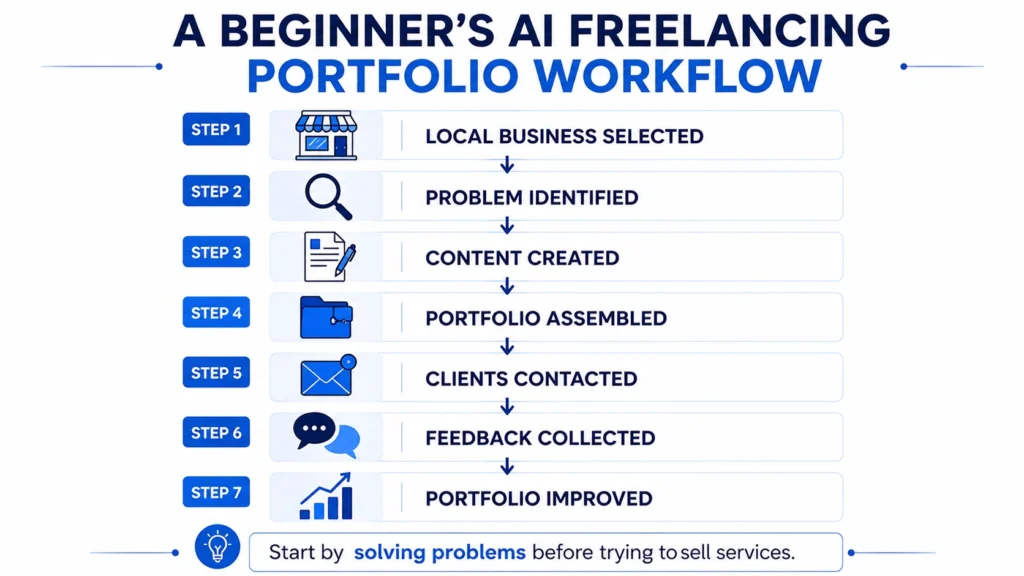
One of the biggest concerns beginners have is, “How can I get clients if I don’t have a portfolio?”
The answer is simple: create one before you get hired.
Clients don’t know whether a portfolio project was created for a paying customer or as a personal sample. What they care about is whether your work looks professional, solves a real business problem, and demonstrates the skills they’re looking for.
Instead of waiting for your first client, build a small portfolio that showcases the service you want to sell.
Create Portfolio Samples That Solve Real Problems
Avoid random practice projects.
Instead, create work that resembles the type of projects businesses actually pay for.
For example:
- Write an SEO blog article for a fictional local business.
- Create a week’s worth of Instagram posts for a restaurant.
- Write product descriptions for an ecommerce store.
- Create an email sequence promoting a new product.
- Research a competitor and summarize the findings in a professional report.
Case Study: Building a Portfolio Without Real Clients
Imagine that a local restaurant has almost no online presence.
Instead of waiting for permission, a beginner could create the following portfolio project.
Objective:
Increase the restaurant’s online visibility and customer engagement.
Deliverables:
- Five Instagram posts
- Three promotional emails
- One SEO blog article
- One competitor analysis report
Tools used:
- ChatGPT
- Canva
- Google Docs
Estimated time required:
Approximately three hours.
The purpose of this exercise is not to earn money immediately. The purpose is to demonstrate initiative, problem-solving ability, and the capacity to deliver measurable business results.
A project like this immediately gives potential clients a clear picture of what you can do for them.
These examples immediately show potential clients what you can deliver.
Keep Your Portfolio Small but High Quality
A common mistake is believing you need dozens of examples.
You don’t.
Five outstanding portfolio pieces are usually more convincing than twenty average ones.
Before adding a project to your portfolio, ask yourself:
- Does it solve a real business problem?
- Is it well written or professionally designed?
- Would I confidently send this to a paying client?
- Does it represent the type of work I want more of?
If the answer is yes, it’s worth including.
Beginner Portfolio Checklist
Your first portfolio can be as simple as:
- ✅ One SEO blog article
- ✅ Five social media posts
- ✅ One product description
- ✅ One marketing email
- ✅ One case-study style project showing your workflow
That’s enough to begin applying for freelance work.
You don’t need a personal website to get started.
Many successful beginners use Google Drive, Google Docs, Canva presentations, or a simple PDF portfolio during their first few months.
The goal isn’t to impress clients with flashy design.
The goal is to prove that you can deliver useful, professional work that helps businesses achieve a specific outcome.
Once your portfolio is ready, the next step is presenting it professionally to potential clients. Read AI Freelance Proposal Templates 2026: 5 High-Converting Templates + Strategic Customization Guide to learn how to combine your portfolio with proposals that help you win freelance projects.
How to Get Your First AI Freelance Client
Finding your first client is often the biggest challenge in AI freelancing with no experience.
Not every platform produces the same results for beginners. Compare Fiverr vs Upwork vs LinkedIn: Where Beginners ACTUALLY Get Their First AI Freelance Client in 2026 before deciding where to invest most of your time.
Successful freelancers actively look for opportunities instead of waiting to be discovered.
Here are the three most effective ways to land your first client.
Reach Out to Small Businesses Directly
Thousands of small businesses have outdated websites, inactive social media accounts, or weak marketing content.
Industry reports published by Upwork continue to show strong demand for independent professionals across writing, marketing, research, design, and technology-related services.
These businesses are potential clients.
Find companies that could benefit from your service and send a short, personalized message explaining how you could help.
Avoid aggressive sales language. Focus on offering a simple solution to a real problem.
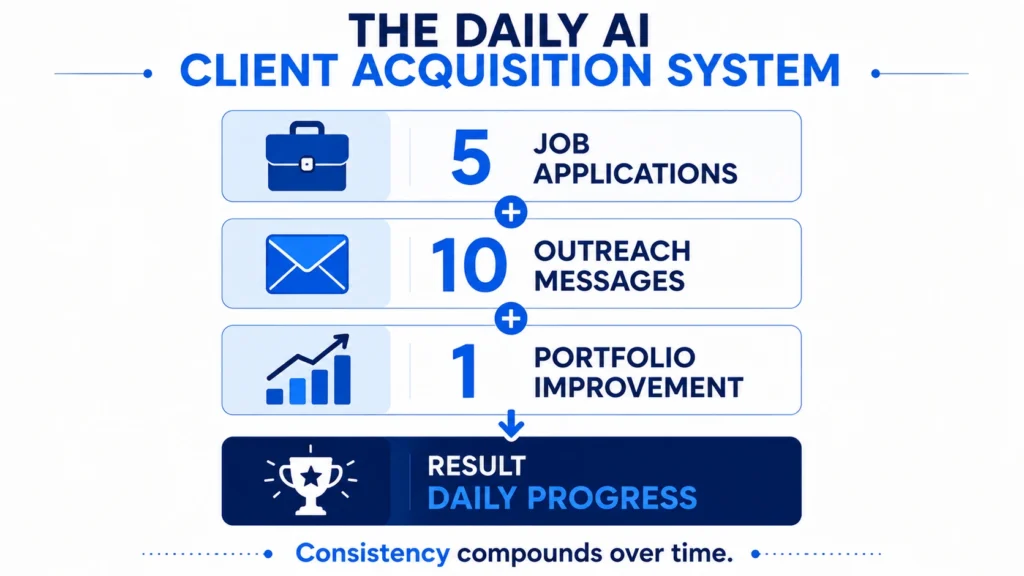
Build a Daily Client Acquisition Routine
Finding clients becomes much easier when you treat it like a daily habit instead of an occasional task.
A simple routine could look like this:
- Apply for five Upwork jobs.
- Send ten personalized outreach messages.
- Improve one portfolio sample.
- Study successful freelancers in your niche for fifteen minutes.
Even if you don’t receive replies immediately, this consistent approach creates momentum and steadily increases your chances of landing your first project.
Focus on Relationships, Not Just Sales
Your first client is more than a single payment.
A satisfied client can return with additional work, recommend you to other businesses, or leave a review that helps you attract future clients.
Instead of chasing dozens of one-time projects, focus on delivering excellent work, communicating professionally, and building long-term relationships.
For beginners, one happy client is often worth far more than ten unsuccessful applications.

Realistic Income Expectations (No Hype)
One of the biggest misconceptions about AI freelancing with no experience is that you’ll start earning thousands of dollars within your first few weeks.
For most beginners, that’s unrealistic.
Your first goal shouldn’t be maximizing income. It should be gaining experience, building confidence, collecting positive reviews, and creating repeatable systems that allow you to deliver consistent results.
As your skills improve and your portfolio grows, increasing your rates becomes much easier.
Rather than comparing yourself to freelancers sharing exceptional income screenshots online, focus on steady progress.
A freelancer who consistently improves one service, communicates professionally, and delivers reliable results will usually outperform someone who spends months chasing the latest AI tools without working with real clients.
Long-term success in AI freelancing with no experience comes from improving one service instead of chasing every new AI trend.
The objective is to build a freelance business that continues growing month after month.
Three Unpopular Opinions About AI Freelancing
Opinion 1: You do not need an expensive course.
Many beginners spend hundreds or even thousands of dollars on courses before earning their first dollar. In reality, most of the knowledge required to get started is already available online.
Opinion 2: You do not need dozens of AI tools.
Many successful freelancers rely on only a few reliable tools. Mastering a simple workflow is often far more valuable than constantly learning new software.
Opinion 3: You should not quit your job immediately.
Building a sustainable freelance business takes time. Consistent progress and patience are usually more valuable than taking unnecessary risks.
Many people fail because they chase excitement instead of consistency.
The market rewards people who repeatedly solve the same problems better than everyone else.
Frequently Asked Questions
Can I start AI freelancing with no experience?
Yes. Many successful freelancers begin without professional experience by choosing one service, building portfolio samples, and learning through real client projects. Businesses care more about the quality of your work and the results you deliver than how long you’ve been freelancing.
Which AI freelance service is best for beginners?
Content writing, product descriptions, social media content, email copywriting, and AI research assistance are among the easiest services to start because they require little upfront investment and can be learned relatively quickly.
Do I need coding skills to become an AI freelancer?
No.
Many beginner-friendly AI freelance services don’t require programming knowledge. Writing, research, marketing, design, and content creation are all excellent entry points for people without technical backgrounds.
Which AI tools should beginners learn first?
Start with one reliable AI assistant such as ChatGPT, then add tools like Canva, Grammarly, and Google Docs as your workflow develops.
Learning how to solve business problems is more valuable than learning dozens of different AI platforms.
How long does it take to get the first freelance client?
There isn’t a fixed timeline.
Some beginners find their first client within a few weeks, while others need several months. The outcome depends on the quality of your portfolio, the demand for your service, and how consistently you apply for jobs or contact potential clients.
Is Fiverr or Upwork better for beginners?
Both platforms can work well.
Fiverr allows clients to discover your services through search, while Upwork lets you apply directly for available projects. Many freelancers use both platforms while also reaching out to businesses independently.
How much can beginners realistically earn?
Income varies depending on your skills, niche, pricing, and client acquisition efforts.
Many beginners focus on gaining experience and collecting reviews before increasing their rates. As your portfolio and reputation grow, earning potential usually increases as well.
Is AI freelancing a good long-term career?
Yes, if you continue developing valuable skills alongside AI tools.
Businesses will always need professionals who can solve problems, communicate effectively, and deliver reliable results. AI improves productivity, but successful freelancers combine technology with human judgment and business understanding.
Final Thoughts
Starting AI freelancing with no experience is less about learning every AI tool and more about developing the ability to solve real business problems.
The freelancers who succeed aren’t necessarily the ones with the most advanced software or the longest list of certifications. They’re the ones who consistently deliver quality work, communicate professionally, and continue improving after every project.
If you’re just getting started, keep your approach simple:
- Choose one service.
- Learn one reliable workflow.
- Build a small but high-quality portfolio.
- Reach out to potential clients every day.
- Improve your skills through real client experience.
Don’t wait until you feel completely ready.
What I Would Do If I Had to Start Again
If I had to start from the beginning today, I would keep everything as simple as possible.
Days 1–7
Choose one service and learn one workflow.
Days 8–30
Build three portfolio projects and improve them continuously.
Days 31–60
Contact potential clients every day and refine your communication skills.
Days 61–90
Increase your rates gradually, improve your systems, and focus on building long-term relationships instead of chasing short-term wins.
Looking back, I would spend far less time learning tools and far more time solving problems.
Your first project won’t be perfect, and that’s okay. Every successful freelancer started with little or no experience before gradually building their skills, reputation, and client base.
The sooner you begin solving real problems for real businesses, the sooner you’ll gain the confidence and experience that no online course or tutorial can provide.
Once you’ve gained confidence through your first projects, the next step is learning how to convert interested prospects into paying clients. Continue with How to Close Your First AI Freelance Client in 2026 to build the negotiation and communication skills that help freelancers grow beyond their first project.
Anyone can start AI freelancing with no experience, but long-term success comes from consistently improving your skills, delivering measurable value, and building trust with clients over time.
AI will continue to change how freelance work is completed, but one thing is unlikely to change: businesses will always pay for results. That’s why AI freelancing with no experience is still one of the most accessible ways to build an online freelance business in 2026.
Focus on delivering those results consistently, and you’ll be building a freelance business with long-term potential rather than chasing short-term trends.
OMAR YOUSAF

Founder of Digital Solo Hub
Omar Yousaf is the founder of Digital Solo Hub, where he writes about AI freelancing, online business, artificial intelligence, automation, and digital income opportunities. Drawing on years of experience as a business owner, he focuses on practical strategies, realistic expectations, and sustainable long-term growth rather than hype.
His goal is to help beginners build valuable skills, find clients, create multiple income streams, and adapt to the rapidly changing digital landscape.
Website: Digitalsolohub.com
LinkedIn: Omar Yousaf on LinkedIn
Medium: Omar Yousaf on Medium
Email:
hello@digitalsolohub.com