The Reality Most Beginners Don’t See
Getting AI freelance clients on LinkedIn in 2026 is not as difficult as most beginners think.
They spend weeks learning tools, experimenting with prompts, and trying to “prepare” before entering the market. What they don’t realize is that the market does not reward preparation. It rewards visibility and relevance.
This is where LinkedIn becomes important.
Not because it is new. Not because it is easy. But because it sits at a very specific intersection: business owners, decision-makers, and freelancers are all active in one place, at the same time, with overlapping intent.
The opportunity is real, but it is not evenly distributed. A small percentage of freelancers consistently get clients from LinkedIn, while the majority see no results at all. The difference between these two groups is not talent. It is how they approach the platform.
If you understand LinkedIn as a system — not a social media app — it becomes predictable. And once it becomes predictable, it becomes scalable.
Why LinkedIn Still Works in 2026 (Despite Saturation)
To understand why LinkedIn still works, you need to look at how most freelancers misinterpret the platform.
The LinkedIn Reality Most Freelancers Misread
There is a consistent gap between how freelancers perceive LinkedIn and how it actually works in practice. This gap is one of the biggest reasons why most beginners fail to get results.
| Factor | Common Assumption | Actual Reality |
|---|---|---|
| Competition | Too many freelancers | Most are poorly positioned |
| Outreach | Doesn’t work anymore | Bad messaging doesn’t work |
| Content | Required to get clients | Optional in early stages |
| Experience | Necessary to start | Clarity matters more |
| Market | Saturated | High demand with weak supply quality |
What this means in practice is simple: the opportunity has not disappeared — it has shifted. Those who adjust to this reality gain an unfair advantage, even at the beginner level.
There is a common narrative that LinkedIn is “too saturated” now, especially with the rise of AI. On the surface, that seems true. Every day, more freelancers are entering the space, and more people are offering similar services.
But saturation alone does not kill opportunity. Poor execution does.
What has actually happened in 2026 is not oversaturation — it is misalignment. Most freelancers are still using outdated strategies:
They either post generic content hoping to attract clients, or they send cold messages that immediately trigger resistance.
Meanwhile, businesses are becoming more open to hiring freelancers, especially for AI-related work. Companies are under pressure to automate processes, reduce operational costs, and improve efficiency. Hiring a full-time team is expensive. Hiring a freelancer is flexible.
This creates a gap.
On one side, you have freelancers who don’t know how to position themselves. On the other, you have businesses actively looking for solutions but not finding clear providers.
LinkedIn works because it allows you to sit directly in that gap — if you know how to present yourself correctly.
Businesses and freelancers are actively using the LinkedIn platform to connect, hire, and test new AI-driven workflows.
Understanding How to Get AI Freelance Clients on LinkedIn
Before getting into tactics, it’s important to understand the structure behind results. Most people jump into actions without understanding the system, which leads to inconsistent outcomes.
LinkedIn client acquisition operates on three interconnected layers: positioning, visibility, and conversion.
Positioning determines how you are perceived. Visibility determines whether the right people even see you. Conversion determines whether those interactions turn into paying clients.
If one of these layers is weak, the entire system breaks.
For example, you can send hundreds of messages (visibility), but if your profile looks unclear or amateur (positioning), responses will be low. Similarly, you can have a strong profile and reach the right people, but if your messaging is generic (conversion), nothing closes.
Most beginners focus heavily on activity — sending messages, adding connections — but ignore the underlying structure. The result is effort without outcome.
The goal is not to “do more.” The goal is to align these three layers so that each action compounds instead of cancels out. Most beginners fail to get AI freelance clients on LinkedIn because they focus on tools instead of outreach.
Step 1: Position Yourself as a Solution, Not a Freelancer
The first mistake most beginners make is defining themselves too broadly. Terms like “AI freelancer,” “ChatGPT expert,” or “automation specialist” might sound relevant, but they do not communicate value.
Clients are not searching for freelancers. They are searching for solutions to specific problems.
If your profile does not clearly communicate what problem you solve and what outcome you deliver, you will be ignored — not because you lack skill, but because you lack clarity.
A strong LinkedIn profile is not about sounding impressive. It is about being immediately understandable.
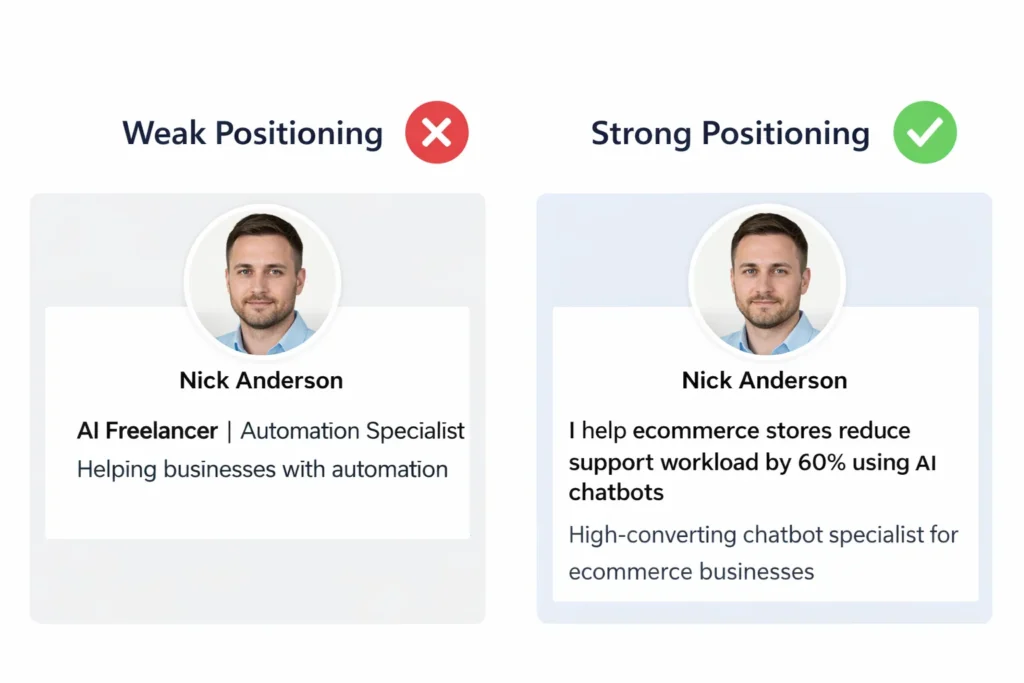
For example, compare these two positioning statements:
“AI freelancer helping businesses with automation.”
“I help e-commerce stores reduce customer support workload by 60% using AI chatbots.”
The second version works because it is specific. It identifies a target audience, a problem, and a measurable outcome. It reduces ambiguity.
This is especially important if you are starting with zero experience. You cannot rely on past results or testimonials, so your positioning must do more of the work.
At this stage, your goal is not to prove authority. It is to create clarity.
The process of getting AI freelance clients on LinkedIn becomes easier once you understand positioning.
If you’re still unsure how to position yourself as a beginner, this complete guide on how to start AI freelancing with no experience will give you the full foundation.
Step 2: Narrow Your Service Until It Becomes Sellable
Another common issue is trying to offer too many services at once. Beginners often think that offering more increases their chances of getting clients. In reality, it does the opposite.
When everything is offered, nothing stands out.
In 2026, AI is not a niche anymore. It is a toolset. What matters is how that toolset is applied to a specific business function.
For example, instead of offering “AI automation,” you might focus on:
To make this more practical, here is how beginner-friendly AI services compare in terms of speed, difficulty, and demand:
| Service Type | Speed to First Client | Difficulty Level | Market Demand |
|---|---|---|---|
| AI Chatbots (Customer Support) | Fast | Medium | High |
| Lead Generation Automation | Medium | Medium | High |
| Content Repurposing Systems | Fast | Low | Medium |
| Email Automation Workflows | Medium | Medium | High |
The goal at this stage is not to pick the “best” service globally, but to pick the one you can start executing immediately. Speed of execution matters more than theoretical potential.
Each of these is a narrow application of AI. Narrow services are easier to understand, easier to sell, and easier to deliver.
They also reduce competition. While thousands of freelancers claim to “do AI,” far fewer can clearly say, “I solve this exact problem for this exact type of client.”
This shift from generalization to specificity is one of the most important transitions you will make.
If you’re unsure which direction to take, this breakdown of the best AI freelance services to offer in 2026 will help you choose based on demand and practicality.
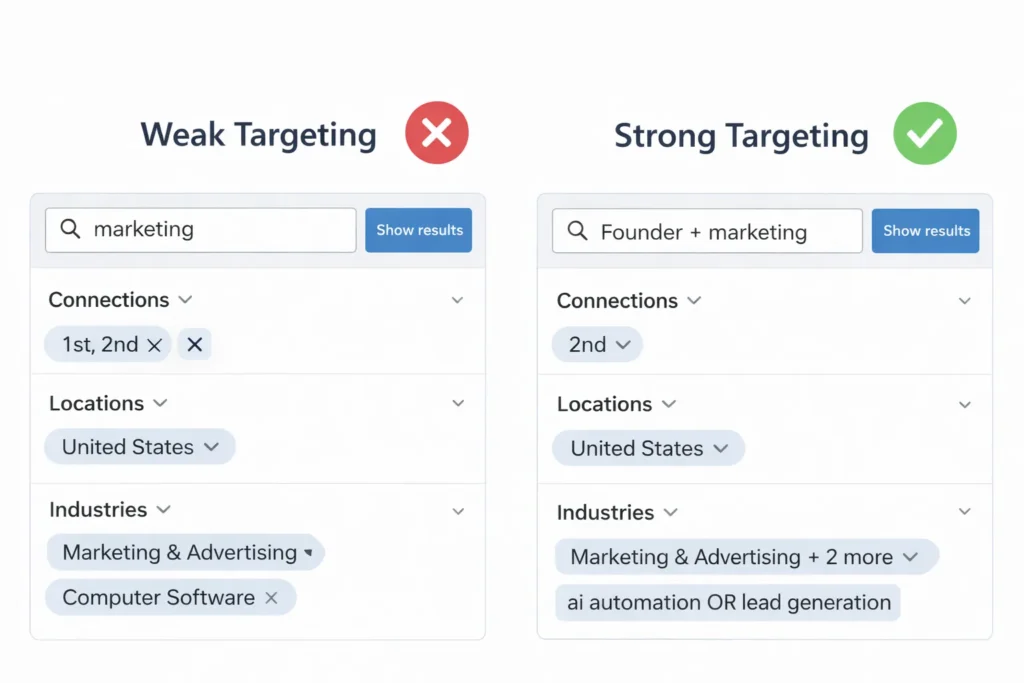
Step 3: Identify and Target the Right Decision-Makers
Once your positioning is clear, the next step is to ensure that the right people actually see you.
LinkedIn is not about reaching the maximum number of people. It is about reaching the correct people.
The ideal targets are decision-makers — founders, agency owners, marketing leads — people who have both the authority and the need to hire.
Instead of randomly sending connection requests, you should approach this as a filtering process. You are not trying to talk to everyone. You are trying to talk to the few who are most likely to benefit from your service.
This means paying attention to signals:
Are they actively posting?
Are they discussing business challenges?
Do they operate in an industry where your solution is relevant?
These indicators matter more than follower count or company size.
When you target correctly, even a small number of conversations can lead to meaningful results.
Step 4: Start Conversations, Not Pitches
This is where most beginners lose potential clients.
They approach LinkedIn messaging as a sales channel rather than a conversation channel. The result is predictable: generic messages, low response rates, and frustration.
The problem is not outreach itself. The problem is how it is done.
When someone receives a message, their first instinct is to assess whether it requires effort or creates value. A direct pitch increases resistance because it demands attention without providing context.
A better approach is to start with relevance.
Instead of presenting your service immediately, you open with observation and curiosity. You show that you have paid attention to their work, and you ask a simple question that connects to a problem you can solve.
This shifts the dynamic.
Instead of trying to sell, you are initiating a discussion. And discussions are easier to continue than sales pitches.
Over time, this approach creates a pipeline of conversations. Not all of them will convert, but enough will to make the system sustainable.
If you’re still trying to land your first client, this step-by-step guide on how to get your first AI freelance client in 2026 breaks down the exact process in more detail.
Step 5: Convert Conversations into Opportunities
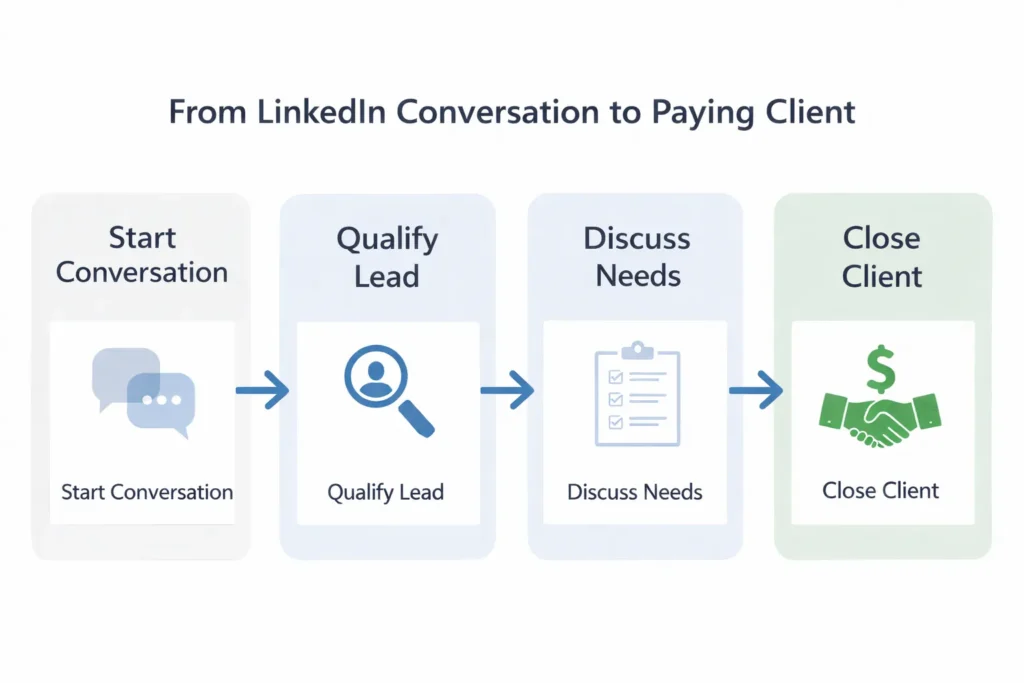
Once a conversation starts, the next challenge is guiding it toward a meaningful outcome.
This is where patience becomes important.
Many beginners rush this stage. They introduce their service too early, before fully understanding the client’s situation. This often leads to rejection, not because the service is irrelevant, but because the timing is wrong.
A more effective approach is to treat the conversation as a discovery process.
You ask questions to understand how the client currently operates, where inefficiencies exist, and what outcomes they are aiming for. This allows you to position your service as a logical next step rather than an external offer.
When done correctly, the transition from conversation to opportunity feels natural. The client does not feel sold to. They feel understood.
This is a subtle but powerful difference.
Realistic Earning Expectations (No Hype)
It’s important to address expectations honestly.
AI freelancing is often presented as a fast way to make money, but this framing is misleading. It is not instant, and it is not passive.
However, it is scalable.
In the first 30 days, your focus should be on activity and learning. You will likely send dozens of messages, receive a smaller number of replies, and have a few meaningful conversations. Closing your first client during this period is possible, but not guaranteed.
By the 60-day mark, if you remain consistent, patterns begin to emerge. You understand which messages get responses, which problems resonate, and which types of clients are easier to work with.
At this stage, earning between $300 and $1000 per month is realistic for a beginner.
This may not seem impressive, but it represents something more important: validation.
Once you have validated your ability to get clients, scaling becomes a matter of increasing volume and improving efficiency.
To understand how this scales, consider a simple breakdown:
If you reach out to 100 targeted prospects:
- 15–25 may respond
- 5–10 may engage in real conversation
- 2–4 may show buying intent
- 1–3 may convert into paying clients
Even at a modest pricing level of $200–$300 per client, this creates a clear and repeatable path to the first $500–$1000/month.
This is not based on virality or luck. It is based on controlled input and predictable output.
Timeline and Execution Reality
The timeline for results depends less on talent and more on consistency.
Setting up your profile and defining your service can be done within a few days. Starting conversations can happen immediately after.
The first responses usually come within one to two weeks. The first client may take anywhere from two to six weeks.
This variability is normal.
To make expectations clearer, here is a realistic breakdown of how progress typically unfolds:
| Phase | Timeline | Expected Outcome |
|---|---|---|
| Setup Phase | Day 1–3 | Profile optimization and service clarity |
| Outreach Phase | Week 1–2 | Initial responses and conversations |
| Conversion Phase | Week 3–6 | First client or near-close opportunities |
| Stabilization Phase | Week 6–8 | Consistent leads and improved messaging |
This timeline is not fixed, but it reflects a realistic progression based on consistent execution rather than occasional effort.
What matters is maintaining momentum. Stopping and restarting repeatedly resets your progress. Consistency compounds, even when results are not immediately visible.
Common Mistakes That Slow Down Progress
There are a few recurring patterns that prevent beginners from getting results.
One of the most common is staying in the learning phase for too long. Consuming more information feels productive, but it often delays action.
Another is overcomplicating the process. Adding unnecessary tools, scripts, or strategies creates friction.
There is also a tendency to seek perfection — waiting until everything feels “ready” before taking action. In reality, readiness comes from execution, not preparation.
Finally, inconsistency breaks momentum. Even a strong system fails if it is not applied regularly.
30–60 Day Execution Blueprint
A simple execution plan is often more effective than a complex strategy.
In the first week, focus on clarity. Define your service, optimize your profile, and understand your target audience.
In the following weeks, shift to action. Engage in daily outreach, start conversations, and observe patterns.
As you move into the second month, refine your approach. Improve your messaging, focus on higher-quality prospects, and work toward closing clients.
This progression — from clarity to action to refinement — creates a natural growth curve.
The Contrarian Truth About LinkedIn
There is a strong emphasis on content creation on LinkedIn, with many people believing that posting regularly is the key to success.
While content can be useful, it is not required — especially in the early stages.
The more direct path to results is conversation.
You do not need an audience to start. You need access. And LinkedIn already provides that.
By focusing on direct interaction rather than passive visibility, you accelerate your learning and your results.
FAQ (Snippet Optimized)
How many messages should I send daily?
A consistent range of 10–20 targeted messages per day is sufficient to build momentum without sacrificing quality.
Can I get clients without experience?
Yes. Clear positioning and problem-focused messaging can compensate for lack of experience.
Do I need to post content on LinkedIn?
No. Content is optional. Direct outreach can generate clients independently.
How long does it take to get the first client?
Typically between two to six weeks with consistent effort and proper execution.
Strategic Closing
LinkedIn is not a shortcut. It is a system.
Most people approach it casually and get casual results. A smaller group approaches it with structure, clarity, and consistency — and they extract real value.
The difference is not access. Everyone has access.
The difference is how that access is used.
If you treat LinkedIn as a place to experiment, results will be inconsistent. If you treat it as a structured acquisition channel, results become predictable.
And once something becomes predictable, it becomes scalable