
Looking for a video editing side hustle in 2026? This guide shows how beginners can use AI-assisted editing to find clients, choose services to offer, set rates, and build a practical path toward earning from video editing.
Why an AI Video Editing Side Hustle Still Works in 2026
The easiest money in AI has already been made.
In this guide, you’ll discover exactly how to start an AI video editing side hustle in 2026 and scale it to $1K–$5K per month as a beginne
In 2023 and 2024, simply adding “AI” to a service title often generated attention. Businesses were curious. Clients were experimenting. Almost every new AI-related offer felt innovative because the technology itself was still novel.
That phase is over.
By 2026, businesses and creators have already tested the tools, hired freelancers, experimented with automation, and seen both the strengths and weaknesses of AI-generated work. Generic outputs no longer impress anyone. Low-effort automation is everywhere. The market has matured, and attention is becoming increasingly selective.
Paradoxically, that maturity is exactly why AI video editing remains one of the strongest beginner side hustles available today.
Not because AI tools are magical.
Because the internet’s demand for short-form content is expanding faster than most businesses can realistically produce and distribute it.
That imbalance matters.
Modern brands are under constant pressure to publish content across YouTube Shorts, TikTok, Instagram Reels, LinkedIn clips, paid ads, and vertical-first platforms. Most creators already possess more raw footage than they can effectively edit. Podcasts, webinars, livestreams, tutorials, interviews, and behind-the-scenes recordings are piling up faster than internal teams can process them.
The bottleneck is no longer content creation.
The bottleneck is production capacity.
That operational gap is where AI-assisted video editors are building businesses.
AI video editing remains one of the strongest beginner side hustles available right now. See our full list of Best AI Side Hustles in 2026 for more options
AI Video Editing Side Hustle Market Reality in 2026
The short-form video economy has become deeply embedded into how modern attention works online. Discovery increasingly happens through feeds, recommendation engines, and algorithmic clip distribution rather than direct search or follower loyalty alone.
A strong 20-second video can now outperform an entire long-form blog post in terms of reach, engagement, and customer acquisition.
That shift changed the economics of content production.
Brands are no longer competing occasionally for attention. They are competing continuously. Algorithms reward consistency, frequency, watch time, retention, shares, and rewatch behavior. Businesses posting weak or inconsistent video content lose visibility rapidly, while creators capable of maintaining a steady flow of optimized short-form clips continue gaining algorithmic distribution.
This creates a difficult operational problem.
A serious creator or business in 2026 may need to publish 10–30 short-form videos per week to remain competitive. Producing that volume internally is exhausting, especially for founders already managing operations, marketing, customer service, and sales.
AI tools reduced the technical difficulty of editing, but they also created saturation at the beginner level. Thousands of new editors entered the market believing the tools themselves were the opportunity.
They were wrong.
The real opportunity is not access to AI.
It is the ability to build reliable production systems around attention.
That distinction separates operators from hobbyists.
Hard Truth: Most Beginners Will Approach This Incorrectly
Most people entering AI video editing in 2026 will struggle to cross even $500/month.
Not because the opportunity disappeared.
Because they approach the market emotionally instead of strategically.
They spend months:
- testing tools
- watching tutorials
- experimenting with effects
- chasing trends
while avoiding:
- outreach
- positioning
- workflow systems
- client acquisition
- retention psychology
The market no longer rewards random experimentation.
It rewards editors who understand how to reliably transform raw footage into content that holds attention and supports business goals.
That is a very different skill set.
That’s why learning how to start an AI video editing side hustle in 2026 the right way — with a client-first approach — is one of the smartest moves you can make right now.
Why Businesses Are Increasingly Outsourcing Short-Form Content
The outsourcing trend behind AI video editing is not temporary hype. It is being driven by structural changes inside the attention economy itself.
Most businesses now understand that video content matters. The problem is execution.
A local gym owner may understand the value of Reels but lack the time to edit consistently. A coach may record hours of useful podcast content yet publish only a fraction of it. E-commerce brands increasingly rely on short-form ads and creator-style clips but struggle to maintain publishing velocity internally.
At the same time, social algorithms are becoming more aggressive.
Platforms reward:
- immediate hooks
- faster pacing
- stronger retention
- platform-native editing
- consistent publishing frequency
This creates pressure that many internal marketing teams cannot handle efficiently.
Most companies are still built around traditional marketing workflows. Approval chains slow down production. Internal designers are often generalists rather than short-form specialists. Hiring full-time editors is expensive, while managing high publishing frequency creates operational fatigue.
Outsourcing solves those problems.
Instead of building an expensive internal media team, businesses increasingly hire specialized operators capable of turning raw footage into scalable distribution assets quickly and consistently.
That is why this opportunity still exists despite increasing competition.
AI video editing is one of the lower-competition opportunities right now. See more in Low Competition AI Side Hustles for 2026.
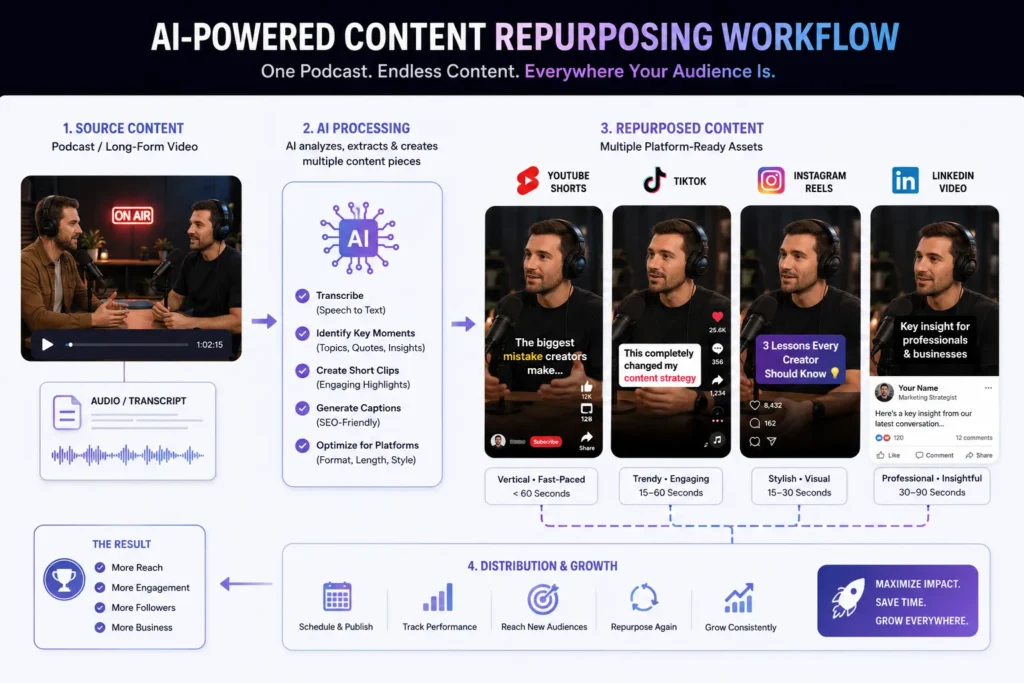
The Attention Economy Is Creating a Production Bottleneck
One of the biggest hidden shifts in online business is that creators now produce far more content than they can realistically distribute.
A mid-sized podcaster may record 10 hours of conversations monthly while only publishing a handful of clips. Coaches sit on archives of webinars and livestreams that never become social assets. Businesses create product demonstrations, tutorials, interviews, and customer stories that remain unused because editing and distribution require time they do not have.
In many ways, podcasts have quietly become content libraries.
A single one-hour episode may contain:
- multiple hooks
- educational insights
- emotional moments
- controversial opinions
- viral clip potential
But most of that value remains trapped inside long-form content.
AI editing workflows changed the economics dramatically.
Modern tools can now:
- remove silence automatically
- generate captions
- identify hooks
- suggest cuts
- create multiple aspect ratios
- clean audio
- accelerate rough editing
That means one skilled operator can process workloads that previously required entire production teams.
But automation also created a second-order effect.
Content production became easier, while content optimization became more important.
Businesses are no longer asking:
“How do we create video?”
They are asking:
“How do we consistently turn raw content into attention?”
That is the real business model behind AI video editing.
The Most Viable AI Video Editing Paths in 2026
Not every path inside this industry is equally attractive for beginners. Some models generate cash flow faster, while others offer stronger long-term scalability but require deeper skill development.
Podcast clipping remains one of the best entry points because the workflow is relatively structured. Podcasters already possess long-form material, and your role is to convert conversations into platform-native clips optimized for attention. Pricing is usually straightforward, burnout is relatively low, and AI automation can handle much of the repetitive production work.
Short-form repurposing for creators and coaches is slightly more competitive but offers significantly stronger upside. Creators increasingly understand that Shorts and Reels are growth engines rather than optional extras. Editors capable of packaging long-form ideas into engaging short-form clips can often transition into ongoing retainers or even full content management relationships.
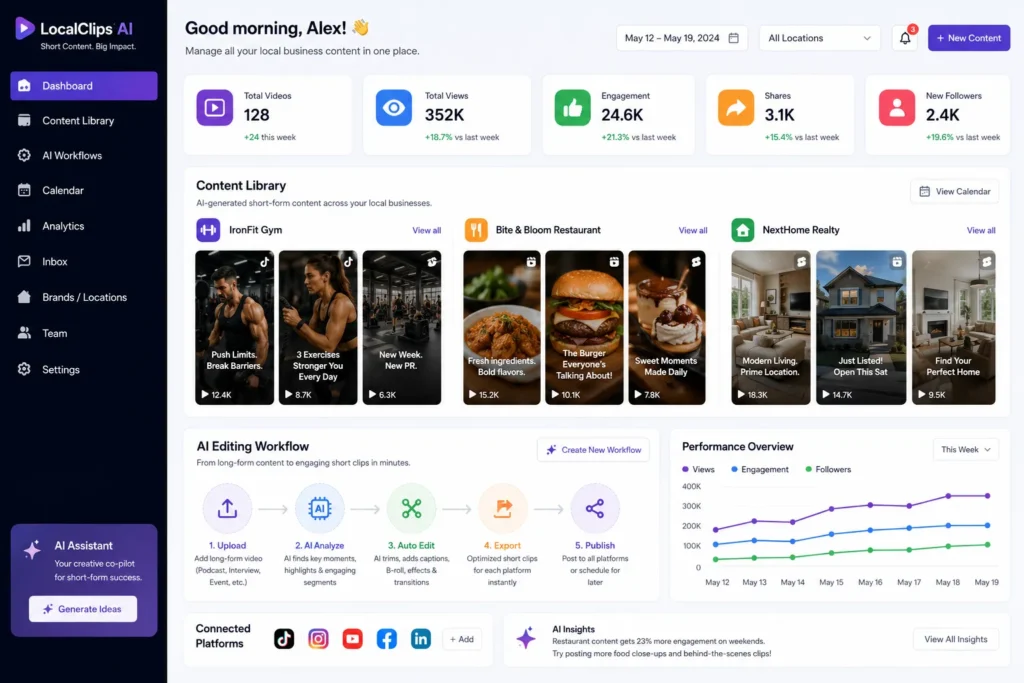
Local business content is currently one of the most overlooked opportunities in the market. Most local businesses still produce weak or inconsistent social video content despite understanding its importance. Restaurants, gyms, clinics, real estate agents, and service businesses often value consistency and speed far more than cinematic perfection. That creates room for beginners capable of delivering reliable monthly content packages.
At the higher end of the market sits full custom AI video production. This involves stronger storytelling instincts, strategic editing decisions, advanced pacing, and more sophisticated visual execution. The upside is significantly larger, but so is the creative pressure and client management complexity. Most beginners should avoid starting here immediately.
“One of the most popular tools for this is Opus Clip — it can automatically turn a long podcast or video into dozens of high-quality short clips in minutes.”
Contrarian Insight: Most Beginners Should Not Start Faceless YouTube Channels
One of the biggest misconceptions in the AI creator economy is the belief that faceless YouTube channels are the ideal beginner path.
They are not.
Faceless channels look attractive because they appear scalable and semi-automated. But beginners drastically underestimate the difficulty of:
- retention engineering
- thumbnail competition
- monetization timelines
- scripting quality
- publishing consistency
Most channels fail before reaching meaningful momentum.
Client work, on the other hand, forces rapid skill development because you are solving real audience and business problems immediately. You learn:
- pacing
- hook structure
- editing psychology
- workflow optimization
- delivery systems
while generating cash flow at the same time.
For most beginners, that is strategically superior.
How Beginners Actually Get Their First Clients
Most beginner editors fail for a simple reason:
They never build a repeatable client acquisition system.
Technical ability matters far less than most people assume. In reality, consistent outreach and positioning create far bigger differences in income than editing talent alone.
LinkedIn remains one of the strongest client acquisition channels because business owners, coaches, consultants, and creators already operate there professionally. Generic pitches perform terribly, but personalized outreach still works surprisingly well.
LinkedIn Outreach Still Works… For a complete guide on closing, read How to Close Your First AI Freelance Client in 2026
The best outreach messages do not sound like sales scripts. They identify a missed opportunity.
A strong message might reference a creator’s recent podcast, point out that several moments could perform well as Shorts, and offer a quick sample edit or audit. This works because it demonstrates thoughtfulness instead of desperation.
The Loom audit strategy has become particularly effective. Instead of pitching abstract services, you record a short video reviewing someone’s content, identify improvement opportunities, and show one optimized example. Demonstrating value before asking for money dramatically increases trust.
Local business outreach is another overlooked strategy. Most local companies dislike producing content themselves and respond well to operators capable of simplifying the process. A short personalized audit showing how their existing content could be improved often performs far better than generic cold messages.
The important point is this:
Beginners who succeed treat outreach as an operational system rather than a motivational activity.
Why Most AI Video Editors Stay Stuck Under $1K/month
The gap between struggling editors and profitable operators is rarely technical.
Usually, it is strategic.
Most low-income editors suffer from weak positioning. Saying “I do AI video editing” means almost nothing in a saturated market. Businesses care about outcomes, not tools. Editors who specialize around niches or business problems instantly become easier to trust.
Another major problem is tool addiction.
Many beginners spend endless time learning new AI platforms while avoiding client acquisition entirely. They confuse preparation with progress. In reality, the market rewards operators capable of delivering consistently using a small number of reliable workflows.
Want to go from $0 to your first $1K faster? See Make Money with AI Freelancing in 30 Days.
Poor understanding of retention is another major weakness. Many editors obsess over transitions and effects while ignoring the psychology of viewer attention. The best editors think in terms of:
- pacing
- emotional rhythm
- curiosity
- interruption patterns
- hook survival
That mindset shift changes everything.
Heavy dependence on Fiverr and Upwork also traps many beginners in low-price competition. Higher-quality clients are often acquired through direct outreach, referrals, and relationships rather than crowded freelance marketplaces.
The uncomfortable reality is that technical editing is increasingly commoditized.
Business discipline is not.
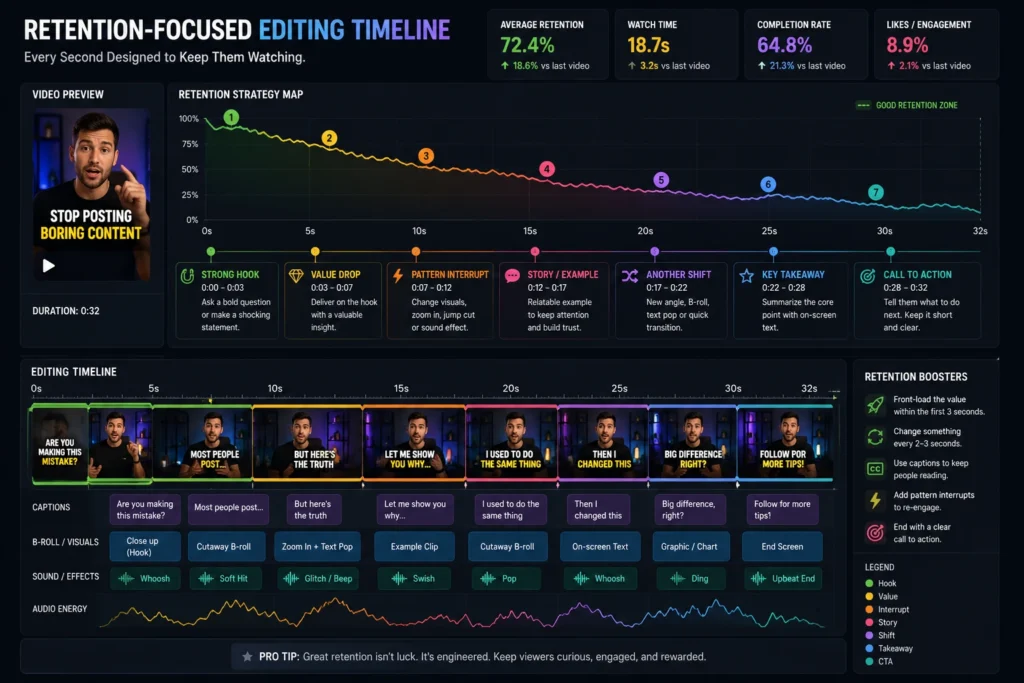
The Retention Editing Layer
Most average editors focus primarily on production mechanics.
Top editors focus on viewer psychology.
The first few seconds of a short-form clip determine whether the audience continues watching or scrolls away. That means hooks are no longer a creative afterthought. They are the foundation of performance.
Strong editors understand how attention behaves. They use pacing changes, visual shifts, captions, pauses, zooms, emotional contrast, and curiosity loops strategically rather than randomly.
Caption timing alone dramatically affects retention. Poorly timed captions create friction, while properly paced subtitles quietly improve watch duration.
Emotional pacing matters too. Constant intensity eventually becomes exhausting. Effective clips create movement between tension and release, speed and calmness, curiosity and payoff.
This is the layer most beginners underestimate because it is harder to automate.
AI can accelerate editing.
It cannot fully replace judgment around human attention.
Pattern Break
The market no longer rewards:
- random experimentation
- generic edits
- cheap freelancing
- endless tool testing
It rewards:
- operational consistency
- audience understanding
- retention optimization
- communication
- scalable workflows
That distinction defines the modern AI creator economy.
Best Tools for an AI Video Editing Side Hustle in 2026
The tool stack matters less than most beginners think, but efficient workflows still require reliable systems.
CapCut remains one of the strongest all-around platforms for short-form editing because of its speed and platform-native features. Descript is particularly powerful for podcast clipping and text-based editing workflows, while Opus Clip dramatically accelerates long-to-short repurposing.
For AI-generated visuals and enhancement layers, tools like Runway, Kling, Pika, and InVideo continue improving rapidly. Audio cleanup tools such as ElevenLabs and Adobe Enhance Speech also play a significant role in professionalizing content quickly.
The important strategic rule is simple:
Master a small workflow deeply before expanding your tool stack.
Tool collectors stay overwhelmed.
Workflow operators build businesses.
Master the right stack with our updated guide: Best AI Tools for Freelancers in 2026.
Mastering these tools is the foundation of a successful AI video editing side hustle in 2026.
Realistic Income Expectations
The $1K–$5K/month range is realistic.
But it is not instant.
Most successful operators reach those numbers gradually through stacked retainers and workflow improvements rather than one viral breakthrough.
A beginner managing several podcast clients may realistically generate $1,500–$2,000/month. Editors handling creator repurposing retainers often move into the $3,000–$5,000 range after building operational consistency and referrals.
The key variable is not talent alone.
It is whether the editor develops:
- repeatable systems
- consistent outreach
- scalable delivery
- reliable client retention
Most disciplined beginners need several months before income stabilizes meaningfully.
That is normal.
If you follow this roadmap, you can realistically build a profitable AI video editing side hustle in 2026 within a few months
30–60 Day Beginner Execution Blueprint
The first month should focus almost entirely on workflow repetition rather than perfection. Choose one niche, one editing style, and one delivery model. Build several sample projects, even if self-created.
During the second phase, attention should shift toward outreach and positioning. A simple portfolio combined with personalized audits and sample clips is usually enough to secure initial conversations.
By the second month, the focus becomes operational efficiency. Templates, editing systems, onboarding workflows, and faster delivery processes matter far more than endlessly improving visual polish.
The editors who survive long-term are usually the ones who learn operational consistency early.
If you want the complete beginner roadmap, read How to Start an AI Side Hustle in 2026.
What This Industry Will Look Like by 2027–2028
Basic editing tasks will continue becoming automated.
AI agents will increasingly handle:
- clipping
- silence removal
- formatting
- caption generation
- rough sequencing
That means low-skill editing work will likely become heavily commoditized.
But the premium layer will remain valuable.
Businesses will still need operators who understand:
- retention
- storytelling
- audience psychology
- emotional pacing
- content systems
- strategic distribution
The long-term winners in this industry probably will not be “editors” in the traditional sense.
They will be production operators managing scalable attention systems.
FAQ
Is AI video editing saturated in 2026?
The low-skill segment is crowded, but businesses still need reliable operators who understand retention and scalable content systems.
How long does it realistically take to reach $1K/month?
Most disciplined beginners need roughly 2–5 months of consistent outreach, workflow development, and client acquisition.
Do you need professional editing experience?
No. Modern AI tools lowered technical barriers significantly. Strategic thinking and audience understanding matter more.
What is the best beginner niche?
Podcast clipping, local business content, and creator repurposing remain among the strongest beginner-friendly opportunities.
Can AI replace video editors completely?
AI will automate many technical tasks, but strategic editing and audience psychology remain difficult to automate fully.
For broader strategies beyond video editing, read How to Make Money Online in 2026
Final Strategic Perspective
AI video editing in 2026 is not a shortcut business.
It is a leverage business.
The market increasingly rewards operators capable of building reliable systems around attention, distribution, and retention rather than people endlessly experimenting with tools.
Competition is real. Saturation exists. Low-effort editing is becoming commoditized rapidly.
But demand for optimized content production continues growing faster than most businesses can manage internally.
That gap still creates opportunity.
For disciplined beginners willing to approach this like a real operational business instead of a trend experiment, AI video editing remains one of the more realistic digital side hustles available today.
Execution — not endless experimentation — is what separates profitable operators from overwhelmed beginners.
The future belongs to those who treat AI video editing side hustle 2026 as a real business rather than just another trend.