
The Reality of AI Automation Agencies in 2026
Artificial intelligence has dramatically changed the economics of digital work.
Many beginners first explore simple earning methods before moving into advanced services. This guide on how to make money with ChatGPT in 2026 explains practical ways to start generating income using AI tools.
Tasks that previously required multiple employees — customer support routing, lead qualification, marketing follow-ups, data processing, reporting dashboards, and internal coordination — can now be handled through AI-driven automation workflows.
This shift has created a new service category:
AI automation agencies.
However, the opportunity is frequently misunderstood.
Online discussions often portray the model as extremely simple:
- connect a few AI tools
- build some automations
- charge businesses thousands per month
The reality is more nuanced.
The barrier to building automation workflows has become very low.
The barrier to earning business trust remains high.
Businesses are not interested in automation tools themselves.
They are interested in business outcomes.
An AI automation agency only becomes valuable when it improves operations in measurable ways:
- reducing manual work
- increasing response speed
- improving lead conversion
- eliminating repetitive tasks
- streamlining internal workflows
The agencies that succeed are not merely technical implementers.
They operate as workflow strategists who understand how businesses actually function.
Many entrepreneurs researching how to start an AI automation agency are looking for scalable AI-based service businesses.
If you’re starting from scratch, this guide on AI freelancing with no experience will help you build your first income before scaling into an agency.
Why AI Automation Agencies Exist in 2026
Automation demand is not simply a result of AI hype. For many entrepreneurs exploring digital businesses, understanding how to start an AI automation agency begins with recognizing why companies increasingly rely on automation systems. For many people entering the AI economy, automation services eventually evolve from smaller opportunities like AI side hustles for beginners.
It exists because businesses face structural pressures that make automation increasingly attractive.
Rising Labor Costs
Labor costs continue to increase across most industries.
For small and medium businesses, payroll often represents the largest operational expense.
Automation allows companies to reduce the time spent on tasks such as:
- data entry
- lead sorting
- reporting
- appointment scheduling
- internal communication
Even relatively simple automation systems can save 10–30 hours of work per week.
According to a McKinsey report on automation and productivity, a large portion of workplace tasks could be automated using existing technologies.
For a business owner, this time saving translates directly into financial value.
Businesses Are Overwhelmed by AI Tools
The AI software ecosystem has expanded rapidly.
Companies now encounter hundreds of platforms such as:
- AI assistants
- marketing automation software
- workflow automation tools
- chatbot platforms
- analytics systems
Most business owners do not have time to experiment with dozens of tools.
Instead, they prefer specialists who can design practical systems using those tools.
This is why many businesses hire specialists offering specific services — these AI freelance services that actually pay can help you understand what clients are willing to pay for.
This gap between available technology and practical implementation is where automation agencies operate.
Operational Efficiency Is Becoming a Competitive Advantage
Automation is no longer only about saving time.
It is about operating faster than competitors.
Businesses that automate internal workflows can:
- respond to leads instantly
- follow up automatically
- generate reports without manual work
- process customer requests faster
These improvements compound over time.
Automation is therefore becoming a strategic operational capability, not simply a technical improvement.
The Core Business Model of an AI Automation Agency
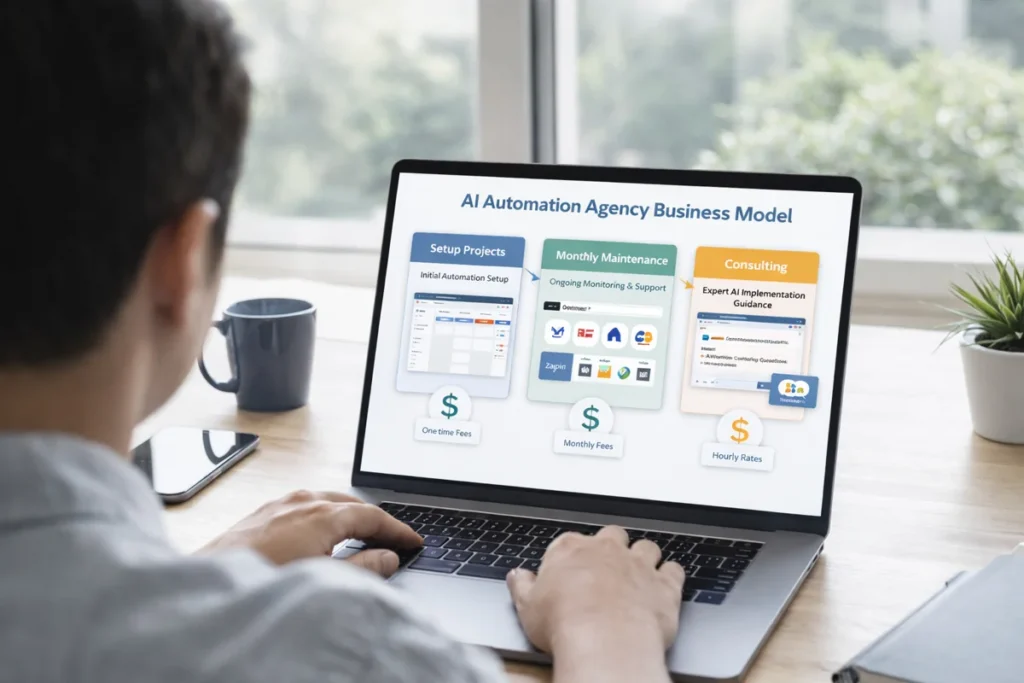
An AI automation agency builds systems that automate business processes.
These systems typically combine multiple technologies such as:
- workflow automation platforms
- AI models
- APIs
- CRM software
- messaging platforms
- data storage systems
Instead of selling software, agencies sell automation systems that improve business operations.
Revenue generally comes from three sources.
Automation Setup Projects
Clients pay for the design and implementation of automation workflows.
Common project examples include:
- automated lead qualification systems
- CRM workflow automation
- AI-powered customer support assistants
- reporting automation dashboards
- chatbot integrations
Typical project pricing:
$500 – $5,000 per automation system
More complex automations can exceed these ranges.
Monthly Automation Maintenance
Automation systems require ongoing management.
Maintenance services include:
- monitoring automation workflows
- fixing integration issues
- optimizing system logic
- updating API connections
Typical monthly retainers:
$100 – $1,000 per client
Recurring revenue stabilizes the agency business.
Automation Consulting
Some companies require strategic guidance rather than implementation.
Consulting services may include:
- workflow analysis
- automation opportunity mapping
- operational optimization
- tool stack recommendations
Consulting rates typically range from:
$75 – $250 per hour
Understanding how to start an AI automation agency requires knowing how automation services are packaged and sold to businesses.
Market Saturation Analysis
The automation agency market often appears crowded online.
However, competition varies significantly depending on positioning.
The market can be divided into three layers.
Why Most AI Automation Agencies Fail in Their First Year
The low barrier to entry in the automation space creates an unusual market dynamic.
While many people attempt to start automation agencies, most fail to build a sustainable business. The reason is rarely technical ability.
The problem is business positioning and execution discipline.
Understanding these failure patterns is important because avoiding them often determines whether an automation agency becomes a viable business or simply another short-lived freelance experiment.
Mistake 1: Selling Tools Instead of Business Outcomes
Many beginners approach the market with a technology-first mindset.
They advertise services such as:
- Zapier automation setup
- Make.com workflow building
- AI chatbot implementation
However, businesses rarely buy tools. They buy solutions to operational problems.
For example, a company is not interested in purchasing “Zapier automation.”
It is interested in reducing manual lead management work or responding to leads faster.
Agencies that position their services around specific operational outcomes consistently outperform those that sell technical implementation.
Mistake 2: Targeting Too Many Industries
Another common failure pattern is attempting to serve every type of business.
At first glance, offering automation to all industries seems logical because automation is widely applicable.
In practice, this creates a positioning problem.
When an agency claims to automate “any business,” potential clients struggle to understand the agency’s expertise.
In contrast, a specialized agency can communicate its value much more clearly.
For example:
- automation for real estate lead management
- automation for marketing agency reporting
- automation for ecommerce order processing
Industry specialization allows agencies to build repeatable workflows, which improves efficiency and profitability.
Mistake 3: Building Fully Custom Systems for Every Client
Many new agencies attempt to build entirely custom automation systems for each client.
While this approach may seem attractive initially, it quickly creates a scalability problem.
Custom systems require extensive time to design, test, and maintain.
Successful automation agencies gradually develop template-based workflows that can be adapted for multiple clients within the same industry.
This approach reduces development time while increasing margins.
Layer 1: Tool-Focused Freelancers (Highly Saturated)
Many beginners position themselves around a specific tool.
Examples:
Zapier automation expert
Make workflow specialist
This approach rarely creates sustainable differentiation.
Businesses do not care which platform is used.
They care about results.
Layer 2: General Automation Agencies (Moderately Saturated)
Some agencies offer vague services such as:
AI automation
automation consulting
AI integration
Without specialization, marketing becomes difficult.
Clients struggle to understand what the agency actually solves.
Layer 3: Industry-Focused Automation Agencies (Underserved)
The most successful agencies specialize in specific industries.
Examples include:
real estate automation
ecommerce automation
recruitment automation
marketing agency automation
healthcare workflow automation
Industry specialization provides several advantages:
- clearer marketing positioning
- repeatable workflows
- stronger credibility
Strategic Paths for Starting an AI Automation Agency
Understanding how to start an AI automation agency requires choosing the right business model and positioning strategy early.
Different agency models vary in speed, difficulty, scalability, and risk.
| Strategy | Speed | Difficulty | Scalability | Risk |
|---|---|---|---|---|
| General automation services | Medium | Medium | Medium | High |
| Niche automation agency | Medium | Medium | High | Medium |
| Productized automation services | Slow | Medium | Very High | Medium |
| Enterprise automation consulting | Slow | High | High | High |
AI Automation Tools Used by Agencies in 2026
Understanding the modern automation tool stack is essential. Anyone learning how to start an AI automation agency must first understand the automation tools and AI platforms used to build these workflows. Many automation professionals first learn these platforms while exploring the best AI tools for freelancers.
Automation Platforms
These platforms connect different applications and trigger workflows.
Common examples include:
Zapier
Make
n8n
Pabbly Connect
These platforms act as the backbone of automation systems.
AI Model Providers
AI models provide reasoning, classification, and generation capabilities.
Common providers include:
OpenAI API
Claude API
Google Gemini API
These models allow workflows to perform intelligent tasks.
Data Storage Systems
Automation workflows require structured data storage.
Common options include:
Airtable
Notion databases
Google Sheets
Supabase
CRM Systems
Customer relationship platforms often become the center of automation workflows.
Examples include:
HubSpot
Salesforce
Pipedrive
Many automations integrate directly with CRM pipelines.
Automation Workflows Businesses Actually Pay For
Businesses rarely purchase automation technology itself.
They purchase solutions to operational problems.
Below are common examples.
The Economics of Automation for Businesses
Understanding the economic logic behind automation helps agencies sell their services more effectively.
Businesses rarely invest in automation simply because it is technologically interesting.
They invest when the financial impact is obvious.
Example: Lead Response Automation
Consider a small real estate agency that receives 120 leads per month.
Without automation, a staff member might spend several hours each day reviewing inquiries, categorizing leads, and sending follow-up emails.
If this process consumes 2 hours per day, the monthly time cost may reach:
2 hours × 22 working days = 44 hours per month
If the employee responsible for this task earns $20 per hour, the monthly cost of this activity is roughly:
44 × $20 = $880 per month
An automation system that performs lead classification and sends immediate follow-up responses could reduce most of this work.
If an agency charges $2,000 to implement the automation, the investment may pay for itself within a few months.
This type of financial framing makes automation far easier for businesses to justify.
Example: Customer Support Automation
Customer support is another common automation opportunity.
A small ecommerce company may receive dozens of repetitive support questions every day:
- order tracking requests
- refund inquiries
- product information questions
If AI automation can resolve even 40–60% of these requests automatically, the business may reduce the need for additional support staff.
For growing companies, this can represent substantial cost savings.
Automation agencies that clearly communicate these economic benefits often close clients more easily.
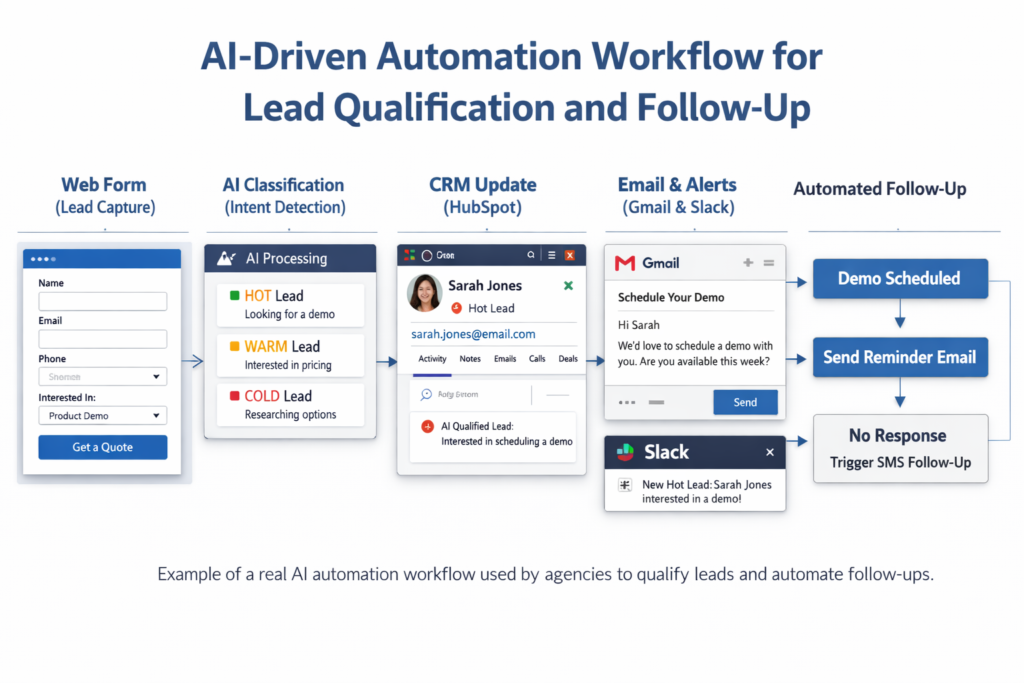
Lead Qualification Automation
Trigger: new website lead.
Workflow:
- AI analyzes the lead message
- Lead quality is classified
- CRM record is created
- sales team receives notification
- automated follow-up email sent
Impact:
- faster response times
- higher lead conversion
Customer Support Automation
Trigger: support ticket submitted.
Workflow:
- AI analyzes request
- knowledge base searched
- AI drafts response
- support team reviews
Impact:
- reduced support workload
- faster responses
Automated Reporting Systems
Trigger: daily or weekly schedule.
Workflow:
- data collected from business tools
- metrics calculated automatically
- dashboard updated
- reports sent to managers
Impact:
- eliminates manual reporting work
Client Acquisition Strategy
Technical ability alone rarely produces clients. Many agency founders actually begin with simple online income methods before gradually expanding into automation consulting services. If you’re exploring beginner-friendly ways to start, this guide on top passive income ideas for beginners in 2026 can help you understand different income paths before moving into client-based work.
Successful agencies focus heavily on clear positioning and targeted outreach.
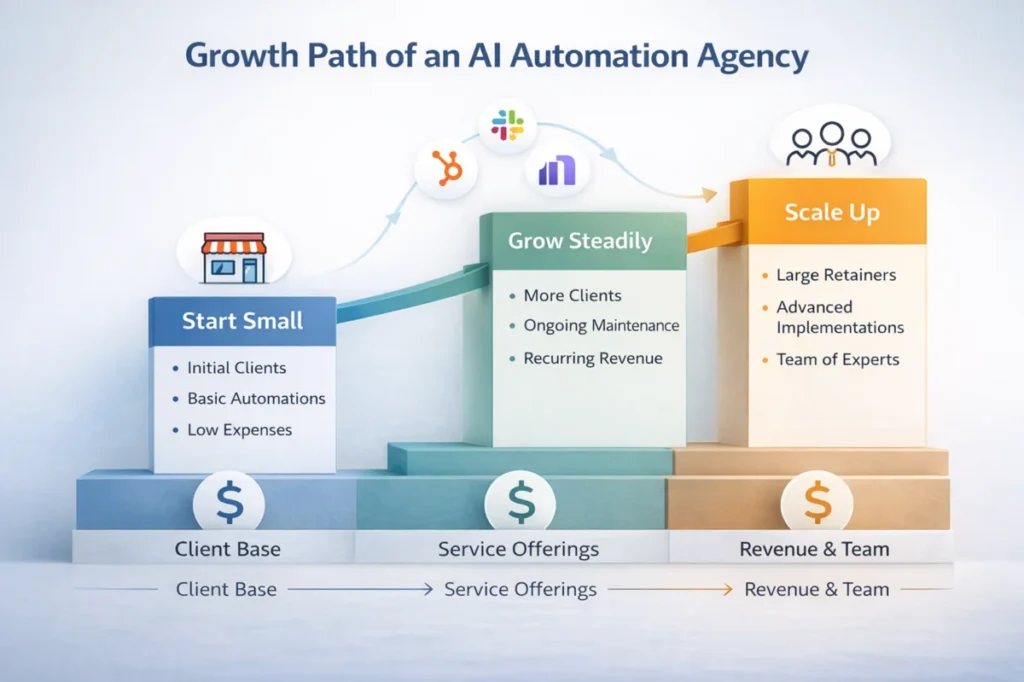
How Automation Agencies Gradually Become More Profitable
The financial trajectory of most automation agencies follows a predictable pattern.
At the beginning, revenue primarily comes from project work.
Over time, the business becomes more stable as recurring revenue increases.
Understanding this transition is important when planning long-term growth.
Phase 1: Project-Based Revenue
During the early months, agencies usually generate income from implementation projects.
Typical structure:
- small automation setups
- one-time workflow implementations
- consulting sessions
Revenue may fluctuate significantly at this stage.
However, the primary objective during this phase is not immediate profit.
It is developing expertise and building case experience.
Phase 2: Recurring Automation Maintenance
As the client base grows, agencies begin offering ongoing support services such as:
- workflow monitoring
- system updates
- automation optimization
These services are typically billed monthly.
For example:
5 clients × $400 monthly maintenance
= $2,000 recurring revenue
Over time, this recurring income becomes the foundation of the business.
Phase 3: Productized Automation Services
The most scalable automation agencies eventually develop productized service packages.
Instead of building unique systems for each client, they sell standardized automation solutions tailored to a specific industry.
Examples include:
- automated lead response system for real estate agencies
- reporting automation for marketing agencies
- candidate screening automation for recruitment firms
Productized services significantly improve scalability because the underlying automation system can be reused across multiple clients.
Positioning Strategy
Weak positioning:
“AI automation services.”
Strong positioning:
“We automate lead qualification for real estate agencies.”
Clear positioning significantly increases response rates.
Outreach Channels
Common client acquisition channels include:
- LinkedIn outreach
- cold email campaigns
- freelance platforms
- industry communities
- referrals
Early-stage agencies often rely heavily on direct outreach.
Demonstration Systems
Potential clients respond better when they see real examples.
Create demonstration workflows such as:
- automated lead qualification
- reporting automation
- support ticket automation
These examples build credibility.
Scalability of an AI Automation Agency
The scalability of an automation agency depends on how systems are structured.
There are three levels of scalability.
Level 1: Custom Project Agency
Each client receives a fully custom automation system.
Advantages:
- higher project pricing
Disadvantages:
- limited scalability
Level 2: Template-Based Automation Agency
Automation workflows are reused across multiple clients.
Advantages:
- faster delivery
- higher profit margins
Level 3: Productized Automation Services
Agencies package automation systems into standardized products.
Examples:
- automated lead response system for real estate agencies
- reporting automation for marketing agencies
This model offers the highest scalability.
Common Failure Points
Many automation agencies fail due to predictable mistakes.
Selling Technology Instead of Outcomes
Businesses buy operational improvements, not software tools.
Messaging must focus on results.
Lack of Industry Focus
Trying to serve every industry prevents expertise from developing.
Specialization improves credibility.
Over-Customizing Projects
Fully custom systems consume excessive time.
Successful agencies develop repeatable automation frameworks.
60-Day AI Automation Agency Launch Blueprint
A realistic launch timeline might look like this.
Week 1–2
Learn automation fundamentals.
Master one automation platform.
Week 3–4
Build three demonstration workflows:
lead automation
report automation
email automation
Week 5–6
Choose a niche industry.
Research operational problems within that niche.
Define a clear automation offer.
Week 7–8
Begin client outreach using:
LinkedIn
cold email
industry communities
Goal: acquire the first paying client.
The Long-Term Future of AI Automation Agencies
The long-term viability of AI automation agencies depends on a simple reality: businesses will continue seeking ways to operate more efficiently.
While AI tools will become easier to use, most companies will still struggle with system design and workflow integration.
Automation rarely involves a single tool. It usually requires connecting multiple systems such as CRM platforms, marketing software, communication tools, and internal databases.
Designing these connections in a way that actually improves operations requires both technical understanding and business awareness.
This is why automation agencies function less like software providers and more like operational consultants.
Over time, the market is likely to separate into two types of automation providers.
The first group will consist of low-cost freelancers who implement simple workflows using popular automation platforms. These services may remain useful for small businesses with straightforward needs.
The second group will consist of specialized automation agencies that deeply understand specific industries and operational processes.
These agencies will focus on designing automation systems that integrate across entire business workflows rather than isolated tasks.
As AI tools become more powerful, the value of automation agencies will shift away from the tools themselves and toward strategic system design.
The agencies that succeed in the long run will not be those chasing the newest AI platforms.
They will be the ones that understand how businesses operate and can translate that understanding into reliable, scalable automation systems.
Frequently Asked Questions
What does an AI automation agency do?
An AI automation agency builds systems that automate repetitive business workflows using AI models and automation platforms.
Do you need coding skills?
Coding helps but is not required. Many automation systems can be built using no-code platforms.
How profitable is an AI automation agency?
Early agencies often earn a few thousand dollars per month. Mature agencies with repeatable systems can exceed $20,000 monthly revenue.
Which industries benefit most from automation?
Industries with repetitive workflows benefit the most, including ecommerce, real estate, recruitment, and marketing agencies.
How do beginners learn how to start an AI automation agency?
Beginners usually start by learning workflow automation tools, studying business processes, and understanding how to start an AI automation agency by offering automation services to small businesses.
Strategic Closing
AI automation agencies exist because businesses value efficiency more than technology. For entrepreneurs exploring different digital income paths, building an automation agency represents one of the more advanced models of making money online in 2026.
The tools themselves rarely create competitive advantage.
What matters is understanding how companies operate and identifying the repetitive processes that slow them down.
The agencies that succeed over the next decade will not be those chasing every new AI platform.
They will be those that understand business workflows deeply and design automation systems that create measurable operational improvements.
For entrepreneurs interested in service-based AI businesses, learning how to start an AI automation agency can become a powerful long-term opportunity.
Automation is not merely a technical service.
It is operational consulting powered by AI.