
The Reality of AI Freelancing in 2026
Artificial intelligence has changed the economics of freelance work.
AI freelancing with no experience has become one of the fastest-growing opportunities for beginners who want to start earning online.
Tasks that once required specialized teams—writing, design, research, and automation—can now be executed by individuals using AI-assisted workflows. This shift has created a new category of opportunity: AI freelancing.
But this opportunity is often misunderstood.
Many beginners believe AI tools alone create income. In reality, tools only compress execution time. They do not create demand, clients, or sustainable income by themselves.
What creates income is the service system built around those tools.
Businesses do not pay for prompts, software, or experimentation. They pay for outcomes: written content, automated processes, research reports, marketing assets, and operational improvements.
This distinction explains why some beginners succeed quickly with AI freelancing while others remain stuck testing tools without earning anything.
AI freelancing is not about discovering clever prompts. Many people searching for AI freelancing with no experience assume technical skills are required, but most beginner services focus on delivering outcomes rather than building software.
For many beginners in 2026, AI freelancing with no experience is becoming one of the most accessible entry points into the digital economy.
It is about using AI to deliver services businesses already need, faster and more efficiently than traditional workflows.
Before committing to freelancing as a path, it is useful to understand how different digital income systems operate. If you’re still evaluating online paths, this guide explains how to choose the right online income model in 2026 based on skill, time, and risk tolerance.
Market Context: Why AI Freelancing Is Growing
The freelance economy has evolved alongside every major technological shift.
In the early internet era, freelance work focused heavily on technical skills such as coding and website development. As social media expanded, the market created demand for content creators, designers, and digital marketers.
AI represents the next phase of that evolution.
According to research published by McKinsey on global AI adoption, businesses across industries are rapidly integrating artificial intelligence into daily operations.
Instead of eliminating freelance work, artificial intelligence has dramatically increased individual productivity. A single freelancer can now generate the output of a small team.
This productivity expansion has created two simultaneous effects.
First, freelancers can deliver work faster, increasing their earning potential.
Second, competition has increased because the barrier to entry has fallen.
AI adoption across businesses has also accelerated. Companies increasingly integrate artificial intelligence into daily operations to reduce costs and improve efficiency.
As a result, many businesses actively search for freelancers who understand how to apply AI tools within practical workflows.
The opportunity is not in the tools themselves.
The opportunity lies in understanding how to turn AI capabilities into real services. For individuals exploring AI freelancing with no experience, this shift has opened opportunities that previously required years of technical training.
Can Beginners Start AI Freelancing With No Experience?
A common misconception is that AI freelancing requires advanced technical expertise.
Understanding how AI freelancing with no experience works helps beginners focus on real market demand instead of simply experimenting with tools.
In practice, many AI freelance services focus on workflow management rather than deep programming knowledge.
What matters more than technical skill is understanding how services create value for businesses.
For beginners, the main barriers to entry are relatively moderate.
- Skill requirement: manageable with focused learning
- Financial investment: extremely low compared to traditional businesses
- Competition: increasing but still fragmented
- Scalability potential: moderate to high depending on the service
Because of these factors, AI freelancing has become one of the most accessible entry points into digital income. Many beginners discover their first opportunities through structured AI side hustles for beginners that combine freelancing with AI-assisted productivity systems.
The Core AI Freelancing Framework
To understand how AI freelancing generates income, it helps to view it as a simple operational system.
Skill → AI Tool → Faster Execution → Business Outcome → Payment
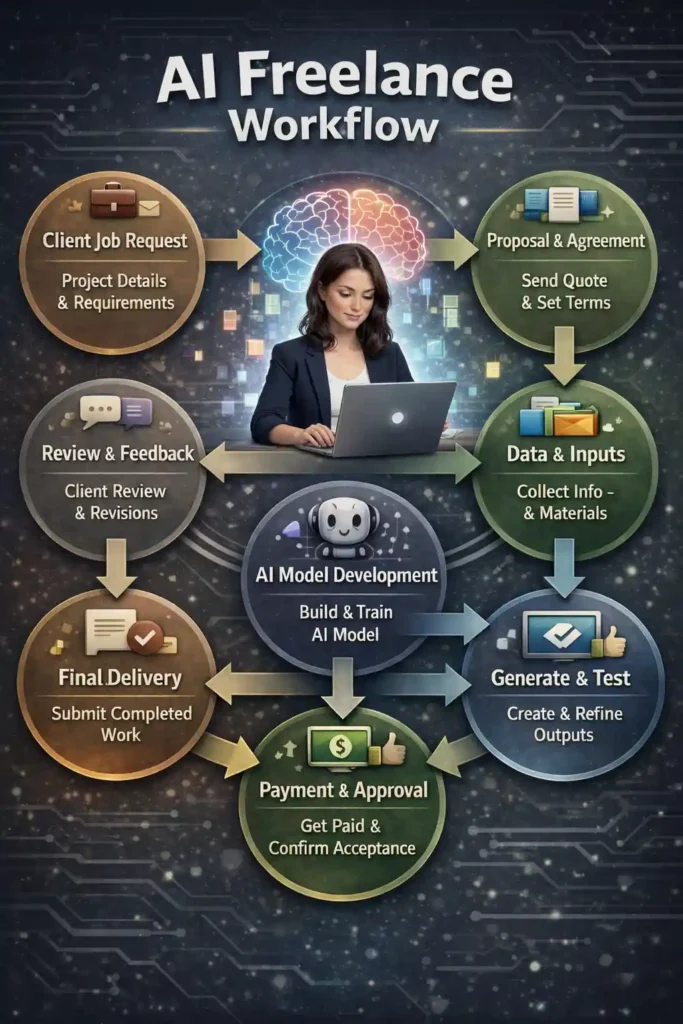
In this framework, the AI tool is not the product.
The product is the outcome delivered to the client.
For example:
A freelancer does not sell ChatGPT prompts.
They sell blog articles, marketing copy, or product descriptions.
A freelancer does not sell automation software.
They sell automated lead pipelines or operational efficiency improvements.
Once this distinction is clear, AI freelancing becomes easier to understand. The goal is not to master every tool but to build a service around a clear outcome.
Understanding how AI freelancing with no experience works helps beginners focus on delivering real services instead of just experimenting with AI tools.
Why Businesses Are Actively Hiring AI Freelancers
The demand for AI freelancing is not driven by technology alone. It is driven by a practical business problem: companies need more digital output than their internal teams can produce.
Modern businesses require constant production across multiple channels—blogs, social media, advertising campaigns, email marketing, and internal automation systems. Hiring full-time employees for every digital task is expensive and often unnecessary.
This is where AI-assisted freelancers become valuable.
By combining AI tools with structured workflows, freelancers can deliver results faster than traditional production methods. Businesses benefit from lower costs, faster execution, and flexible outsourcing.
Several trends are driving this demand:
• Content demand expansion — Companies must publish regularly to maintain search visibility and brand presence.
• Marketing automation growth — Businesses increasingly rely on automated systems for lead generation and customer communication.
• Operational efficiency pressure — Organizations constantly look for ways to reduce repetitive work through automation.
• Flexible workforce models — Companies prefer project-based specialists rather than long-term hires.
Because of these factors, AI freelancing is not simply a short-term trend. It represents a structural shift in how digital work is produced and outsourced.
Freelancers who understand how businesses operate—not just how AI tools work—are far more likely to succeed in this environment. This is why many professionals entering AI freelancing with no experience can still compete by focusing on delivering clear business outcomes.
Ranking the Best AI Freelance Services for Beginners
Not all freelance services offer the same combination of speed, difficulty, scalability, and risk.
Some services generate quick income but have limited long-term growth potential. Others require more learning but can scale into larger consulting or agency businesses.
The following comparison illustrates the strategic trade-offs.
The table below compares the most practical AI freelance services for beginners based on speed, difficulty, scalability, and risk.
| AI Service | Speed | Difficulty | Scalability | Risk |
|---|---|---|---|---|
| AI Content Writing | Fast | Low | Medium | Medium |
| AI Social Media Content | Fast | Low | Medium | Low |
| AI Design Service | Medium | Medium | Medium | Medium |
| AI Automation Setup | Slow | High | High | Low |
| AI Research Assistance | Medium | Low | Medium | Low |
| AI Video Editing | Medium | Medium | Medium | Medium |
| AI Marketing Copywriting | Medium | Medium | High | Medium |
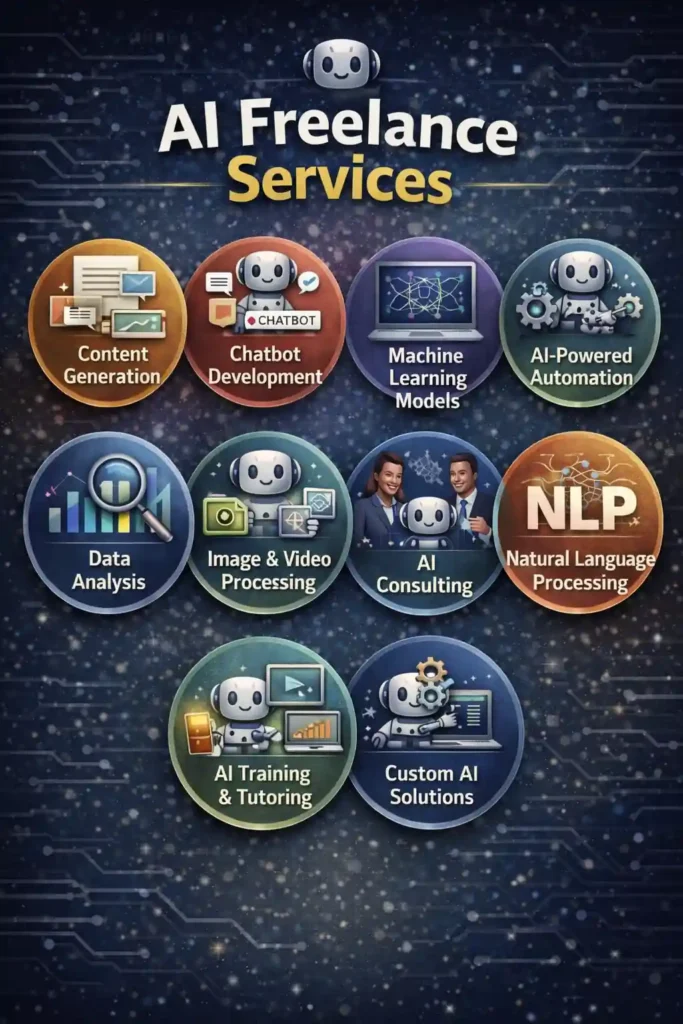
Each of these services represents a practical entry point into AI freelancing for beginners. A deeper breakdown of the most practical service models is explained in this guide on AI freelance services beginners can start in 2026.
AI Content Writing Services
Content writing remains one of the fastest entry points for beginners starting AI freelancing with no experience.
Businesses constantly require written material for websites, blogs, marketing campaigns, newsletters, and product descriptions. AI tools significantly accelerate the drafting process.
However, professional writing still requires human oversight.
Freelancers must refine AI-generated drafts to ensure accuracy, clarity, and alignment with search intent. Editing, research validation, and SEO optimization remain essential components of the workflow.
A typical AI-assisted writing process often follows this structure:
Research → AI Draft → Editing → SEO Optimization → Final Delivery
Freelancers who build systems around this workflow can dramatically increase their productivity. Many writers combine this workflow with specialized tools, which is why understanding the best AI tools for freelancers can significantly improve production speed and content quality.
AI Social Media Content Services
Social media has become a continuous content engine for modern businesses.
Companies require regular content across platforms such as LinkedIn, Instagram, TikTok, and Twitter. Many businesses lack the internal resources to produce this content consistently.
AI tools allow freelancers to generate ideas, captions, visuals, and posting schedules much faster than traditional workflows.
Instead of selling individual posts, many freelancers package their services into monthly retainers.
AI Design Services
Visual content demand has increased dramatically across digital platforms.
Businesses require graphics for advertising campaigns, presentations, social media posts, and thumbnails. AI image generation tools can significantly accelerate the design process.
However, businesses rarely want raw AI images. They require finished marketing assets.
AI Automation Services
Automation represents one of the most scalable opportunities for professionals entering AI freelancing with no experience who want to build higher-value services.
Many businesses spend large amounts of time performing repetitive tasks such as updating spreadsheets, transferring data between applications, or responding to routine emails.
Automation freelancers design systems that eliminate these manual tasks.
AI Research Assistance Services
Research has become a major bottleneck for many organizations.
Businesses frequently require structured information for competitor analysis, industry reports, content creation, and market insights.
AI tools accelerate the process of gathering information, but businesses still require human interpretation and structured summaries.
Tools Beginners Need for AI Freelancing
Although AI freelancing with no experience is built around services rather than tools, certain platforms can significantly improve productivity.
Common tools include:
- ChatGPT for writing and research
- Canva for visual design
- Zapier for automation workflows
- Notion for project organization
Most people starting AI freelancing with no experience rely on a small set of core tools before expanding their workflows.
How Beginners Build Their First Freelance Portfolio
One of the biggest obstacles beginners face when starting AI freelancing is the lack of a portfolio.
Clients rarely hire freelancers without examples of previous work. However, beginners can solve this problem by creating sample projects rather than waiting for real clients.
A simple portfolio strategy includes three steps.
First, choose one clear service category. For example, AI content writing, social media content creation, or automation setup.
Second, create realistic sample projects. These projects should mimic the type of work businesses actually require. A content writer might produce blog articles, product descriptions, or marketing copy. A social media freelancer might create a full content calendar for a hypothetical brand.
Third, organize these examples into a simple portfolio format. This can be a Google Drive folder, a personal website, or a portfolio platform.
The goal of early portfolio projects is not perfection. The goal is demonstrating capability.
Freelancers who present structured examples of their work dramatically increase their chances of securing first clients.
How Beginners Get Their First Clients
For most beginners, the hardest step in freelancing is not delivering work but finding the first client.
Freelance marketplaces remain one of the most accessible entry points for beginners starting AI freelancing with no experience. Platforms such as Upwork and Fiverr allow freelancers to offer clearly defined services to businesses already searching for help.
Professional networking platforms such as LinkedIn also provide opportunities to connect with entrepreneurs and small business owners. Building a simple portfolio is often the first practical step for anyone starting AI freelancing with no experience.

Realistic Income Expectations
One of the biggest misconceptions surrounding AI freelancing is the expectation of instant high income.
Most people who begin AI freelancing with no experience start with smaller projects before gradually increasing their rates and client base.
In reality, earnings typically increase gradually as freelancers gain experience and client trust.
Example beginner model:
$40 per project
2 projects per day
20 working days per month
This produces roughly $1,600 monthly revenue.
Timeline Expectations
Freelancing progress rarely follows overnight success narratives.
A typical development timeline:
Month 1 – learning tools and building portfolio
Month 2 – securing first projects
Month 3–4 – improving workflow and client retention
Month 6 – stable freelance income potential
Common Mistakes Beginners Make
Several recurring mistakes prevent beginners from succeeding with AI freelancing:
- Using too many tools instead of mastering one service
- Selling AI tools instead of business outcomes
- Underpricing services excessively
- Switching services too frequently
30–60 Day Execution Blueprint
Days 1–10
Choose one service category and study competitors.
Days 10–20
Create portfolio samples demonstrating your service capability.
Days 20–30
Build freelance profiles or begin outreach campaigns.
Days 30–60
Focus on acquiring clients and refining your workflow.
Frequently Asked Questions
What is AI freelancing?
AI freelancing refers to offering digital services using artificial intelligence tools to improve speed, productivity, and efficiency.
Can beginners start AI freelancing?
Yes. Many services such as content writing, social media management, and research assistance can be started without advanced technical skills.
How much can AI freelancers earn?
Beginner freelancers often earn $500–$2,000 monthly. With experience and consistent clients, income may reach $3,000–$8,000 depending on specialization.
Long-Term Growth Path for AI Freelancers
Many beginners view freelancing as a short-term income method, but it can also evolve into a larger business model.
Freelancers often follow a predictable growth path.
Many beginners view freelancing as a short-term income method, but it can also evolve into a larger business model.
Freelancers often follow a predictable growth path.
Even professionals who begin with AI freelancing with no experience can gradually expand their services and build long-term client relationships.
In the beginning, freelancers trade time for income by completing small client projects. This stage focuses on learning, building experience, and developing service systems.
As freelancers gain confidence and clients, they often begin increasing their pricing and specializing in specific industries or service categories.
Over time, some freelancers expand further by hiring assistants or collaborating with other specialists. This allows them to manage multiple projects simultaneously without performing every task personally.
At this stage, freelancing begins to resemble a small agency rather than individual gig work.
The key advantage of AI-assisted freelancing is that automation and productivity tools allow small teams—or even individuals—to operate at a scale that previously required much larger organizations.
For freelancers who remain consistent and strategic, AI freelancing can evolve from a side income into a long-term digital business.
Strategic Conclusion
Artificial intelligence has changed the mechanics of freelance work, but it has not eliminated the fundamentals of business.
Income still comes from solving real problems for real clients.
AI tools simply increase the speed and efficiency with which those problems can be solved.
For beginners willing to stay consistent, AI freelancing with no experience can become a practical way to build sustainable online income. As AI tools continue improving, the barrier to entering AI freelancing with no experience will likely become even lower for new freelancers.
Freelancers who treat AI as a shortcut often struggle.
Freelancers who treat AI as leverage build systems that scale.
The key decision is not which tool to use.
The key decision is which service you are prepared to deliver consistently.
Once that choice is clear, AI becomes a powerful multiplier rather than a confusing distraction.