
This page is a ranked list of AI freelance services — the gigs you can actually sell, compared on speed, difficulty, scalability, and who each one fits.
It answers one question: what should I sell?
It deliberately does not answer three other questions that usually get mashed into the same article:
- Who should I sell it to? That is a niche / ideal-client decision, covered in the AI freelancing niche guide (who to serve).
- How should I package and price the offer? Scopes, tiers, and retainers live in How to Package AI Freelance Services That Clients Actually Buy.
- How do I find and land the first client? That is the acquisition playbook: How to Get Your First AI Freelance Client.
Keeping those jobs separate is the point. Most “best AI freelance services” posts list five gigs, then wander into platforms, outreach scripts, pricing tiers, and a 30-day plan — and you finish reading with ten ideas and no decision. Here, you get a ranked shortlist and a clear way to pick one service. Then the guides above take you through the next steps.
One framing note before the list. Businesses do not hire freelancers because they use ChatGPT, Claude, Midjourney, or Make. They hire freelancers to remove a specific problem: content that never ships, social accounts that go quiet, leads that sit in an inbox, research nobody has time to do. AI compresses execution time. It does not decide what is worth doing, check facts, match a brand voice, or take responsibility for the result. That human layer is what you are actually selling — and it is why some services below rank higher than their “hype score” would suggest.
The market context is simple enough to state in two lines: companies keep adopting AI to raise productivity, but most small and mid-sized businesses do not have anyone in-house to run those workflows well. That gap — between “we know AI could help” and “someone is actually doing it every week” — is where every service on this list lives.
If you are still deciding whether freelancing is the right income model at all (versus content, products, or a job), step back to how to choose the right online income model or the broader make money online guide. Otherwise, let’s rank services.
How These AI Freelance Services Are Ranked
Every service on this page is scored on the same five criteria. That way you are comparing gigs, not comparing marketing copy.
1. Speed to first sale
How quickly can a beginner with decent samples realistically sell this service? Fast services solve problems buyers already recognise and already budget for (“we need blog posts,” “our Instagram is dead”). Slow services require you to explain the problem before you can sell the fix (“you are losing hours to manual CRM updates”). Speed here is about the service, not your outreach method — the outreach method is covered on the acquisition page.
2. Delivery difficulty
How much skill does it take to deliver the service reliably, every time, without embarrassing errors? AI lowers the floor for drafting but not for judgment. A blog post with one wrong statistic or a broken automation that silently drops leads costs you the client. Difficulty is scored on the “reliable delivery” bar, not the “I made one demo” bar.
3. Scalability
Can the service grow beyond trading hours for money? Some services stay linear (more output = more hours). Others naturally become recurring work, templated systems, or higher-ticket projects. Scalability is scored on how the service tends to evolve — the mechanics of structuring that recurring offer belong on the packaging guide.
4. Demand stability (risk)
How exposed is the service to price collapse, commoditisation, or clients doing it themselves with a $20 tool? Low risk means buyers keep paying a human even as tools improve, usually because the service involves accountability, integration, or judgment.
5. Proof-ability
How easily can you show you can do it — before anyone has hired you? Some services can be proven with two sample pieces built in an afternoon. Others need a working demo, a case study, or access to a real system. Proof-ability matters more than most beginners realise: a service you cannot demonstrate is a service you cannot sell.
What is deliberately not a ranking criterion
- Industry / niche. “Content writing for dentists” and “content writing for SaaS” are the same service with different buyers. Choosing the buyer is a separate decision — see the AI freelancing niche guide.
- Tool hype. A new model release does not change what businesses pay for. Tools appear inside each card only as delivery helpers.
- Headline income. The highest advertised rate usually belongs to the hardest-to-deliver service. Income bands are included, but they do not drive the ranking on their own.
The ranking is weighted for beginners and early-stage freelancers: speed to first sale and proof-ability count slightly more than ceiling. If you already have technical or marketing experience, use the comparison matrix further down to re-weight the list for yourself.
Quick Pick: Which AI Freelance Service Fits Your Goal?
If you only read one section, read this one. Find the row that matches your situation, note the service, then jump to its card below.
| Your situation / goal | Best service to start | Runner-up |
|---|---|---|
| Need the fastest realistic first sale | #1 AI Content Writing | #2 AI Social Media Content |
| Lowest skill floor, comfortable with daily output | #2 AI Social Media Content | #4 AI Research & Reports |
| Strong writer who likes persuasion and numbers | #3 AI Marketing Copywriting | #1 AI Content Writing |
| Analytical, prefers structured “thinking” work | #4 AI Research & Reports | #8 AI Data & Ops Support |
| Visual eye, some design-tool comfort | #5 AI Design & Visual Assets | #2 AI Social Media Content |
| Highest long-term income potential, willing to learn systems | #6 AI Automation Setup | #7 AI Chatbot & Agent Setup |
| Want recurring monthly work early | #2 AI Social Media Content | #8 AI Data & Ops Support |
| Technical background, want fewer but bigger projects | #7 AI Chatbot & Agent Setup | #6 AI Automation Setup |
| Long-term “stack” toward an agency | #6 Automation + #3 Copywriting | #1 Content + #2 Social |
The three-line rule
- If your priority is speed → choose content writing or social media content.
- If your priority is long-term income → choose automation or copywriting (and accept a slower start).
- If your priority is stability → choose a service that naturally repeats every month (social, ops support, content).
The rule is intentionally blunt. The most common failure is not picking the “wrong” service — it is picking three services and selling none of them clearly. One service, described in one sentence, beats a menu.
Your one-sentence service line
Before you scroll, try to finish this sentence with the service you are leaning toward:
“I help businesses get [outcome] by delivering [service] using an AI-assisted workflow with human review.”
Example: “I help businesses publish four search-focused blog posts a month by delivering researched, edited articles using an AI-assisted workflow with human review.” Notice there is no industry in that sentence yet — adding who it is for is the job of the niche guide, and turning it into a buyable offer is the job of the packaging guide.
The Ranked List: 8 Best AI Freelance Services to Offer
Each card follows the same structure so you can compare quickly: what you actually sell, the buyer problem it removes, what AI does versus what you do, skill floor, how to prove it, who it fits (and who should skip it), indicative market rates, and a score on the five ranking criteria (out of 10; higher is better, and for difficulty, higher means easier).

Rates shown are indicative ranges seen across marketplaces and direct clients for AI-assisted work — not promises. Your rate depends on proof, buyer quality, and positioning. For the full pricing breakdown, see AI freelancing rates for beginners. To see what your own minimum looks like before you commit to a service, try the hourly rate calculator.
#1 — AI Content Writing (Blog, SEO & Website Content)
Scores: Speed 9 · Ease 8 · Scale 6 · Stability 6 · Proof-ability 10
Why it ranks #1: It is the service buyers understand instantly, budget for already, and can judge from a sample in thirty seconds. That combination — obvious demand plus effortless proof — makes it the most sellable AI freelance service for beginners, even though it is also the most crowded.
What you actually sell
Not “AI articles.” You sell publish-ready content that a business can put its name on: blog posts built around search intent, website and service pages, product descriptions, newsletters, and repurposed pieces (one article → email + social snippets). The deliverable unit is usually per piece or per word, though it often becomes a monthly content flow once trust is built.
Buyer problem it removes
“We know we should publish, but nobody here has time, and the AI drafts we tried ourselves sounded generic and got facts wrong.” Your value is closing the gap between a raw AI draft and something accurate, on-brand, and actually useful to readers.
AI does vs you do
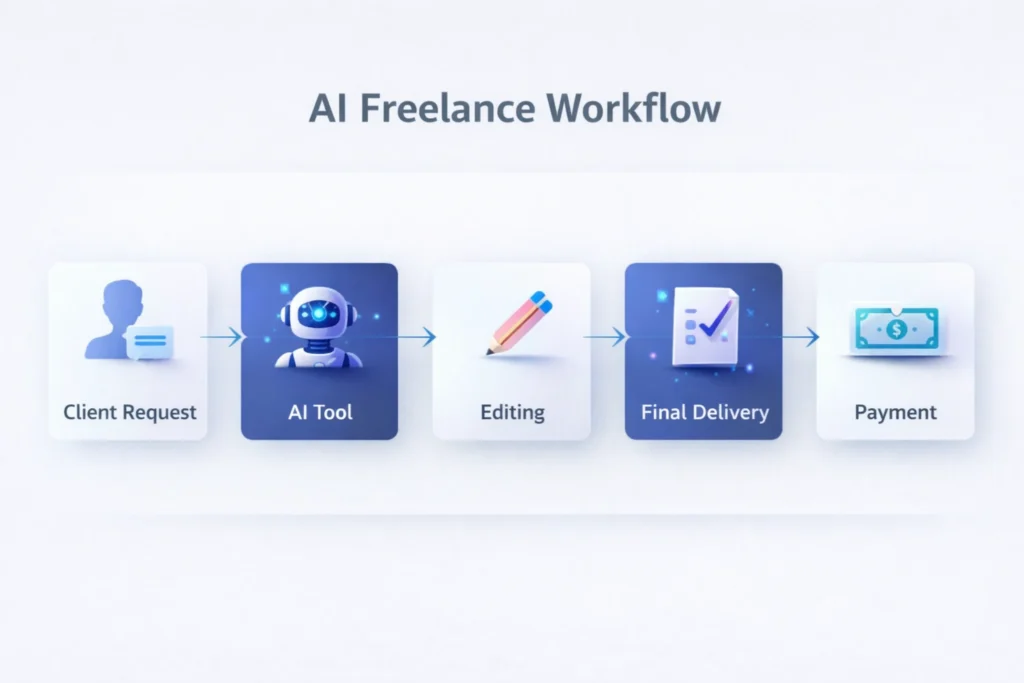
A typical workflow: Research → AI draft → human edit → SEO / intent check → fact check → final delivery.
- AI handles: outlines, first drafts, rewording, meta descriptions, headline variations, summarising sources.
- You handle: choosing the angle, verifying every claim and number, matching brand voice, cutting filler, internal-linking logic, and making sure the piece answers what the searcher actually wanted.
The best AI content freelancers position themselves as content operators, not prompt users. The tool stack is secondary — if you want options, see the best AI tools for freelancers.
Skill floor
Clear written English (or your target language), basic SEO awareness (search intent, headings, keywords used naturally), and the discipline to fact-check. You do not need a journalism degree. You do need to be the kind of person who notices when a sentence says nothing.
How to prove it (before your first client)
- Two or three sample articles on realistic business topics, edited to a standard you would sign.
- One “before / after” showing a raw AI draft next to your edited version — this demonstrates the human value better than any claim.
- A short note on your process (research, fact-check, voice) so buyers know AI is assisted, not unattended.
Who it fits
- People who enjoy writing or editing and can stay consistent on volume.
- Beginners who want the shortest gap between “samples ready” and “someone could buy this.”
- Anyone planning to stack copywriting or social content later — content is the foundation for both.
Who should skip it
- People who dislike editing and want AI to “do the writing.” Buyers can tell, and the market for unedited AI text has collapsed.
- Anyone unwilling to fact-check — one fabricated statistic can end a client relationship.
Indicative market rates
| Stage | Typical per-article range |
|---|---|
| Beginner (samples, few reviews) | $20–$40 |
| Intermediate (proof + consistent quality) | $75–$150 |
| Experienced (strategy + SEO ownership) | $300–$500 |
Rough illustration (not a guarantee): 3 articles a day at a $60 average across 20 working days is about $3,600 a month — but that level depends on steady demand and a reliable workflow, not just writing speed.
Watch-outs
This is the most competitive service on the list, and price pressure at the bottom is real. You escape it by being visibly better at the human layer (accuracy, voice, intent) and by pairing the service with a clear buyer — which is a niche decision, not a writing decision.
#2 — AI Social Media Content (Captions, Calendars & Post Systems)
Scores: Speed 9 · Ease 8 · Scale 6 · Stability 7 · Proof-ability 9
Why it ranks #2: Nearly every small business knows its social accounts are inconsistent, and most hate doing it themselves. Demand is broad, proof is visual, and the work naturally repeats every month — which gives it slightly better stability than content writing, with a similar speed to first sale.
What you actually sell
Consistent, on-brand social presence without the business owner having to think about it. Typical deliverable units:
- A monthly content calendar (themes, post types, posting rhythm).
- Written captions and hooks for LinkedIn, Instagram, Facebook, X, or Threads.
- Reusable visual templates (carousels, quote cards, announcement posts).
- Short-form scripts and hook lists for reels / TikTok.
- Basic engagement guidelines (how to reply, what to avoid).
How those units get bundled into an actual offer — and whether you include scheduling, community management, or reporting — is a packaging decision. See the packaging guide for that.
Buyer problem it removes
“We post in bursts, then go silent for six weeks.” Your value is the system: a predictable flow of posts that sound like the brand, not a pile of AI captions.
AI does vs you do
- AI handles: idea generation, caption drafts, hook variations, repurposing a blog post into ten posts, first-pass visuals.
- You handle: brand voice, what not to post, platform-specific judgment, visual consistency, and the calendar logic that makes posts build on each other.
Skill floor
Low to moderate. Good short-form writing, an eye for what performs on each platform, and comfort with a design tool such as Canva. The real skill is consistency — showing up with the calendar every month without being chased.
How to prove it
- A sample two-week calendar for a fictional or real (unpaid, with permission) business.
- Six to nine finished posts showing captions + templates together.
- A one-page “voice sheet” you created for the sample brand — buyers love seeing that you think about tone.
Who it fits
- People who already spend time on social platforms and understand what native content looks like.
- Beginners who want recurring work early rather than one-off projects.
- Organised people who like calendars and checklists.
Who should skip it
- Anyone who dislikes daily or weekly deadlines.
- People who expect to “set and forget” — social content is a rhythm business.
Indicative market rates
| Stage | Typical monthly range per client |
|---|---|
| Beginner | $150–$300 |
| Intermediate | $500–$1,200 |
Rough illustration: five ongoing clients at around $600 each is roughly $3,000 a month of recurring revenue. The ceiling depends on how many clients your system can handle without quality slipping.
Watch-outs
Scope creep (“can you also reply to DMs… and run ads… and film reels?”) is the classic trap. Define what the service includes before you sell it — again, a packaging question, not a service question.
#3 — AI Marketing Copywriting (Emails, Landing Pages & Ads)
Scores: Speed 7 · Ease 6 · Scale 8 · Stability 7 · Proof-ability 8
Why it ranks #3: Copywriting is tied directly to revenue — sign-ups, sales, booked calls — so buyers will pay more for it than for general content. It is slightly harder to sell first because the buyer wants to believe you understand conversion, not just writing. Once you have one result to point to, it scales better than any other writing service.
What you actually sell
Words that make people act. Typical deliverable units:
- Email sequences (welcome, nurture, launch, abandoned cart, re-engagement).
- Landing pages and sales pages.
- Ad copy variations for Meta, Google, or LinkedIn.
- Product and offer descriptions focused on benefits and objections.
- Copy refreshes for an existing page that is not converting.
Buyer problem it removes
“We have traffic or a list, but not enough people buy.” Your value is understanding the reader’s objections and writing around them — something AI can imitate in structure but rarely nails without a human who has studied the offer and the audience.
AI does vs you do
- AI handles: headline and hook variations, first-draft sequences, objection brainstorming, A/B test variants, rewriting for length.
- You handle: offer clarity, the “big idea,” proof selection, ordering arguments, compliance-sensitive claims, and choosing what not to say.
Skill floor
Moderate. You need to understand basic persuasion structure (problem → stakes → solution → proof → call to action), be comfortable reading analytics (open rate, click rate, conversion rate), and be willing to study a product deeply before writing.
How to prove it
- A rewritten landing page for a real business (spec work, clearly labelled), with a short annotation explaining each choice.
- A five-email welcome sequence for a sample offer.
- If you have any result at all — even from your own project — a one-paragraph mini case study beats ten samples.
Who it fits
- Writers who enjoy psychology and numbers as much as words.
- People coming from sales, customer support, or marketing roles who already know how buyers object.
- Content writers ready to move up in rate.
Who should skip it (for now)
- Complete beginners with no writing samples at all — start with #1 and graduate.
- Anyone uncomfortable being measured on results.
Indicative market rates
| Deliverable | Typical range |
|---|---|
| Short email sequence (3–5 emails) | $150–$600 |
| Landing page | $250–$1,000+ |
| Ad copy set (multiple variants) | $100–$400 |
Watch-outs
Never promise conversion numbers you cannot control. Traffic quality, the offer, and the price matter as much as copy. Sell the craft and the testing process; let results become your proof over time.
#4 — AI Research & Reports (Market, Competitor & Content Research)
Scores: Speed 6 · Ease 8 · Scale 6 · Stability 8 · Proof-ability 8
Why it ranks #4: It is underrated. Competition is lighter than in writing, the skill floor is low for analytical people, and demand is stable because decision-makers always need synthesised information. It ranks below the writing services only because buyers search for it less directly — you often have to name the problem for them.
What you actually sell
Decisions made easier. Typical deliverable units:
- Competitor analysis (positioning, pricing, content, offers).
- Market or industry snapshots.
- Product and tool comparisons.
- Content research briefs for writers and SEO teams.
- Executive summaries of long reports, transcripts, or meeting notes.
Buyer problem it removes
“I need to make a call, and I don’t have six hours to read everything.” Your value is not finding information — AI can find plenty — it is verifying, structuring, and interpreting it into something a busy person can act on.
AI does vs you do
- AI handles: gathering sources, summarising documents, extracting data points, drafting comparison tables.
- You handle: source quality, catching hallucinated facts, spotting what matters, and writing the “so what” — the recommendation section buyers actually read.
Skill floor
Low to moderate. Strong reading comprehension, scepticism about sources, and clean structured writing. Spreadsheet comfort helps. This service rewards careful people more than creative ones.
How to prove it
- A two-page competitor snapshot for a real, public company.
- A content research brief (search intent, angles, questions, sources) for a sample keyword.
- A one-page summary of a long public report with a clear “what this means” section.
Who it fits
- Analytical people who prefer structured “thinking” work over creative output.
- Students, ex-researchers, analysts, and anyone with a background in reports.
- Introverts who want deliverables that speak for themselves.
Who should skip it
- People who get bored by detail or dislike checking sources.
Indicative market rates
| Deliverable | Typical range |
|---|---|
| Content research brief | $30–$100 |
| Competitor / market snapshot | $150–$600 |
| Ongoing research support | Often billed hourly or monthly |
Watch-outs
AI research tools still fabricate citations. Every fact in a report should be traceable to a real source. Your reputation in this service is entirely built on accuracy.
#5 — AI Design & Visual Assets (Graphics, Thumbnails & Ad Creatives)
Scores: Speed 7 · Ease 6 · Scale 6 · Stability 5 · Proof-ability 9
Why it ranks #5: Visual demand is huge and proof is instant — a portfolio grid sells itself. It ranks mid-table because AI image tools have also made it the easiest service for clients to attempt themselves, which squeezes the low end. The freelancers who win combine generation with real layout and brand judgment.
What you actually sell
- Social media graphics and carousel designs.
- YouTube thumbnails.
- Ad creatives in multiple sizes and variants.
- Presentation and pitch-deck visuals.
- Simple brand asset kits (colours, fonts, templates) for small businesses.
Buyer problem it removes
“Our visuals look inconsistent and amateur, and we need new ones every week.” Your value is consistency and usability — assets that look like one brand and actually work at the size and format required.
AI does vs you do
- AI handles: concept generation, backgrounds, image variations, upscaling, background removal.
- You handle: composition, typography, brand consistency, legibility at small sizes, fixing AI artefacts, and licensing awareness.
Skill floor
Moderate. Basic design principles (hierarchy, contrast, spacing) plus comfort in Canva, Figma, or similar. Without those fundamentals, AI images look like AI images — and buyers notice.
How to prove it
- A grid of 9–12 finished assets for one sample brand (consistency is the selling point).
- Before/after redesigns of real, public examples (clearly labelled as concepts).
Who it fits
- People with a visual eye who already enjoy design tools.
- Social media freelancers who want to add visuals to their service.
Who should skip it
- Anyone hoping AI generation alone will carry the work — that is the segment being commoditised fastest.
Indicative market rates
| Deliverable | Typical range |
|---|---|
| Thumbnail / single graphic | $10–$60 |
| Ad creative set | $80–$400 |
| Template / mini brand kit | $150–$800 |
Watch-outs
Clarify image rights and which AI tools you use if a client cares about commercial licensing. Avoid generating anything resembling real people or trademarks without permission.
#6 — AI Automation Setup (Zapier, Make & Workflow Systems)
Scores: Speed 4 · Ease 4 · Scale 9 · Stability 9 · Proof-ability 6
Why it ranks #6 for beginners — and #1 for ceiling: Automation has the highest long-term value on this list. It produces measurable savings, it is hard for clients to do themselves, and it naturally leads to maintenance and follow-on projects. It ranks lower here only because the learning curve is steeper, demos take longer to build, and buyers need convincing that the problem is worth fixing. Many experienced freelancers eventually build an entire AI automation agency around it. To climb that learning curve step by step, see how to become an AI automation specialist, which sets out the eight skills in order.

What you actually sell
Hours given back. Typical deliverable units:
- Lead capture workflows (form → CRM → welcome email → team notification).
- CRM automation (tagging, follow-up reminders, pipeline updates).
- Email marketing sequences triggered by behaviour.
- Data processing pipelines (invoices, spreadsheets, reports).
- AI-enhanced steps inside workflows (summarising emails, classifying requests, drafting replies for review).
Buyer problem it removes
“My team spends hours every week copying data between tools, and things fall through the cracks.” A simple example: a system that captures website leads, adds them to the CRM, sends a welcome sequence, and pings the sales team instantly. That saves time and stops lost leads — a benefit owners can put a number on.
The phone leaks leads too. A missed-call text-back automation texts unanswered callers from the business number, which makes it a compact first build to demo for a local service business.
AI does vs you do
- AI handles: helping write formulas, scripts, and logic; classification and summarisation steps inside the workflow; documentation drafts.
- You handle: mapping the actual business process, choosing tools (Zapier, Make, Airtable, n8n, native integrations), error handling, testing edge cases, and making sure nothing breaks silently.
Skill floor
Higher. Logical thinking, comfort with APIs and webhooks at a no-code level, patience for debugging, and the ability to explain technical systems in plain language. You do not need to be a programmer, but you must enjoy systems.
How to prove it
- A recorded walkthrough (3–5 minutes) of a working automation you built for yourself or a sample business.
- A simple diagram of the before/after process with estimated hours saved.
- Templates or documentation that show you think about reliability, not just the happy path.
Who it fits
- People with ops, admin, IT, or analytical backgrounds.
- Anyone who enjoys puzzles and is willing to accept a slower start for a higher ceiling.
Who should skip it (as service #1)
- Beginners who need income within weeks and have no systems experience — start with a faster service and learn automation on the side.
Indicative market rates
| Deliverable | Typical range |
|---|---|
| Single workflow | $150–$500 |
| Multi-step system / project | $500–$3,000 |
| Ongoing maintenance / optimisation | Often monthly |
Watch-outs
Broken automations damage trust fast. Build monitoring and clear hand-off documentation into every project, and be honest about which tool subscriptions the client will need to pay for.
#7 — AI Chatbot & Agent Setup (Support Bots, Lead Qualifiers & Internal Assistants)
Scores: Speed 4 · Ease 3 · Scale 9 · Stability 7 · Proof-ability 6
Why it ranks #7: It is the newest service on the list and the one with the most buzz — but also the most misunderstood by buyers. Done well, it is high-value: a support bot that answers routine questions from a company’s own documents, or a lead qualifier that books calls. It sits low on a beginner list because delivery risk is high (a bot that says the wrong thing is worse than no bot) and buyers are still learning what to ask for.
What you actually sell
- Website or messaging chatbots trained on the business’s FAQs, docs, and policies.
- Lead qualification assistants that ask the right questions and route or book.
- Internal knowledge assistants (search across SOPs, policies, past proposals).
- AI agents that run multi-step tasks with human approval points.
Buyer problem it removes
“We answer the same twenty questions all day,” or “leads come in at night and nobody responds until morning.” Your value is a bot that is accurate, on-brand, and safe — and knows when to hand over to a human.
AI does vs you do
- AI handles: the conversation itself, retrieval from documents, drafting responses.
- You handle: knowledge-base preparation, guardrails, testing hundreds of real questions, escalation rules, privacy considerations, and ongoing tuning.
For a deeper look at what agent-style services involve, see AI agents for freelancers.
Skill floor
High. Comfort with chatbot platforms or agent builders, prompt and retrieval design, testing discipline, and awareness of data handling. Automation experience (#6) is a natural prerequisite.
How to prove it
- A live demo bot trained on a public company’s FAQ (clearly labelled as a demo).
- A test log showing tricky questions and how the bot handles or escalates them.
Who it fits
- Technically curious freelancers, automation specialists adding a higher-ticket service, people with customer support experience.
Who should skip it
- Beginners without systems experience, and anyone uncomfortable taking responsibility for what an AI says to customers.
Indicative market rates
| Deliverable | Typical range |
|---|---|
| Simple FAQ bot | $300–$1,000 |
| Integrated assistant / agent | $1,000–$5,000+ |
| Ongoing tuning & monitoring | Often monthly |
Watch-outs
Never deploy a customer-facing bot without testing and a clear human fallback. Be explicit about what data the bot can access and where it is stored.
When you’re ready to quote one, here’s how to price an AI chatbot setup and monthly fee.
#8 — AI Data & Operations Support (AI-Assisted Virtual Assistance)
Scores: Speed 6 · Ease 8 · Scale 3 · Stability 6 · Proof-ability 5
Why it ranks #8: It is the least glamorous service here, which is exactly why it works for some beginners. Small businesses drown in admin — inbox triage, spreadsheet cleanup, meeting notes, SOP writing, data entry — and an AI-assisted assistant can do far more in an hour than a traditional VA. It ranks last only because it scales poorly unless you specialise or systemise.
What you actually sell
- Spreadsheet and CRM data cleanup, de-duplication, and formatting.
- Meeting notes, action items, and follow-up drafts from recordings.
- SOP and process documentation written from screen recordings or interviews.
- Inbox triage and draft replies for review.
- Recurring report preparation.
Buyer problem it removes
“I’m the founder and I’m spending my evenings on admin.” Your value is reliability: tasks done correctly, on time, without supervision.
AI does vs you do
- AI handles: transcription, summarisation, formula writing, first-draft documents and replies.
- You handle: accuracy, confidentiality, judgment on what needs escalating, and keeping systems tidy.
Skill floor
Low. Organisation, spreadsheet basics, clear written communication, and trustworthiness. It is an excellent on-ramp toward automation (#6) because you see the repetitive work first-hand.
How to prove it
- A before/after of a messy sample spreadsheet you cleaned and structured.
- A sample SOP written from a short public tutorial video.
Who it fits
- Organised, dependable people who like clearing lists; former admin, office, or support staff.
Who should skip it
- Anyone chasing a high ceiling without planning to move into automation or specialised ops later.
Indicative market rates
Commonly billed hourly ($8–$30+ depending on market and specialisation) or as a monthly arrangement for a set scope.
Watch-outs
You will often handle sensitive data. Agree on access, confidentiality, and which AI tools are allowed with client data before you start.
For the exact wording, use the green/amber/red data rule and contract clauses in how to tell clients you use AI.
AI video editing is not ranked here because it has its own dedicated guide: AI video editing side hustle.
AI Freelance Services Compared: Full Matrix
Here are all eight services side by side. Use it to re-weight the ranking for your own situation — for example, if you already have technical skills, “difficulty” matters less and “scalability” matters more.
| # | Service | Speed to first sale | Difficulty | Scalability | Risk (commoditisation) | Proof-ability | Recurring potential | Tool cost to start |
|---|---|---|---|---|---|---|---|---|
| 1 | AI Content Writing | Fast | Low | Medium | Medium–High | Very easy | Medium | Low |
| 2 | AI Social Media Content | Fast | Low | Medium | Medium | Easy | High | Low |
| 3 | AI Marketing Copywriting | Medium | Medium | High | Medium | Easy | Medium | Low |
| 4 | AI Research & Reports | Medium | Low | Medium | Low | Easy | Medium | Low |
| 5 | AI Design & Visual Assets | Medium | Medium | Medium | High | Very easy | Medium | Low–Medium |
| 6 | AI Automation Setup | Slow | High | High | Low | Medium | High | Medium |
| 7 | AI Chatbot & Agent Setup | Slow | High | High | Low–Medium | Medium | High | Medium |
| 8 | AI Data & Ops Support | Medium | Low | Low | Medium–High | Medium | High | Low |
Score summary (out of 10, higher = better for a beginner)
| Service | Speed | Ease | Scale | Stability | Proof | Total /50 |
|---|---|---|---|---|---|---|
| #1 AI Content Writing | 9 | 8 | 6 | 6 | 10 | 39 |
| #2 AI Social Media Content | 9 | 8 | 6 | 7 | 9 | 39 |
| #3 AI Marketing Copywriting | 7 | 6 | 8 | 7 | 8 | 36 |
| #4 AI Research & Reports | 6 | 8 | 6 | 8 | 8 | 36 |
| #5 AI Design & Visual Assets | 7 | 6 | 6 | 5 | 9 | 33 |
| #6 AI Automation Setup | 4 | 4 | 9 | 9 | 6 | 32 |
| #7 AI Chatbot & Agent Setup | 4 | 3 | 9 | 7 | 6 | 29 |
| #8 AI Data & Ops Support | 6 | 8 | 3 | 6 | 5 | 28 |
How ties are broken: content writing and social media both score 39 — content takes #1 on proof-ability and because buyers search for it directly. Copywriting and research both score 36 — copywriting takes #3 because its direct revenue link lets beginners move up in rate faster once they have one result. Automation and chatbots sit low on a beginner list because of speed and ease, but if you weight scale and stability double, they jump to the top two. Data & ops support is the easiest to start but the hardest to grow, which is why it ranks last unless you treat it as an on-ramp to automation.
Two patterns stand out:
- Fast services are rarely the most scalable. Content and social get you selling sooner but stay closer to linear unless you systemise.
- Scalable services are rarely fast. Automation and agent work pay more and last longer, but demand proof you can only build with time.
That trade-off is exactly why many freelancers start with one fast service and add one scalable service later — which is the subject of the next section.
Which AI Freelance Services Scale the Best (and Natural Upgrade Paths)
Not all services scale the same way. Some grow by volume, some by recurrence, and some by ticket size. Knowing which kind you picked tells you what “growth” will look like a year from now.
Scale by volume — content writing, design
Income grows by producing more pieces or raising per-piece rates. The ceiling is your hours, unless you add editors or designers later. Strong positioning raises rates; systems (templates, briefs, checklists) raise output.
Scale by recurrence — social media, data & ops support
These services repeat every month by nature. Once your workflow is templated, you can serve several clients in parallel. Growth comes from adding clients without letting quality slip.
Scale by ticket size — copywriting, automation, chatbots & agents
These services are tied to revenue or measurable savings, so each project can be worth more. Automation and agent work also tend to generate maintenance and optimisation needs, which adds a recurring layer on top of project fees.
Natural upgrade paths between services
| Start with | Natural next service | Why it works |
|---|---|---|
| #1 Content Writing | #3 Copywriting | Same core skill, higher value per word |
| #2 Social Media Content | #5 Design | You already make the visuals; formalise it |
| #4 Research & Reports | #1 Content or #3 Copywriting | Research is the hardest part of good writing |
| #8 Data & Ops Support | #6 Automation | You see the repetitive work first-hand |
| #6 Automation | #7 Chatbots & Agents | Same systems thinking, newer layer |
Notice the paths combine services, not industries. Whether you stay with one type of buyer while you upgrade is a niche decision — see the niche guide. How you structure the recurring version of a service (monthly scopes, retainers, maintenance plans) is covered in the packaging guide.
Choosing a service with a natural upgrade path early can significantly increase long-term earning potential, because every month of experience compounds into the next service rather than starting over.
Mistakes People Make When Choosing an AI Freelance Service
These are mistakes in choosing and defining the service — the step this guide covers.
1. Picking by tool instead of by problem
“I’ll offer Midjourney services” or “I do ChatGPT work” is not a service. Businesses do not pay for prompts; they pay for results. Name the problem you remove, then the tools become a footnote.
2. Offering a menu of five services
A beginner listing writing, design, automation, chatbots, and video looks like someone still experimenting. One service, described clearly, is easier to trust and easier to remember.
3. Choosing the highest-paying service with no way to prove it
Automation and agent work pay well, but if you cannot show a working demo, you cannot sell it yet. Start where you can prove skill this week, and build toward the higher ceiling.
4. Ignoring commoditisation risk
If a client can get 80% of your output from a $20 tool in ten minutes, your service needs a stronger human layer — accuracy, strategy, integration, or accountability — or you will compete on price forever.
5. Switching services every few weeks
Freelancers who constantly pivot never build samples, reviews, or reputation in any category. Give one service a fair run before deciding it “doesn’t work.”
6. Confusing service, niche, and package
“Social media for real-estate agents, three tiers starting at $300” is three decisions stacked together: the service (social media content), the niche (real-estate agents), and the package (tiers and price). Make them in that order, one at a time. This page is step one.
7. Underpricing to compensate for an unclear service
When the service is vague, beginners drop the price to make it attractive. A clearly defined service lets you charge fairly from the start. For realistic numbers, see AI freelancing rates.
You’ve Picked a Service — Here’s Where Each Next Step Lives
This page’s job ends once you have chosen one service. Everything after that is a different decision, and each one has its own guide on Digital Solo Hub. Do them in this order:
| Next decision | Question it answers | Guide |
|---|---|---|
| 1. Niche | Who exactly will I sell this service to? | AI freelancing niche guide |
| 2. Package | What exactly is included, at what scope and price structure? | How to package AI freelance services |
| 3. Setup (if you are brand new) | What skills, samples, and profile do I need before selling? | Start AI freelancing with no experience |
| 4. Acquisition | Where do I find buyers and how do I reach them? | How to get your first AI freelance client |
| 5. Close | A lead is interested — how do I turn them into a paying client? | How to close your first AI freelance client |
| 6. Schedule | What should I do each week for the first month? | 30-day AI freelancing plan |
Why the order matters
- Service before niche: you cannot choose who to serve until you know what you are offering them. “Content writing” and “automation” attract very different buyers.
- Niche before package: scope and pricing depend on the buyer. A local café and a SaaS company need different packages of the same service.
- Package before outreach: it is much easier to reach out when you can describe a specific, buyable offer instead of “I do AI stuff.”
Your service decision checklist
Before you leave this page, make sure you can tick every line:
- I have chosen one service from the ranked list.
- I can describe it in one sentence using the outcome-first formula from the Quick Pick section.
- I know what AI does in my workflow and what I do.
- I know how I will prove I can deliver it (two or three samples, a demo, or a before/after).
- I know which natural upgrade service I might add later.
- I have not yet decided my niche or packages — and that is fine, because those are the next two guides.
Platform choice also comes later. If you are deciding where to list your service, compare Fiverr vs Upwork vs LinkedIn once your niche and package are clear.
Frequently Asked Questions
What are AI freelance services?
AI freelance services are client services delivered with the help of AI tools, where a human freelancer remains responsible for quality and results. Examples include AI-assisted content writing, social media content, marketing copywriting, research and reports, design, automation setup, chatbot and agent setup, and data or operations support.
What is the best AI freelance service for beginners?
For most beginners, AI content writing or AI social media content. Both are services buyers already understand, both can be proven with samples in an afternoon, and both have a low skill floor. If you have analytical strengths, AI research and reports is an underrated alternative with less competition.
Which AI freelance service pays the most?
AI automation setup and AI chatbot or agent setup usually command the highest project fees, because they produce measurable time savings and are hard for clients to do themselves. They also have the steepest learning curve and the slowest start, which is why they rank lower on a beginner-weighted list.
Which AI freelance services are least likely to be replaced by AI tools?
Services that involve integration, accountability, or judgment hold up best: automation, chatbot and agent setup (with testing and guardrails), research that requires verification, and copywriting tied to a specific offer. Unedited text and generic image generation are the most exposed.
How much can AI freelancers earn?
Ranges vary widely by service and proof. As a rough guide, beginners often earn $500–$2,000 a month once they have a few clients, and experienced freelancers with steady clients can reach $3,000–$8,000 or more, especially in copywriting and automation. These are typical ranges, not guarantees. See AI freelancing rates for detail.
Do I need technical skills to offer AI freelance services?
Not for most of the list. Content, social media, copywriting, research, and data support are about workflow management and quality control, not programming. Automation and chatbot/agent setup require comfort with no-code platforms and systems thinking, but still not traditional coding for most projects.
Should I offer more than one AI freelance service?
Not at the start. One clearly defined service is easier to prove, easier to explain, and easier to sell. Add a second service later along a natural upgrade path — for example, content writing to copywriting, or data support to automation.
Is this the same as choosing a niche?
No. A service is what you deliver; a niche is who you deliver it to. This page ranks services. To choose who to serve, use the AI freelancing niche guide.
Where can I find clients for these services?
That is covered step by step in How to Get Your First AI Freelance Client. Pick your service and niche first — outreach works far better with a specific offer.
Final Take: Pick One Service, Then Move to the Next Decision
The best AI freelance service is rarely the one with the highest advertised income. It is the one you can deliver consistently, explain clearly, prove quickly, and improve over time.
Recap of the ranked list:
- AI Content Writing — fastest, easiest to prove, most crowded.
- AI Social Media Content — fast, recurring by nature.
- AI Marketing Copywriting — tied to revenue, scales well after first results.
- AI Research & Reports — underrated, stable, less competition.
- AI Design & Visual Assets — instant proof, high commoditisation risk.
- AI Automation Setup — slow start, highest long-term ceiling.
- AI Chatbot & Agent Setup — newest, high value, high delivery risk.
- AI Data & Ops Support — easiest on-ramp, lowest ceiling unless you upgrade.
Most successful freelancers start with one simple service, build credibility through finished work, and add a higher-value service along a natural upgrade path as their skills and client base grow.
Your next action: write your one-sentence service line today. Then open the niche guide to decide who it is for, and the packaging guide to turn it into an offer someone can say yes to.
Service chosen. Niche next. Package after that. Outreach only once all three are clear.