This guide is about packaging — turning an AI service you have already chosen into a clear offer with a written scope, three tiers, and a retainer path. It is not a ranking of which AI services to sell, it is not a niche-selection guide, and it is not a playbook for finding clients.
Many AI freelancers struggle to win good clients for a simple reason: they sell skills instead of solutions. A beginner profile usually reads like a tool list:
- ChatGPT content writing
- AI image generation
- Workflow automation
- Prompt engineering

Meanwhile, another freelancer offering almost identical work keeps landing higher-paying projects. The difference rarely comes down to technical ability. It comes down to how the service is packaged.
Businesses don’t wake up looking for “someone who knows ChatGPT.” They look for someone who can publish consistent content, automate repetitive work, generate more leads, or give their team hours back every week. The AI tools simply help deliver those outcomes. Packaging is how you make that outcome visible, bounded, and easy to say yes to.
Before you package: two decisions should already be made
Packaging sits downstream of two earlier choices. If either is still open, settle it first — otherwise you will design a beautiful offer for the wrong buyer.
- What you sell. Pick one core service. If you are still comparing options, use Best AI Freelance Services to Offer in 2026 (Ranked Gigs) — that page owns the “which service” decision.
- Who you sell it to. Pick one buyer type and the problem they pay to solve. The framework for that lives in how to choose an AI freelancing niche.
You don’t need clients yet. In fact, packaging before outreach is the smarter order: every message, profile, and proposal you send afterwards gets easier because there is a concrete offer behind it.
By the end of this guide you will have: one core package with a written scope, a three-tier menu (good / better / best), a small paid entry offer, a retainer that follows naturally from the project, and a one-page offer sheet you can reuse in your profile and proposals.
Why Selling AI Tasks Stops Working in 2026
A few years ago, simply offering “AI-assisted” work was a differentiator. That advantage is gone. Thousands of freelancers on Upwork, Fiverr, LinkedIn, and personal sites now describe themselves in nearly identical words:
- “I use ChatGPT.”
- “I create AI content.”
- “I automate workflows.”
- “I build AI solutions.”
From a buyer’s side of the screen, those lines give no reason to choose one person over another. Competition isn’t rising because everyone got better — it’s rising because everyone started to look the same. When offers look the same, the only remaining comparison is price, and that is a race no solo freelancer wins for long.
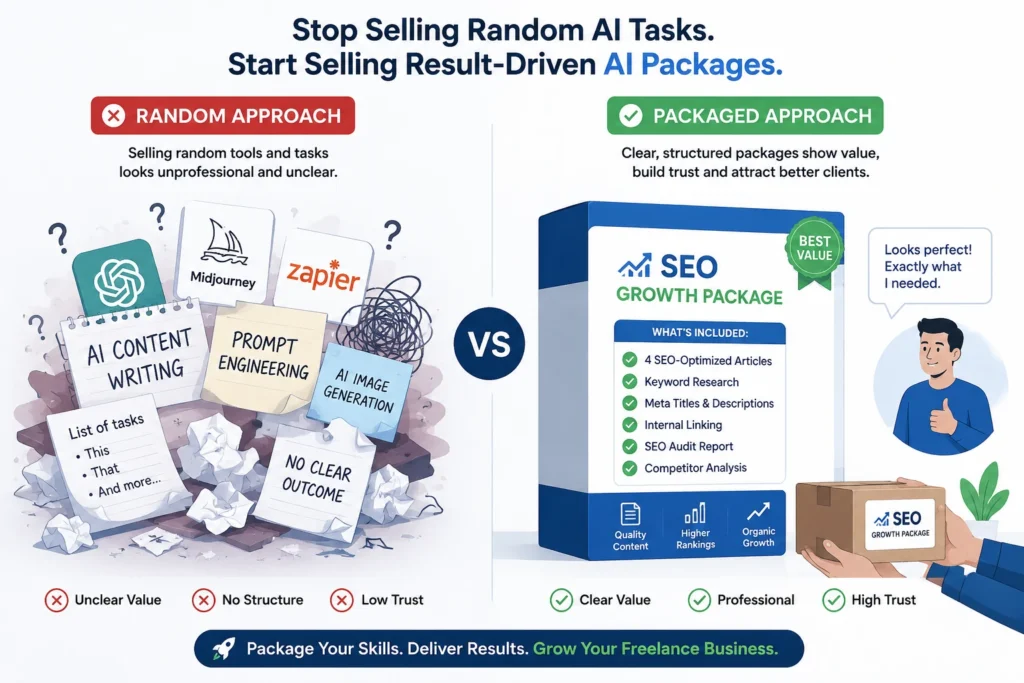
Packaging breaks that tie. Instead of selling “AI blog writing,” you sell a Monthly SEO Growth Package. Instead of “AI automation,” you sell a Lead Qualification Workflow System. The underlying work barely changes. The perceived value — and the conversation about price — changes dramatically.
Clients buy outcomes, not skills
One of the most expensive misconceptions in freelancing is that more skills automatically create more income. They don’t. Businesses rarely purchase skills; they purchase solutions to problems.
Picture two freelancers. Freelancer A: “I write AI-generated blog articles.” Freelancer B: “I help SaaS companies publish four SEO articles a month that bring in qualified organic traffic.” Both may deliver similar articles. One sounds like a task. The other sounds like a business investment with a defined size, cadence, and purpose.
That difference shapes trust and pricing long before a proposal is opened. Businesses don’t want prompts, Midjourney images, automation scripts, or research dumps. They want more customers, faster operations, lower costs, and fewer things to manage. The freelancer who packages those outcomes usually wins — even against someone with slightly better technical skills.
| Selling Tasks | Selling Outcomes (Packaged) |
|---|---|
| AI blog writing | Monthly SEO growth |
| Prompt engineering | Faster content production |
| Workflow automation | Reduced manual work |
| AI research | Better business decisions |
| Chatbot setup | Faster customer response times |
Clients understand outcomes immediately. Tasks require explanation. That is why well-packaged services convert more consistently — and why the rest of this guide is about turning the left column into the right one.
The Psychology Behind Service Packaging
Imagine a restaurant menu with two choices. Option one: Chicken, Rice, Vegetables, Sauce. Option two: Signature Grilled Chicken Meal — premium grilled chicken, herb rice, seasonal vegetables, house sauce, and a fresh drink.
The ingredients are nearly identical. The second option feels more valuable because it has been packaged as a complete experience with a name, a boundary, and a promise. Freelance services work exactly the same way. Four buying mechanics are at play:
- Certainty. A package answers “What exactly am I paying for?” before the client has to ask. Uncertainty is the most common silent reason buyers stall.
- Lower decision cost. Comparing three named packages is easy. Evaluating a custom quote with an hourly estimate is work — and busy owners postpone work.
- Comparison anchoring. When a client sees a higher tier, the middle tier feels reasonable. Without a reference point, every price feels arbitrary.
- Lower perceived risk. Fixed deliverables, timelines, and revision rules make the purchase feel safe. Hourly billing feels open-ended, even when it isn’t.
That is why many businesses prefer fixed packages over hourly work. Packages simplify decisions, and simpler decisions convert. Packaging also protects you: when the scope is written down, “just one more thing” becomes a visible add-on instead of invisible unpaid work.
The 7-Step AI Freelance Packaging Framework
Strong packages aren’t random bundles. They follow a repeatable framework, and every package solves one business problem from start to finish. Here is the whole sequence at a glance:
- Anchor the package to one recurring business problem
- Bundle related deliverables into a complete solution
- Name the package around the result
- Write a clear scope (what’s in, what’s out)
- Price the package — not your time
- Build three tiers
- Attach a retainer path
Step 1: Anchor the Package to One Recurring Business Problem
This is where most freelancers go wrong. They begin with their skills (“What can I do with AI?”). Professionals begin with the client’s recurring problem: “What does this buyer need solved again and again?”
You have already chosen your service and buyer. Now narrow to the single problem the package will own. Examples: publishing consistent SEO content, keeping a founder visible on LinkedIn, clearing a support inbox faster, turning messy research into a decision-ready brief, or removing a repetitive admin workflow.
Write a one-sentence problem statement before anything else:
“[Buyer] struggles to [recurring problem], which costs them [time / money / missed opportunity]. This package fixes that by [outcome] within [timeframe].”
If you can’t fill that sentence in, the package isn’t ready. If you can, everything that follows — deliverables, name, price, tiers — has a reference point.
Step 2: Bundle Related Deliverables Into a Complete Solution
Once the problem is clear, combine deliverables that naturally belong together. A useful way to think about it is a four-layer deliverable stack:
- Core deliverable — the main thing the client gets (e.g., four articles, one automation, one research report).
- Enablers — the prep work that makes the core work land (keyword research, workflow audit, competitor list).
- Quality layer — human editing, fact-checking, testing, brand-voice review. This is where you separate yourself from raw AI output.
- Handover — what makes the result usable without you: upload guidance, documentation, a short Loom walkthrough, a checklist.
For example, an SEO content package might include keyword research, AI-assisted article drafts, human editing, internal linking recommendations, meta titles and descriptions, and upload guidance. Individually, each task has value. Together, they become a complete solution — and clients rarely enjoy managing five freelancers for one project. Convenience is part of what they pay for.
Quick win: take the service you already offer and ask, “What three related deliverables would make this feel complete?” Instead of “AI blog writing,” you now have an SEO Content Growth Package: keyword research, one optimized article, meta description, internal linking suggestions, and an optimization checklist. You haven’t learned a new skill. You’ve made the offer easier to buy.
Guardrail: bundle only what serves the problem statement. Adding unrelated extras (“plus a logo!”) dilutes the package and invites scope creep.
Step 3: Name the Package Around the Result
Package names matter more than most freelancers realize. A name is the first signal of what the client is buying.
| Weak (tool / task) | Strong (result) |
|---|---|
| AI Content Writing | SEO Growth Package |
| ChatGPT Service | Monthly LinkedIn Authority Package |
| AI Research | Competitor Intelligence Report |
| Zapier Automation | Client Onboarding Automation System |
A simple naming formula: [Outcome] + [Format or cadence] + [Package / System / Sprint / Report]. “Lead Qualification Sprint.” “Monthly Content Engine.” “Support Inbox Reset.” Clients rarely care whether you use ChatGPT, Claude, Gemini, or something else — they care what those tools help their business achieve.
Step 4: Write a Clear Scope (What’s In, What’s Out)
One of the fastest ways to lose profit is selling a service with no defined limits. Many beginners accidentally create “unlimited” projects simply by never writing down what is — and isn’t — included. A professional scope removes that confusion before work begins. Every package should define:
- Deliverables — exact quantity and format (4 articles of ~1,500 words, delivered as Google Docs).
- Turnaround — when each piece arrives (delivery every Monday; first draft within 5 business days).
- Revisions — how many rounds, and what counts as a revision versus a new request.
- Client responsibilities — what you need from them and by when (logins, brand guidelines, feedback within 3 business days).
- Communication — channel and response window (email or Slack, replies within one business day).
- Exclusions — what is explicitly not included (publishing, images, paid tools, strategy calls beyond one per month).
- Completion criteria — what “done” means, so a project can actually end.
- Change requests — how extra work is quoted (as a priced add-on, never absorbed silently).
Compare “I’ll write blog articles” with this:
SEO Content Growth Package — includes: four SEO-optimized articles per month, keyword research, meta titles and descriptions, internal linking recommendations, two revision rounds per article, delivery every Monday. Not included: publishing, custom graphics, link building. Extra articles: $X each.
The second version instantly feels more professional and is far easier to evaluate. Businesses appreciate certainty, and clear boundaries protect both sides. A useful habit: write the exclusions line first. If you can’t name three things the package doesn’t include, the scope is too loose.
Define “revision” in writing. A revision is a change within the agreed brief (tone, structure, accuracy). A new topic, a new audience, or a new deliverable is a change request. One sentence like this in your scope prevents most scope-creep arguments.
Once your scope is written, AI Freelance Proposal Templates 2026 shows how to drop it into proposals that build confidence from the first line.
Step 5: Price the Package — Not Your Time
Many beginners price like this: hours × hourly rate = project price. The problem is that clients don’t buy hours. They buy outcomes. And as you get faster with AI, hourly pricing actively punishes you — the better you get, the less you earn per deliverable.
A package should be priced according to the value it creates, its complexity, and the size of the problem it solves. Use a two-check method:
- Floor check (private): estimate realistic hours including revisions and communication, multiply by the minimum rate you’ll accept. That is your floor — never price below it.
- Value check (public): ask what the outcome is worth to the client (hours saved, leads gained, a hire avoided). Price somewhere meaningfully below that value and above your floor.
Illustrative beginner ranges for well-scoped packages:
| Package | Suggested Beginner Range |
|---|---|
| SEO Content Growth Package | $250–$800/month |
| LinkedIn Authority Package | $200–$700/month |
| AI Research Package | $150–$500/project |
| Workflow Automation Package | $500–$2,000/project |
These ranges aren’t fixed — your niche, experience, and client type all move them. The important lesson: the more complete your solution, the less attention clients pay to your hourly rate. Value-based pricing focuses on results delivered rather than time spent, and the U.S. Small Business Administration likewise recommends pricing that reflects the value your business provides instead of relying only on costs or hourly rates.
For rate benchmarks and how to raise prices over time, see AI Freelancing Rates for Beginners in 2026. This page focuses on how pricing fits inside a package structure.
Step 6: Build Three Tiers
A single package forces a yes/no decision. Three tiers turn it into a “which one?” decision — a much easier conversation. The full method is in the next section, but the principle is simple: same problem, same quality, three levels of depth, speed, or volume.
Step 7: Attach a Retainer Path
Every project package should point toward an ongoing version of itself: setup becomes maintenance, a one-off report becomes monthly tracking, a content batch becomes a monthly content engine. Designing the retainer at the same time as the project is what turns one-off income into predictable income. The section on retainers below covers how.
How to Build Good / Better / Best Tiers
Three tiers is the sweet spot. One option feels like a take-it-or-leave-it quote; five or more options create decision paralysis. Three gives clients a real choice while keeping the decision simple.
What should change between tiers
Pick one or two of these levers and move them consistently from tier to tier:
- Volume — 2 vs 4 vs 8 articles; 1 vs 3 automations.
- Depth — a summary report vs a full report vs a report plus a strategy session.
- Speed — standard turnaround vs priority delivery.
- Access — email-only vs a monthly call vs a shared Slack channel.
- Support window — 7 days of fixes vs 30 days vs ongoing monitoring.
What should never change between tiers
Quality. The entry tier must still be work you are proud of. If the cheapest tier is deliberately worse, clients who start there never upgrade — they leave. Tiers differ in how much and how fast, not in how good.
Five rules for tiers that sell
- Design the middle tier first. It is the package you actually want most clients to buy. Build it around the problem statement, then create a lighter version below and a deeper version above.
- Keep meaningful price gaps. Roughly 1.8–2.5× between tiers is a common pattern. Gaps that are too small make the top tier feel like a trick; gaps too large make the middle tier look cheap.
- Make the top tier strategic. Add something the lower tiers can’t — a planning session, a quarterly roadmap, priority access. That is what justifies the jump, not just “more of the same.”
- Name every tier. “Starter / Growth / Authority” or “Launch / Scale / Partner” says more than “Basic / Standard / Premium.”
- Highlight one tier. Mark the middle tier as “Most popular” or “Recommended.” Clients like guidance.
Example: a tiered SEO Content Growth Package
| Starter | Growth (recommended) | Authority | |
|---|---|---|---|
| Articles / month | 2 | 4 | 8 |
| Keyword research | Per article | Monthly topic plan | Quarterly content roadmap |
| Meta + internal links | Yes | Yes | Yes |
| Revisions | 1 round | 2 rounds | 2 rounds + priority |
| Reporting | — | Monthly summary | Monthly report + 30-min call |
| Illustrative price | $250/mo | $500/mo | $1,100/mo |
Notice the pattern: volume and strategic depth increase, quality stays constant, and the top tier adds a planning layer. Most buyers will choose Growth — which is exactly the tier you designed first.
Add-ons: the pressure valve
Keep a short list of priced add-ons (an extra article, a rush delivery, one more automation, an extra call). When a client wants “Starter plus one thing,” you sell the add-on instead of rebuilding the tier or giving it away. Add-ons should cost a little more per unit than the same item inside a tier — that keeps tiers the better deal.
How to Design AI Freelance Retainers
A retainer is a recurring monthly package: the client pays a fixed fee for a defined amount of ongoing work or access. Retainers are where packaging pays off most — predictable income for you, predictable results for the client, and no re-selling every month.
Three retainer models
| Model | What the client pays for | Example | Best when |
|---|---|---|---|
| Output retainer | A fixed set of deliverables each month | 4 articles + meta + monthly summary | The work is repeatable and easy to count |
| Maintenance retainer | Keeping something you built working and improving | Automation monitoring, fixes, small updates | You delivered a setup project first |
| Advisory / access retainer | Your judgment and availability | Monthly strategy call + async questions | You have proven expertise with that buyer |
Beginners usually start with output or maintenance retainers. They are the easiest to scope, price, and prove.
Retainer scope rules
- Monthly allowance in writing. “Up to 4 articles” or “up to 5 small automation changes per month.” Never “ongoing support” with no number.
- Rollover policy. Decide whether unused allowance rolls over (and for how long). A simple rule: unused items roll over one month, then expire.
- Minimum term. Three months is a fair starting minimum — long enough for results to show, short enough to feel safe.
- Notice period. 30 days’ notice to cancel protects your income and gives both sides time to wrap up.
- Billing in advance. Invoice at the start of each month, not the end.
- Monthly report. A short summary of what was delivered and what changed. Retainers that go quiet get cancelled; retainers that report get renewed.
- Response time. State it (“replies within one business day”). Access retainers live or die on this line.
Project-to-retainer bridges
The easiest retainer to sell is the natural continuation of a project the client already paid for. Design these bridges when you build the project package, not after it ends:
| Project package | Retainer that follows |
|---|---|
| Website content batch | Monthly SEO content engine |
| Workflow automation setup | Automation monitoring + improvements |
| Competitor intelligence report | Monthly competitor tracking |
| LinkedIn profile + content calendar | Monthly LinkedIn authority retainer |
| Support chatbot setup | Monthly knowledge-base updates + tuning |
Mention the retainer inside the original project package (“Optional: continue as a monthly retainer at $X”). Then offer it formally in the final delivery, when the client has just seen results. That is the moment the yes is easiest.
When not to offer a retainer
Not every package needs one. If the client’s problem is genuinely one-time (a single migration, a one-off audit with no follow-up value), forcing a retainer erodes trust. Offer recurring work only when it genuinely benefits the client — retention follows real value, not contract tricks. For keeping clients after the first project, see Why Most AI Freelancers Never Get Repeat Clients in 2026.
The Offer Ladder: Entry Offer → Core Package → Retainer
Once you have tiers and a retainer, arrange them into a simple ladder. Each step is a smaller, safer “yes” that leads to the next one.
- Entry offer (paid, small, fast). A diagnostic that lets a new client test working with you: a content audit, a workflow review, a one-page competitor snapshot. Typically $75–$300, delivered in a few days. Its job is to surface the problem your core package solves.
- Core package (your tiers). The main project or first month of work, structured as Starter / Growth / Authority.
- Retainer (recurring). The ongoing version of the core package, offered at delivery.
Two rules keep the ladder honest. First, the entry offer must be genuinely useful on its own — not a disguised sales pitch. Second, credit part or all of the entry fee toward the core package if the client upgrades within 30 days. That turns a small purchase into a low-risk step up.
Productized services: the end state of good packaging
When a package has a fixed scope, fixed price, fixed timeline, and a repeatable delivery process, it becomes a productized service. You stop writing custom quotes and start selling the same well-defined thing repeatedly. AI makes this especially practical: once your prompts, templates, and quality checklist are documented, delivery becomes consistent and faster each time — while your price stays tied to the outcome. Don’t aim for this on day one; aim for it after you’ve delivered the same package three to five times and know where the time really goes.
Package Anatomy: Four Worked Examples
These examples show structure — how a problem, deliverables, scope, tiers, and retainer fit together. They are not a ranking of which services to offer; that comparison lives in Best AI Freelance Services to Offer in 2026 (Ranked Gigs). Swap in your own service and buyer and keep the skeleton.
1. SEO Content Growth Package
- Problem: the business can’t publish consistently enough to grow organic traffic.
- Includes: keyword research, four optimized articles, meta titles and descriptions, internal linking suggestions, monthly performance review.
- Excludes: publishing, custom graphics, link building.
- Tier lever: article volume + strategic depth (see the tier table above).
- Retainer path: it already is one — monthly, three-month minimum.
- Outcome: consistent organic content without hiring a full-time writer.
2. LinkedIn Authority Package
- Problem: the founder or consultant knows they should post but never finds the time.
- Includes: monthly content calendar, weekly LinkedIn posts, carousel outlines, engagement guidelines, profile recommendations.
- Excludes: commenting or messaging on the client’s behalf, paid ads.
- Tier lever: posts per week (2 / 3 / 5) and whether a monthly strategy call is included.
- Retainer path: monthly; the first month includes profile work as a one-time setup fee.
- Outcome: steady visibility and authority with minimal time from the client.
3. Competitor Intelligence Report
- Problem: the business is making marketing decisions without knowing what competitors are doing.
- Includes: analysis of up to five competitors, SEO overview, content gap report, AI-assisted opportunity summary, prioritized recommendations.
- Excludes: implementation of recommendations, paid tool subscriptions.
- Tier lever: number of competitors (3 / 5 / 10) and a walkthrough call at the top tier.
- Retainer path: monthly competitor tracking — a shorter update report each month.
- Outcome: better decisions backed by structured research.
4. Workflow Automation Package
- Problem: the team loses hours every week to repetitive admin.
- Includes: workflow audit, automation design, AI integration, documentation, staff handover session.
- Excludes: software licence costs, automations outside the agreed workflow.
- Tier lever: number of workflows automated (1 / 3 / 5) and length of the post-launch support window.
- Retainer path: monthly monitoring, fixes, and up to a set number of small changes.
- Outcome: less manual work and smoother operations.
When a package includes automation, estimate usage up front using the per-client platform checklist.
Every example follows the same pattern: one problem, a bounded deliverable stack, an explicit exclusions line, one tier lever, and a retainer that continues the value. That repeatable pattern — not the specific service — is what makes an offer easy to buy.
The One-Page Offer Sheet Template
Pull everything together into a single page you can paste into a profile, attach to a proposal, or share after a call. If it doesn’t fit on one page, the package is still too complicated.
- Package name — result-based (Step 3).
- Who it’s for — one line naming the buyer.
- Problem statement — the sentence from Step 1.
- What you get — the deliverable stack, as a short list.
- What’s not included — three or more exclusions.
- Timeline — kickoff to delivery, or monthly cadence.
- Tiers + prices — three columns, one highlighted.
- Add-ons — two to four priced extras.
- Ongoing option — the retainer, with minimum term.
- How we work — revisions, communication, client responsibilities.
- Next step — one clear action (book a call, start the entry offer).
This sheet becomes the backbone of your sales material. AI Freelance Proposal Templates 2026 shows how to turn it into written proposals, and How to Close Your First AI Freelance Client covers presenting it on a call and handling price questions.
Hard Truth: Clients Reject Unclear Offers, Not Prices
Many freelancers believe clients reject their prices. In reality, clients often reject unclear offers. When a proposal says “AI services,” “automation,” or “content creation,” the business can’t tell exactly what it is buying, how big it is, or when it ends. Confusion creates hesitation, and hesitation looks like a price objection.
Clear packages create confidence. The easier your offer is to understand, the easier it becomes to justify a premium price — because the client is comparing your package to the cost of their problem, not to a stranger’s hourly rate.
A quick diagnostic: if a prospect asks “So what exactly do I get?” after reading your offer, the packaging failed — not the price.
Contrarian Insight: Stop Selling AI
One of the biggest packaging mistakes in 2026 is putting artificial intelligence at the center of the offer. Businesses aren’t hiring you because you know ChatGPT — they assume most freelancers already use AI. It has become a standard productivity tool, not a competitive advantage.
Your advantage is understanding the business problem better than competitors and packaging the fix clearly.
- Instead of “I build AI automations,” say: “I help businesses cut repetitive admin and save 15–20 hours every month.”
- Instead of “I write with ChatGPT,” say: “I help businesses publish consistent SEO content that attracts qualified traffic.”
- Instead of “I do AI research,” say: “I turn competitor data into a one-page action plan every month.”
AI stays inside your workflow; it simply stops being the headline. One nuance: don’t hide it either. A single line in your “How we work” section — “AI-assisted drafting, with human editing and fact-checking on every deliverable” — builds trust and sets expectations. The quality layer from Step 2 is what clients are really paying for.

Common Packaging Mistakes (and the Fix for Each)
Even experienced freelancers build offers that are hard to buy. Check your package against these eight.
1. Offering too many choices
A client who sees ten services usually postpones the decision. Fix: one core package in three tiers, plus a short add-on list. Three well-structured options consistently outperform ten unrelated ones.
2. Still selling individual tasks
Clients rarely want to coordinate several freelancers for related work. Fix: use the deliverable stack (core + enablers + quality layer + handover) so the package solves the whole problem.
3. No recurring option
Excellent projects that end with “thanks, bye” leave money and relationships on the table. Fix: design the project-to-retainer bridge at the same time as the project package.
4. Naming packages after tools
“ChatGPT Content Service” positions you as a tool operator. Fix: name the outcome. Clients invest in growth, not software.
5. Unlimited revisions
“Unlimited revisions” sounds generous and quietly destroys profit. Fix: a fixed number of rounds plus a written definition of what counts as a revision versus a change request.
6. Tiers that are too similar
If Standard and Premium differ by one extra revision, nobody upgrades. Fix: move a real lever (volume, depth, speed, access) and give the top tier a strategic element.
7. Discounting instead of de-scoping
When a client says “that’s over budget,” cutting the price for the same work teaches them your prices are negotiable. Fix: offer the lower tier or remove a deliverable. Price moves only when scope moves.
8. Retainers with no visible output
A retainer that delivers quietly gets questioned at renewal. Fix: a short monthly report — what was delivered, what changed, what’s next.
The 7-Day Package Build Sprint
Packaging doesn’t need a month. With your service and buyer already chosen, you can go from “I sell tasks” to a complete, tiered offer in a focused week — about an hour a day.
| Day | Task | Output |
|---|---|---|
| 1 | Write the problem statement | One sentence: buyer, problem, cost, outcome, timeframe |
| 2 | Build the deliverable stack | Core, enablers, quality layer, handover |
| 3 | Name the package + write the outcome line | Result-based name and one-line promise |
| 4 | Write the scope | Inclusions, exclusions, revisions, client responsibilities, completion criteria |
| 5 | Price it and build three tiers | Floor + value check; Starter / Growth / Authority; add-on list |
| 6 | Design the entry offer and retainer | Paid diagnostic + retainer terms (allowance, minimum term, notice, report) |
| 7 | Assemble the one-page offer sheet | Updated profile, services page, and proposal template |
Day 7 quality check: could a stranger read your offer sheet and answer “What do I get, by when, for how much, and what happens next?” in under a minute? If yes, the package is ready.
What comes after the sprint is a different job. Getting the package in front of buyers is covered in How to Get Your First AI Freelance Client in 2026 (Outreach & Platforms). Revisit the package after every three to five deliveries: tighten the scope where time leaked, raise the price where clients said yes too easily, and adjust tiers based on which one people actually choose.
Frequently Asked Questions
Should beginners sell packages instead of hourly services?
In most cases, yes. Packages make it easier for clients to understand what they’re buying and let you focus on results rather than tracking hours. They also stop AI efficiency from shrinking your income.
Is hourly billing ever the right choice?
Sometimes — for genuinely undefined exploratory work, or ad-hoc support you can’t scope in advance. Even then, consider a paid diagnostic first, then convert what you learn into a fixed package.
How many service packages should I offer?
One core package in three tiers is usually enough, plus a few add-ons. A clear structure gives clients meaningful choice without confusion. Add a second core package only once the first sells reliably.
How should I price a retainer compared with a one-off project?
Price the monthly allowance on value, then consider a modest saving versus buying the same work one-off — that rewards commitment. Pair it with a minimum term (often three months) so the saving is earned, not given away.
What if a client only wants one piece of the package?
Point them to the lowest tier or sell the piece as an add-on at a slightly higher per-unit price. Don’t rebuild the package around every request — that’s how tidy offers turn back into custom quotes.
Should I show package prices publicly?
Showing a “starting from” price on lower tiers filters out poor-fit leads and builds trust. Many freelancers show Starter and Growth prices and mark the top tier “from $X” or “custom.” Either works — consistency matters more than the choice.
How do I handle scope creep mid-project?
Refer back to the written scope politely: “Happy to do that — it’s outside this package, so here’s the add-on price.” Because exclusions and change requests were defined up front, this feels like process, not confrontation.
Can I use AI to deliver these packages?
Absolutely. AI improves research, drafting, analysis, and workflow speed. Your value comes from solving the business problem and the human quality layer — not the software itself.
Should every package include recurring services?
Not necessarily. But every project should be designed so ongoing support is a natural option whenever it genuinely benefits the client.
What is the biggest packaging mistake beginners make?
Trying to package every AI skill they have. Businesses prefer one clear offer that solves one problem over a long menu of unrelated services.
Final Thoughts
Packaging turns freelancing from selling isolated tasks into delivering complete, bounded business solutions. You’re not learning a new skill — you’re making the skill you have easy to understand, easy to compare, and easy to keep buying.
As AI becomes more accessible, raw technical ability will matter less on its own. Freelancers who anchor offers to one problem, write clear scopes, structure three sensible tiers, and build retainers that continue the value will attract better clients, hold firmer prices, and build more predictable income.
Once your package is selling consistently, continue with How to Scale an AI Freelancing Business from $1K to $10K+/Month in 2026 to see how structured offers, retainers, and systems work together as you grow.