By Omar Yousaf, Founder of Digital Solo Hub
One of the most common patterns I see among aspiring AI freelancers has very little to do with skill.
People spend weeks comparing tools, watching tutorials, refining prompts, and planning services. Yet when it comes time to approach clients, they have nothing concrete to show.
The issue isn’t usually capability.
It’s visibility.
A potential client cannot see the hours you’ve spent learning ChatGPT, Claude, automation tools, content creation workflows, or AI research methods. They can only evaluate the evidence placed in front of them.
That is where a portfolio becomes important. Building an AI freelancing portfolio is often the first major challenge beginners face.
A strong portfolio bridges the gap between what you know and what a client believes you can do.
This is particularly relevant in 2026.
The AI freelancing market has matured significantly. Businesses are no longer impressed simply because someone knows how to use AI tools. Most decision-makers understand that AI software is widely available. What they’re evaluating now is whether a freelancer can apply those tools to solve a specific problem.
A portfolio helps answer that question.
Done properly, it demonstrates judgment, communication, execution, and problem-solving ability long before a sales call ever happens.
The encouraging part is that none of this requires paid clients.
Many beginners assume a portfolio is something you build after gaining experience. In reality, a portfolio is often what helps you gain that experience in the first place.
This guide will show you how to build an AI freelancing portfolio from scratch, structure it professionally, and use it to create opportunities even if you’re starting with zero client work.
Key Takeaways
- Paid clients are not required to build a professional portfolio.
- Three to six strong projects are usually enough for a beginner portfolio.
- Case studies are often more persuasive than the projects themselves.
- A focused portfolio tends to outperform a broad portfolio.
- Clients evaluate outcomes and thinking, not just deliverables.
- Demonstration projects can create credibility long before you secure your first client.
If you’re completely new to freelancing, read Start AI Freelancing With No Experience in 2026 before implementing the strategies in this guide.
The Reality of AI Freelancing in 2026

A few years ago, knowing how to use AI tools created an immediate advantage.
That advantage has largely disappeared.
Today, virtually anyone can access advanced AI software within minutes. A freelance marketplace search reveals thousands of people offering AI writing, AI content creation, AI research, and automation services.
At first glance, this can feel discouraging.
However, there is an important distinction that many beginners overlook.
Access to tools is saturated.
Business results are not.
Most clients are not paying for prompts.
They are paying for outcomes.
A company hiring a content writer is not looking for someone who can open ChatGPT. They are looking for someone who can help attract readers, generate leads, or improve search visibility.
A business investing in automation is not interested in software for its own sake. It wants to reduce repetitive work, save time, or improve efficiency.
This shift changes how freelancers should think about positioning.
The goal is no longer demonstrating that you know AI.
The goal is demonstrating what you can accomplish with it.
This approach also aligns with Google’s people-first content guidelines, which emphasize creating content that demonstrates genuine value and expertise.
A portfolio remains one of the clearest ways to communicate that difference.
Is AI Freelancing Too Saturated?
This question appears in almost every AI freelancing discussion.
The honest answer is more nuanced than most people expect.
Certain parts of the market are crowded.
Generic AI writing services, basic prompt creation, and low-effort gig offerings attract intense competition because the barrier to entry is low.
On the other hand, freelancers who combine AI with domain knowledge, strategy, or business understanding often face far less direct competition.
Consider these two positioning statements:
Example A
“I offer AI writing services.”
Example B
“I help SaaS companies create SEO-focused content using AI-assisted research and editing workflows.”
The second statement is far more specific.
Specificity creates differentiation.
Differentiation reduces competition.
A portfolio supports that positioning by providing evidence rather than claims.
Instead of telling clients what you do, you show them.
Quick Answer
Can You Build an AI Freelancing Portfolio Without Clients?
Yes.
Personal projects, demonstration projects, volunteer work, mock client assignments, and self-initiated case studies can all be used to build a professional portfolio. What matters is the quality of the work and how clearly it demonstrates value.
A Common Misunderstanding About Portfolios
Many beginners treat a portfolio as a collection of finished work.
That definition is incomplete.
A portfolio is really a collection of proof.
This distinction matters.
Two freelancers might present identical deliverables.
One simply uploads the files.
The other explains the business problem, thought process, tools used, and intended outcome.
The second portfolio almost always feels stronger because it provides context.
Clients are not only evaluating the work.
They are evaluating the person behind the work.
They want to understand how you think, communicate, and approach challenges.
A strong portfolio makes those qualities visible.
A strong AI freelancing portfolio should focus on business outcomes rather than tools.
Hard Truth
Many aspiring freelancers already know enough to start.
What they lack is evidence.
I’ve seen people spend months moving from one course to another while postponing actual portfolio creation. The assumption is that one more certification will make them feel ready.
In practice, confidence usually follows action rather than preparation.
The first meaningful portfolio project often teaches more than several additional courses because it forces you to apply knowledge instead of collecting it.
Why Portfolios Often Carry More Weight Than Certifications
This doesn’t mean certifications are worthless.
Courses can accelerate learning, introduce frameworks, and shorten the trial-and-error process.
The problem is that clients rarely buy courses.
They buy outcomes.
Imagine a business owner reviewing two freelancer profiles.
The first profile contains multiple certifications but no work samples.
The second profile contains several detailed project examples with clear explanations of the strategy behind them.
Most decision-makers will spend more time examining the portfolio.
Not because certificates have no value, but because examples reduce uncertainty.
The portfolio answers practical questions:
- Can this person communicate clearly?
- Do they understand the problem they’re solving?
- Is the quality level acceptable?
- Would I trust them with a project?
These are hiring decisions, not educational evaluations.
If you’re still deciding what service to offer, read Best AI Freelance Services to Offer in 2026 before building your portfolio.
A Contrarian View: Most Beginners Build Too Much
One portfolio mistake appears surprisingly often.
People assume that more projects automatically create more credibility.
As a result, they fill their portfolio with every piece of work they’ve ever created.
The outcome is usually the opposite of what they intended.
When reviewing beginner portfolios, I often notice twenty or thirty average examples competing for attention.
The strongest piece becomes harder to find.
The overall impression becomes weaker.
A portfolio with four focused projects can outperform a portfolio with twenty scattered projects.
Clients are not conducting a quantity audit.
They’re looking for signals of competence.
Quality, relevance, and clarity send stronger signals than volume.
This becomes even more important when you’re just starting.
You don’t need a large body of work.
You need a small body of convincing work.
Step 1: Choose One Service Before Building Your Portfolio
One of the easiest ways to confuse potential clients is to showcase unrelated services at the same time.
A portfolio that offers writing, video editing, research, automation, social media management, and graphic design often creates uncertainty.
The client is left wondering:
“What is this person actually best at?”
A focused portfolio answers that question immediately.
That does not mean you must stay in one niche forever.
It simply means your initial positioning should be clear enough that a client understands your value proposition within seconds.
Common beginner-friendly services include:
AI Content Writing
Examples:
- SEO articles
- Blog posts
- Email sequences
- Landing pages
AI Social Media Content
Examples:
- Content calendars
- Captions
- Carousel concepts
- Posting strategies
AI Video Editing
Examples:
- Reels
- Shorts
- Promotional videos
- Educational clips
AI Research and Analysis
Examples:
- Competitor research
- Industry reports
- Market summaries
AI Automation
Examples:
- Lead capture workflows
- CRM automation
- Customer onboarding systems
The best choice is usually where personal interest, market demand, and practical execution overlap.
If positioning is a challenge, read Most AI Freelancers Choose the Wrong Niche in 2026 before moving forward.
A Simple Weekend Portfolio Project
For readers who feel overwhelmed, here’s a practical exercise.
Choose a service.
Create one project.
Document the process.
For example, if you’re interested in AI content writing:
- Select a business niche.
- Research a topic.
- Write a long-form article.
- Edit and improve it manually.
- Create a short case study explaining your approach.
By the end of the weekend, you’ll have something tangible to show.
That is often more valuable than another week spent researching portfolio platforms, pricing models, or certification programs.
Momentum creates clarity.
And clarity makes the next project easier.
Step 2: Create Projects That Demonstrate Real Business Value
Once you’ve chosen a service, the next challenge is deciding what to put in your portfolio.
This is where many beginners overcomplicate the process.
They assume portfolio projects need to be groundbreaking, highly technical, or indistinguishable from paid client work.
In reality, a strong portfolio project usually does something much simpler:
It solves a realistic problem.
Businesses hire freelancers because they want a result. The closer your portfolio projects are to real business situations, the easier it becomes for potential clients to imagine hiring you.
For every project you create, ask a simple question:
“What problem is this solving?”
That question immediately improves the quality of most beginner portfolios.
A blog article solves a traffic problem.
A content calendar solves a consistency problem.
A competitor report solves an information problem.
An automation workflow solves an efficiency problem.
When projects are framed around outcomes rather than deliverables, they become more persuasive.
10 Portfolio Project Ideas for Beginner AI Freelancers
If you’re unsure where to start, these projects work well because they reflect services businesses already buy.
| Project | Skill Demonstrated | Difficulty |
|---|---|---|
| SEO Blog Article | Content Writing | Beginner |
| Landing Page Copy | Conversion Writing | Beginner |
| Email Sequence | Copywriting | Beginner |
| Social Media Calendar | Content Planning | Beginner |
| Competitor Analysis Report | Research | Beginner |
| Industry Trend Report | Market Analysis | Intermediate |
| Content Strategy Document | Strategic Planning | Intermediate |
| Short-Form Video Package | Video Editing | Intermediate |
| Lead Generation Workflow | Automation | Advanced |
| Client Onboarding System | Process Design | Advanced |
A useful benchmark is to aim for four to six projects.
That is usually enough to demonstrate capability without overwhelming visitors.
Step 3: Turn Projects Into Case Studies
A project shows what you created.
A case study explains why it matters.
That distinction is important.
When I review beginner portfolios, one of the most common weaknesses is the absence of context. A visitor sees a document, article, video, or workflow but has no idea what problem it was designed to solve.
Case studies solve this problem.
A simple structure is enough.
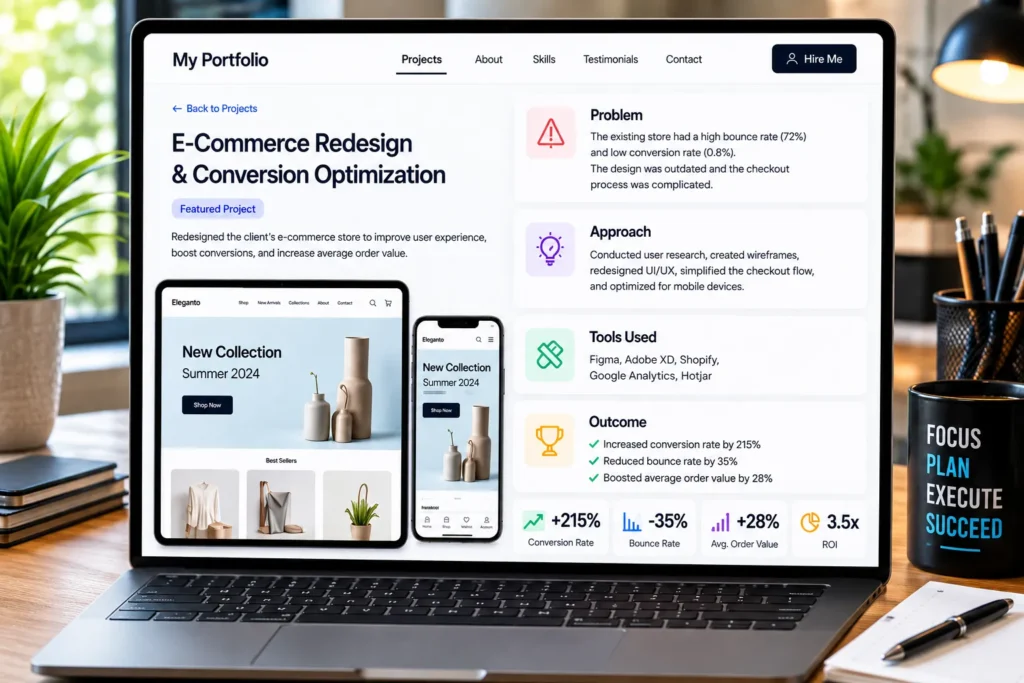
Problem
What challenge existed?
Example:
A local fitness business wanted educational content that could attract potential customers through search engines.
Approach
How was the project handled?
Example:
- Researched search intent
- Analyzed competing content
- Created an outline
- Used AI-assisted drafting
- Performed manual editing and optimization
Tools Used
List the primary tools.
Examples:
- ChatGPT
- Claude
- Grammarly
- Canva
- CapCut
Outcome
What business result was the project intended to support?
Example:
Created a long-form article designed to increase visibility and establish authority within the fitness niche.
This structure immediately makes a portfolio feel more professional because it reveals decision-making rather than simply displaying outputs.
What Clients Actually Look For in a Portfolio
Many beginners focus on the wrong details.
They worry about:
- Fancy design
- Complex animations
- Unique layouts
- Advanced branding
In most cases, clients care about simpler things.
When someone reviews a portfolio, they are usually asking four questions:
Can this person solve my problem?
This is the most important question.
Everything else is secondary.
Do they understand my industry?
Even a small amount of niche relevance can create a significant advantage.
Can they communicate clearly?
A freelancer who explains their process clearly often appears more trustworthy.
Would I feel comfortable hiring them?
Trust is rarely built through flashy design.
It is usually built through clarity, professionalism, and evidence.
Clients reviewing an AI freelancing portfolio are usually looking for proof of competence.
Example: Weak Portfolio vs Strong Portfolio
Consider these two portfolio approaches.
Weak Portfolio
- 15 random projects
- 7 different services
- No explanations
- No outcomes discussed
- Generic positioning
A visitor leaves with questions.
Strong Portfolio
- 4 focused projects
- One primary service
- Clear case studies
- Defined target client
- Outcome-oriented descriptions
A visitor leaves with confidence.
Interestingly, the second portfolio often contains less work.
Yet it tends to perform better because the work is easier to understand.
This is one reason why editing matters as much as creating.
What Should an AI Freelancing Portfolio Include?
A beginner portfolio does not need dozens of pages.
Most effective portfolios contain a small number of essential sections.
Homepage
Your homepage should quickly communicate:
- What you do
- Who you help
- Why it matters
For example:
Helping SaaS Companies Create SEO-Focused Content Using AI-Assisted Research and Editing Workflows
Specific positioning tends to outperform vague descriptions.
About Page
Keep this concise.
Explain:
- Your focus
- Your service
- Your approach
Avoid long autobiographies.
Clients are usually more interested in how you can help them.
Services Page
Clearly explain your offer.
Examples:
AI Content Writing
- SEO articles
- Landing pages
- Email sequences
AI Automation
- Lead generation systems
- CRM workflows
- Client onboarding automation
The goal is clarity rather than complexity.
Portfolio Page
This is where your projects and case studies live.
For each project include:
- Title
- Problem
- Process
- Tools
- Outcome
Think of this section as your evidence library.
Contact Page
Make communication easy.
Include:
- Contact form
Reducing friction often increases inquiries.
Choosing the Right Portfolio Platform
A surprising number of beginners spend more time choosing a platform than creating projects.
In most situations, the platform has very little impact on whether someone hires you.
The quality of the work matters far more.
That said, some platforms are easier to use than others.
| Platform | Best For | Cost | Difficulty |
|---|---|---|---|
| Notion | Most beginners | Free | Easy |
| Carrd | Simple websites | Low | Easy |
| Visibility | Free | Easy | |
| Google Drive | Quick sharing | Free | Easy |
| WordPress | Long-term authority | Medium | Medium |
For most people:
- Start with Notion.
- Add projects to LinkedIn.
- Build a website later.
This keeps the focus on creating proof rather than managing technology.
Common Portfolio Mistakes
Several mistakes appear repeatedly in beginner portfolios.
Avoiding them is often easier than creating additional projects.
Offering Too Many Services
A focused specialist generally appears more credible than a generalist offering everything.
Publishing Raw AI Outputs
Clients care about business value, not tool outputs.
Always explain the reasoning behind the work.
Ignoring Outcomes
Every project should answer:
Why does this matter?
If the answer is unclear, revise the project description.
Hiding Contact Information
This sounds obvious, yet it happens frequently.
Make contacting you simple.
Waiting for Perfection
Many portfolios remain unpublished because their creators keep refining them.
Publishing version one is usually better than endlessly planning version ten.
How Many Portfolio Projects Do You Actually Need?
Another common misconception is that credibility comes from volume.
In practice, credibility usually comes from relevance.
A portfolio with four strong case studies often outperforms a portfolio with twenty scattered projects.
As a general guideline:
3 Projects
Enough to begin.
4–6 Projects
Ideal for most beginners.
8–10 Projects
More than sufficient.
Beyond that point, additional projects rarely create significant advantages.
Using Your Portfolio to Get Your First Client
A portfolio is only useful if people see it.
Once your projects are complete, distribution becomes the priority.
Upwork
Attach relevant samples to proposals.
Choose projects that closely match the client’s needs rather than sending everything.
How to Get Your First AI Freelance Client in 2026
Fiverr
Use portfolio examples to strengthen gig credibility.
Relevant examples often improve conversion rates.
Fiverr vs Upwork vs LinkedIn 2026
Share:
- Project breakdowns
- Lessons learned
- Case studies
- Portfolio updates
Over time this creates visibility and trust.
Building a professional presence on LinkedIn for freelancers and professionals can help increase visibility, strengthen credibility, and create networking opportunities that often lead to client conversations.
How to Get AI Freelance Clients on LinkedIn 2026
Direct Outreach
When contacting prospects, avoid generic messages.
Instead of:
“I offer AI services.”
Try:
“I created a sample project for businesses in your industry and thought you might find the approach useful.”
Evidence tends to generate more responses than claims.
Need help writing proposals? Check out our AI Freelance Proposal Templates 2026
A Practical 60-Day Portfolio Blueprint
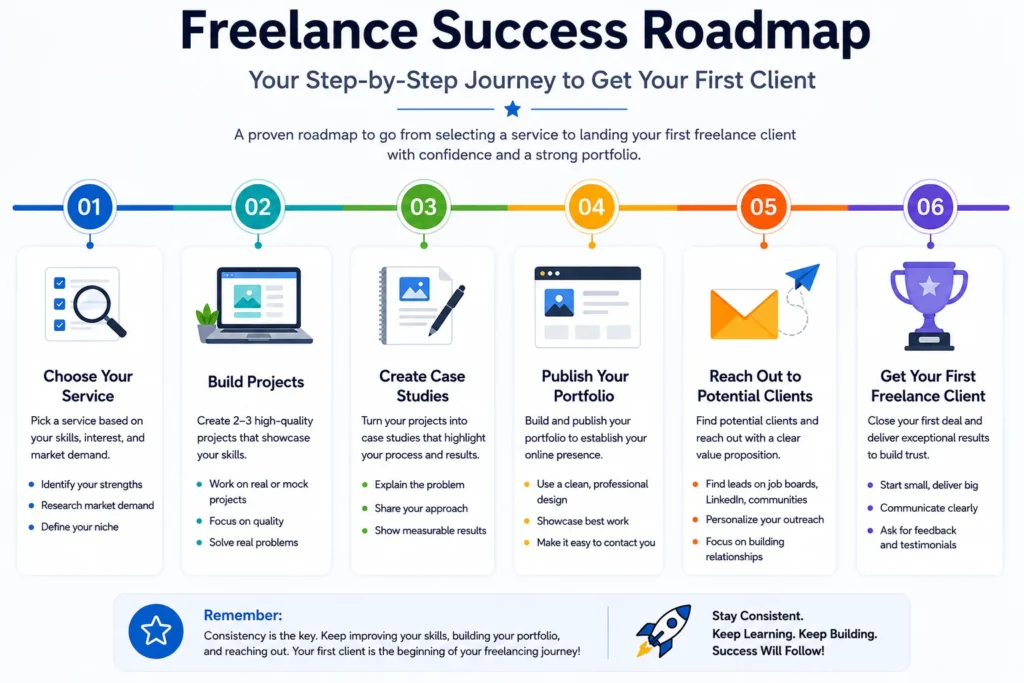
A realistic timeline helps prevent overthinking.
Days 1–10
Choose:
- One service
- One target audience
- One positioning angle
Days 11–25
Create:
- Project #1
- Project #2
- Project #3
Document your process.
Days 26–40
Convert projects into case studies.
Improve presentation and organization.
Days 41–50
Publish your portfolio.
Update LinkedIn.
Prepare outreach materials.
Days 51–60
Begin:
- Networking
- Proposals
- Outreach
- Portfolio promotion
By Day 60, your AI freelancing portfolio should be live and actively supporting outreach efforts.
At this stage, the objective is learning which messages and projects generate interest.
How I’d Make My First $1000 With AI Freelancing in 30 Days
Frequently Asked Questions
Can I build an AI freelancing portfolio without paid clients?
Yes. Demonstration projects, personal projects, volunteer work, and mock assignments can all be used to showcase your abilities.
What is the best portfolio platform for beginners?
Notion is usually the easiest starting point because it is free, flexible, and simple to update.
How many projects should I include?
Most beginners only need four to six strong projects.
Should I disclose that projects are samples?
Yes. Transparency builds trust and credibility.
How long does it take to build an AI freelancing portfolio?
Many beginners can create a functional portfolio within 30–60 days while learning and improving their skills.
Final Thoughts
The strongest portfolios are rarely the most complicated.
They are the clearest. The purpose of an AI freelancing portfolio is not to impress everyone. A well-structured AI freelancing portfolio can often create opportunities long before you gain extensive client experience.
A visitor should be able to understand what you do, who you help, and how you create value within a few minutes.
That level of clarity matters far more than advanced design, expensive software, or a large collection of projects.
If there is one lesson worth remembering, it is this:
A portfolio is not a collection of files.
It is a collection of evidence.
The sooner you begin creating that evidence, the sooner potential clients can evaluate your work instead of your claims.
Start small.
Build one useful project.
Document the process.
Then repeat.
Experience often follows proof—not the other way around.
For your next step, read:
- Start AI Freelancing With No Experience in 2026
- Best AI Freelance Services to Offer in 2026
- How to Get Your First AI Freelance Client in 2026
- How to Close Your First AI Freelance Client in 2026
- How I’d Make My First $1000 With AI Freelancing in 30 Days
About the Author
Omar Yousaf
Founder of Digital Solo Hub
I help beginners develop practical AI freelancing skills, build proof of work, and create sustainable income opportunities through focused execution rather than endless learning.