
By Omar Yousaf, Founder of Digital Solo Hub
AI freelancing rates for beginners are one of the most confusing parts of starting an AI freelance business in 2026. Most new freelancers struggle to decide what they should charge because online advice varies widely.
One of the first questions every new AI freelancer asks is surprisingly difficult to answer:
“What should I charge?”
Search online and you’ll find hourly rates ranging from $5 to over $200. Some creators recommend charging premium prices immediately, while others encourage beginners to work almost for free to build experience.
Neither approach tells the full story.
In reality, pricing is not just about choosing a number. It is a business decision that affects the types of clients you attract, the projects you win, your confidence during negotiations, and ultimately how quickly your freelancing business grows.
Price yourself too low, and clients may assume your work lacks value. Price yourself too high without sufficient proof, and many prospects will simply move on to someone else.
The goal is not to become the cheapest freelancer or the most expensive one. The goal is to choose a price that reflects your current level of experience while leaving room to increase your rates as your portfolio and reputation improve.
This guide explains a practical pricing framework specifically designed for beginners entering AI freelancing in 2026. Instead of copying random rates from YouTube videos or Reddit discussions, you’ll learn how to calculate prices based on your skills, market demand, project complexity, and long-term positioning.
Whether you plan to offer AI content writing, AI automation, AI research, AI video editing, or other AI-powered services, the principles in this guide will help you build pricing that is both competitive and sustainable.
Key Takeaways
- Pricing is a positioning strategy, not just a number.
- Beginners should compete through value and professionalism—not by offering the lowest rates.
- Fixed project pricing is usually easier than hourly billing when you’re starting.
- Your first prices should evolve as your portfolio and client results grow.
- Strong proposals and clear deliverables often justify higher prices than experience alone.
- Avoid copying other freelancers’ prices without understanding what those prices include.
- Review your pricing every 3–5 completed projects instead of keeping the same rates indefinitely.
If you’re still building your foundation, read Start AI Freelancing With No Experience in 2026 before deciding how much to charge. Likewise, a strong portfolio makes pricing conversations much easier, so you should also read How to Build a Strong AI Freelancing Portfolio With No Experience in 2026.
Why Pricing Has Become More Difficult in 2026
AI tools have dramatically lowered the barrier to entry for freelancers.
Creating blog drafts, social media content, marketing research, and workflow automations now takes less time than it did only a few years ago. As a result, clients know AI can speed up production, and many expect freelancers to charge less simply because AI is involved.
This creates a misunderstanding that hurts both freelancers and clients.
Clients are not paying for access to ChatGPT, Claude, Gemini, or other AI tools. They are paying for someone who knows how to transform those tools into useful business outcomes.
That difference matters.
Two freelancers may use the same AI platform, yet deliver completely different results because one understands strategy, editing, quality control, SEO, or automation while the other simply copies AI-generated output.
Your pricing should reflect the value of your complete process—not just the software you use.

The Current Market Reality
The AI freelancing market in 2026 is more competitive than it was a year ago, but it is also significantly larger.
Businesses are no longer asking whether they should adopt AI. They are asking who can help them implement it effectively.
That means the market now rewards freelancers who can demonstrate three things:
- A clearly defined service.
- Reliable execution.
- Professional communication.
Notice that none of these require years of experience.
For beginners, this is encouraging because pricing depends as much on trust and positioning as it does on employment history.
Contrarian Insight: Stop Trying to Be the Cheapest Freelancer
Many beginners believe charging the lowest prices will help them win their first clients faster.
In practice, extremely low pricing often attracts clients who negotiate aggressively, request additional work without increasing the budget, and rarely become long-term customers.
Reasonable beginner pricing sends a different message.
It tells clients that you understand your value while recognising you’re still building experience.
Professional buyers generally compare freelancers using three questions:
- Can this person solve my problem?
- Can I trust them?
- Does the price make sense for the expected outcome?
Being the cheapest rarely answers any of those questions.
The Four Factors That Should Determine Your Pricing
Instead of copying someone else’s rates, evaluate every project using four variables.
1. Your Current Skill Level
Beginners should be honest about where they are.
If you’re still learning prompts, workflows, or editing, your prices should reflect that.
However, “beginner” does not automatically mean “cheap.”
Someone with a well-organised portfolio, clear communication, and professional case studies often deserves to charge more than someone with years of experience but poor presentation.
This is one reason building a portfolio before chasing clients is such an important step.
2. Business Value
Ask yourself a better question than:
“How long will this take?”
Instead ask:
“How valuable will this be to the client?”
A landing page that helps generate leads is worth more than a simple blog draft.
An AI automation that saves a company five hours every week has greater business value than a basic spreadsheet cleanup.
Your prices should gradually move toward value rather than hours worked.
3. Market Demand
Some AI freelance services consistently command higher prices because businesses see a direct financial return.
Examples include:
- AI workflow automation
- Lead generation systems
- SEO content strategy
- Marketing copywriting
- Sales email sequences
Meanwhile, services that are easy to replace or heavily commoditised often face stronger price competition.
Choosing the right niche has a direct impact on your AI freelancing rates. Specialists can usually justify higher prices than generalists because they solve more specific business problems and communicate their value more clearly.
Related Guide: Learn how choosing the right specialization can improve your pricing power in Most AI Freelancers Choose the Wrong Niche in 2026.
4. Proof of Work
Clients are buying confidence.
Your portfolio, proposal, testimonials (when available), communication style, and project explanations all reduce the client’s perceived risk.
The stronger your proof, the less pressure you face to compete on price.
This explains why two freelancers offering the same service can charge very different rates while still winning clients.
A Simple Pricing Framework for Beginners
Most beginners overcomplicate pricing.
Instead of using dozens of formulas, start with this framework.
Foundation → Proof → Confidence → Higher Pricing
- Learn one service.
- Build portfolio projects.
- Win initial clients.
- Collect testimonials.
- Increase rates gradually.

Each stage supports the next.
Trying to skip directly to premium pricing usually creates unnecessary friction.
In the next section, we’ll translate this framework into practical pricing ranges for different AI freelance services, compare hourly versus project-based pricing, and show exactly how beginners can increase their rates without losing quality clients.
AI Freelancing Rates for Beginners in 2026
Understanding the framework is one thing. Applying it to real projects is another.
The following pricing ranges are not universal rules. They are realistic starting points based on common beginner projects, moderate competition, and clients who understand they are hiring someone with a growing portfolio rather than an established agency.
As your experience, portfolio, testimonials, and efficiency improve, your rates should increase accordingly.
| Service | Beginner Range | Intermediate | Advanced |
|---|---|---|---|
| SEO Blog Article (2,000 words) | $80–$180 | $100–$250 | $250–$600+ |
| Landing Page Copy | $120–$280 | $150–$400 | $400–$1,000+ |
| Email Sequence (5 emails) | $100–$250 | $120–$300 | $300–$800+ |
| AI Research Report | $90–$200 | $100–$250 | $250–$700+ |
| Social Media Content (30 days) | $150–$350 | $200–$500 | $500–$1,200+ |
| Short-Form Video Package | $150–$400 | $250–$600 | $600–$1,500+ |
| AI Workflow Automation | $250–$650 | $400–$1,000 | $1,000–$5,000+ |
These figures are intended as practical reference points rather than guarantees. Pricing ultimately depends on your niche, target market, complexity of work, and the value you create.
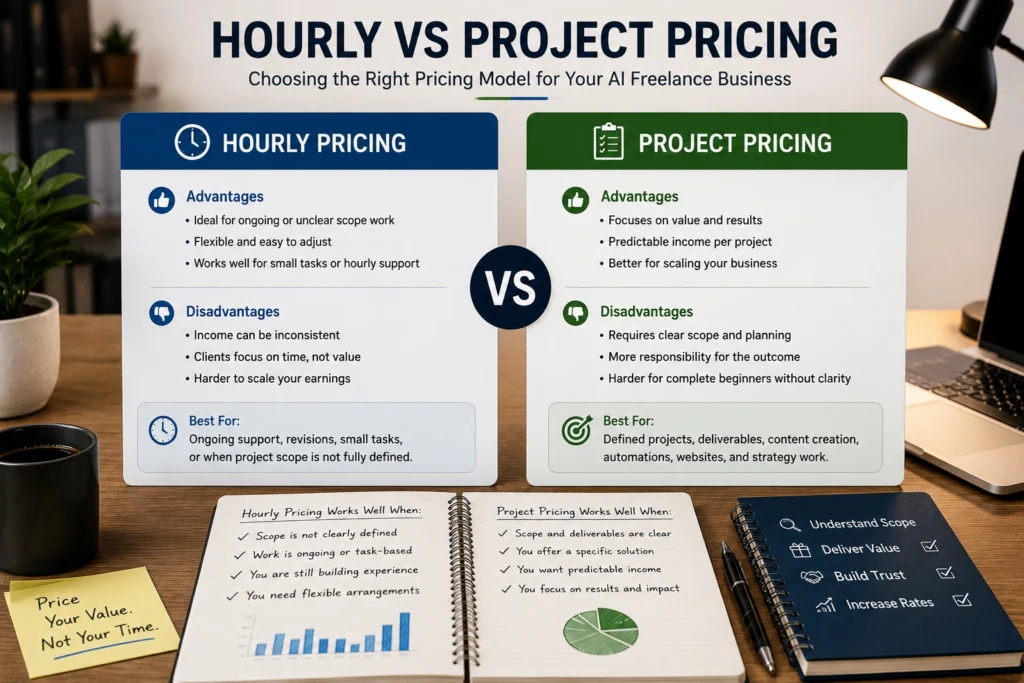
Hourly vs Project Pricing
One of the first decisions every freelancer makes is whether to charge by the hour or by the project.
For beginners, project pricing usually works better.
Before deciding on your AI freelancing rates, it helps to understand how established freelance marketplaces approach pricing and project scopes. Reviewing industry guidance from Upwork’s freelance resources can give you additional context on common pricing models, client expectations, and project structures without simply copying someone else’s rates.
Hourly Pricing
Advantages:
- Easy to calculate.
- Suitable when project scope is uncertain.
- Common on some freelance platforms.
Disadvantages:
- Clients often focus on time instead of results.
- AI allows many tasks to be completed faster, making hourly billing less attractive.
- Every efficiency improvement reduces your income unless you increase your hourly rate.
Project Pricing
Advantages:
- Clients buy outcomes instead of hours.
- Easier to communicate value.
- Income becomes less dependent on time spent.
Disadvantages:
- Requires clearly defined deliverables.
- Scope creep must be managed carefully.
For most AI freelancers in 2026, project pricing creates better long-term positioning.
Quick-Win Method: Use Three Pricing Packages
Instead of quoting a single number, offer three options.
Starter
Suitable for smaller businesses or first-time clients.
Professional
The package you expect most clients to choose.
Premium
Includes additional revisions, strategy, or implementation support.
Example:
AI Blog Writing
- Starter — One article
- Professional — Four articles + optimization
- Premium — Monthly content strategy + articles + updates
Three-package pricing gives clients a sense of choice while naturally positioning your middle package as the best value.
Realistic Monthly Income Scenarios
Pricing often feels abstract until you translate it into monthly income.
Scenario 1: Part-Time Beginner
- 5 projects/month
- Average project value: $80
Monthly income:
$400
Scenario 2: Consistent Beginner
- 10 projects/month
- Average project value: $150
Monthly income:
$1,500
Scenario 3: Growing Specialist
- 8 projects/month
- Average project value: $300
Monthly income:
$2,400
Notice that income growth usually comes from increasing average project value rather than dramatically increasing workload.
Hard Truth
Many beginners believe they need higher prices to earn more.
In reality, they often need better positioning.
If clients don’t understand your value, doubling your prices rarely doubles your income.
Improving your portfolio, proposals, communication, and niche positioning usually has a greater impact than simply changing your pricing.
When Should You Increase Your Rates?
Pricing should evolve.
Consider increasing your rates when:
- You’ve completed 3–5 successful projects.
- Clients consistently accept your proposals without negotiating.
- You’re receiving repeat work.
- Your schedule is becoming full.
- Your portfolio demonstrates stronger results than when you started.
Small, regular increases are generally easier than making one dramatic jump.
Common Pricing Mistakes
Charging Too Little
Extremely low prices often attract clients who focus primarily on cost.
Copying Someone Else’s Rates
Every freelancer has different skills, experience, expenses, and target markets.
Use competitor pricing as research—not as instructions.
Quoting Before Understanding the Project
Always understand:
- Scope
- Deliverables
- Timeline
- Revision expectations
before discussing pricing.
Ignoring Revisions
State revision limits clearly.
Unlimited revisions can quickly turn profitable work into unpaid work.
Forgetting to Raise Prices
Many freelancers continue charging beginner rates long after they’ve outgrown them.
Review your pricing regularly.
30–60 Day Pricing Action Plan
Days 1–10
- Choose one AI freelance service.
- Research competitors.
- Define three pricing packages.
Internal Link Opportunity: Best AI Freelance Services to Offer in 2026
Days 11–20
Build 3–5 portfolio projects.
Document each project as a professional case study. A strong portfolio gives you the confidence to justify your AI freelancing rates and helps clients understand the value behind your pricing.
Related Guide: How to Build a Strong AI Freelancing Portfolio With No Experience in 2026
Days 21–30
Create proposal templates.
Practice explaining your AI freelancing rates confidently. A well-written proposal should explain not only your price but also the business value your services provide.
Related Guide: AI Freelance Proposal Templates 2026
Days 31–45
Start applying for projects using pricing that reflects your current experience and portfolio. Testing your AI freelancing rates with real clients will help you refine your pricing strategy over time.
Record:
- Proposal acceptance rate
- Client feedback
- Questions clients ask about pricing
Related Guide: How to Get Your First AI Freelance Client in 2026
Days 46–60
Review your first completed projects.
If clients consistently accept your prices, consider a modest increase for future work.
Growth comes from gradual refinement rather than sudden changes.
Frequently Asked Questions
How much should a beginner charge for AI freelancing?
Most beginners can start by charging rates that reflect their portfolio quality, service complexity, and target market rather than simply their lack of experience. Fixed project pricing often works better than competing solely on hourly rates.
Should I charge hourly or per project?
Project pricing is generally more effective because clients focus on outcomes instead of time.
Can I increase my prices after getting clients?
Yes.
Many freelancers review and adjust pricing after every few successful projects or whenever demand begins exceeding available time.
What if clients say my prices are too high?
That feedback doesn’t automatically mean your pricing is wrong.
It may indicate:
- Poor positioning.
- Weak portfolio.
- Wrong target market.
- Insufficient explanation of value.
Should I work for free?
Free work should be the exception rather than the strategy.
Creating your own portfolio projects usually provides stronger long-term value than relying on unpaid client work.
Final Thoughts
Pricing is often treated as a simple question of numbers.
It isn’t.
It reflects how you position yourself in the market, the confidence you communicate, and the value clients expect to receive.
The strongest beginner freelancers rarely win because they charge the least.
They win because they present themselves professionally, define clear services, communicate confidently, and provide evidence that they can solve real business problems.
Your first pricing structure doesn’t need to be perfect.
It needs to be practical enough to help you start.
As your portfolio improves, your proposals become stronger, and your reputation grows, your prices should evolve alongside your business.
Treat pricing as an ongoing process rather than a one-time decision.
That mindset will serve you much better over the long term than chasing arbitrary hourly rates.
Your pricing strategy is only one part of building a successful freelance business. Once you’ve established your rates, the next challenge is winning clients and increasing your income over time. If you’re ready for the next step, explore How to Close Your First AI Freelance Client in 2026 and How I’d Make My First $1,000 With AI Freelancing in 30 Days.
About the Author
Omar Yousaf
Founder of Digital Solo Hub
I help beginners build practical AI freelancing skills through structured learning, portfolio development, and realistic business strategies. My focus is on helping new freelancers create sustainable income by combining AI tools with professional execution rather than shortcuts or unrealistic promises.