Learning how to scale an AI freelancing business is one of the biggest challenges freelancers face after landing their first few clients.
Landing clients feels like progress—until you realize you’re constantly starting from zero every month.
Scaling from $1K to $10K+ per month requires a different mindset. Instead of chasing new projects, successful freelancers build systems, strengthen client relationships, introduce retainers, and increase the value of every project they deliver.
This guide explains the practical strategies that actually work in 2026.
How to Scale an AI Freelancing Business Without Burning Out
Most freelancers believe that earning more means working more hours.
That’s the trap.
As workload increases, quality drops, deadlines get missed, and client acquisition becomes impossible because you have no time left. The biggest obstacle isn’t competition or AI tools — it’s the lack of a scalable system.
As your workload increases, deadlines become tighter, communication suffers, and finding new clients becomes even more difficult because every available hour is already committed to existing projects.
Eventually, growth stops.
The biggest obstacle isn’t competition.
It is the absence of a scalable business model.
Most freelancers remain trapped because they:
- Depend entirely on one-off projects.
- Charge based on time instead of business value.
- Constantly search for new clients instead of keeping existing ones.
- Accept almost every opportunity without specializing.
- Build no repeatable systems for delivering work.
Individually, none of these mistakes seem serious.
Combined, they create a business that can never grow beyond the freelancer’s personal capacity.
Scaling begins when your business becomes repeatable.
That means creating processes that improve efficiency, increasing the average value of every client, and building relationships that continue generating work long after the first project is completed.
This is why experienced freelancers often spend less time chasing clients and more time improving the systems that support their business.
If you’re still relying entirely on new projects every month, learning Why Most AI Freelancers Never Get Repeat Clients in 2026 can help you build recurring relationships before focusing on larger revenue goals.
The Three Stages of Scaling an AI Freelancing Business
Most successful AI freelancers don’t jump from their first project to earning five figures per month.
Growth usually happens in predictable stages.
Understanding where you are helps you focus on the right priorities instead of comparing yourself to freelancers who are solving completely different challenges.
Stage 1: Survival ($0–$1K/Month)
Goal: Prove people will pay you.
At this stage, your objective isn’t maximizing income—it’s building credibility. Focus on choosing one profitable AI freelance service, creating strong portfolio samples, landing your first three to five clients, and collecting testimonials. Every completed project improves your skills, confidence, and reputation while laying the foundation for future growth.
Stage 2: Stability ($1K–$5K/Month)
Goal: Create predictable income.
Once you’re getting clients consistently, the focus shifts from simply finding work to building a more reliable business. Gradually raise your prices, introduce monthly retainers, standardize your delivery process, and strengthen relationships with existing clients. Predictable systems and repeat business become far more valuable than constantly chasing new projects.
Stage 3: Scale ($5K–$10K+/Month)
Goal: Deliver greater value with fewer clients.
Scaling isn’t about working longer hours—it’s about increasing the value you provide. Focus on offering complete business solutions instead of individual tasks, positioning yourself as a strategic partner, and outsourcing repetitive work where appropriate. At this stage, stronger systems, higher-ticket projects, and long-term client relationships become the primary drivers of growth.

Build Systems Before You Need Them
One of the biggest differences between a freelancer earning $1,000 per month and one consistently earning $10,000 per month isn’t talent.
It’s systems.
Many freelancers only think about improving their workflow after becoming overwhelmed with client work. By then, projects are delayed, communication becomes inconsistent, and growth begins slowing down.
Understanding how to scale an AI freelancing business starts with building simple systems early.
Every process that repeats should eventually become standardized.
This doesn’t mean creating complicated documentation or buying expensive software.
It means reducing unnecessary decisions so you can spend more time solving client problems.
Start by creating a repeatable workflow for every project.
For example:
- Initial client inquiry
- Discovery call
- Proposal
- Project onboarding
- Research
- AI-assisted workflow
- Quality review
- Client delivery
- Feedback and revisions
- Follow-up
When every project follows the same structure, mistakes become less common and delivery becomes more consistent.
Building repeatable systems is a common characteristic of growing businesses, not just freelance operations. The U.S. Small Business Administration’s guidance on managing business growth explains why documented processes and efficient operations become increasingly important as a business expands.
Clients notice professionalism long before they notice advanced technical skills. Professional systems don’t just improve delivery—they make your business easier to scale as your client workload grows.
Standardize Your Client Onboarding
Many freelancers begin working immediately after receiving payment.
Professional freelancers begin with onboarding.
A simple onboarding process prevents misunderstandings later.
Before starting any project, confirm:
- Business goals
- Target audience
- Deliverables
- Deadlines
- Communication preferences
- Required files and access
- Revision policy
This simple checklist often eliminates the majority of future problems.
Strong onboarding also makes clients feel confident that they’re working with someone organized rather than someone improvising throughout the project.
If you’re still refining your proposal process, AI Freelance Proposal Templates 2026 explains how to create professional proposals that naturally lead into a structured onboarding experience.
Create Templates for Repetitive Tasks
Not every project should begin from scratch.
Templates allow you to deliver consistent quality while reducing delivery time.
Useful templates include:
- Discovery questionnaires
- Proposal documents
- Client welcome messages
- Project checklists
- Delivery reports
- Follow-up emails
- Testimonial requests
These templates don’t replace personalized communication.
They simply remove repetitive work so you can focus on strategy and execution.
Saving even fifteen minutes on every project compounds significantly over dozens of clients.
Keep Communication Predictable
Clients rarely become frustrated because work takes time.
They become frustrated when they don’t know what’s happening.
Consistent communication builds confidence.
Even short progress updates reassure clients that the project is moving forward.
A simple message such as:
“Research is complete. I’m now finalizing the first draft and expect delivery tomorrow afternoon.”
often prevents unnecessary follow-up messages and strengthens trust.
Professional communication is one of the easiest competitive advantages because many freelancers simply disappear until delivery day.
Monthly Retainers Change Everything
Many freelancers believe scaling requires constantly finding bigger projects.
In reality, predictable income usually comes from serving the same clients repeatedly.
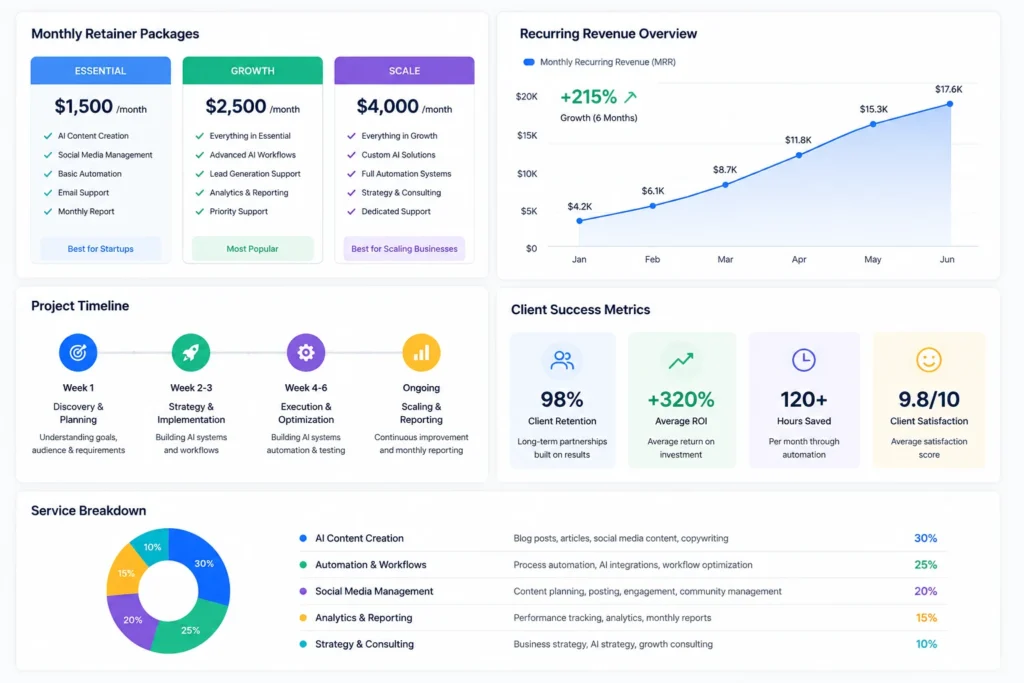
If you’re wondering how to scale an AI freelancing business, retainers are often the biggest turning point because they create predictable monthly income.
Instead of completing one project and starting the sales process again, a retainer creates ongoing collaboration.
The client benefits from continuous support.
You benefit from predictable revenue.
This reduces one of the biggest challenges in freelancing:
Starting every month at zero.
Retainers are much easier to introduce after you’ve successfully completed an initial project and earned your client’s trust. Learn the complete client-closing process in How to Close Your First AI Freelance Client in 2026.
What Makes a Good Retainer?
A successful retainer solves an ongoing business problem.
For example:
SEO Content
- Four optimized blog articles every month
- Content updates
- Internal linking improvements
- Performance reviews
Social Media
- Monthly content calendar
- Weekly post creation
- Caption writing
- Performance analysis
AI Research
- Competitor monitoring
- Industry trend reports
- Monthly research summaries
Workflow Automation
- Automation monitoring
- Process improvements
- New integrations
- Performance optimization
Notice that every service continues creating value after the first month.
That’s why businesses continue paying.
Introduce Retainers Naturally
Many beginners make one mistake.
They try selling retainers before proving their value.
A much better approach is introducing ongoing support after successfully completing the first project.
For example:
“Now that we’ve completed your website content, the next logical step is keeping it updated with fresh articles every month to maintain search visibility.”
This feels like helpful business advice rather than a sales pitch.
Clients are much more likely to accept recurring services when they clearly understand the long-term benefit.
Raise Value Before Raising Prices
Many freelancers immediately ask,
“When should I increase my rates?”
A better question is,
“How can I create more value?”
Higher pricing becomes much easier when clients clearly understand the business results you’re delivering.
Instead of simply completing tasks, demonstrate outcomes.
Show improvements.
Share insights.
Recommend additional opportunities.
Businesses rarely object to paying more when they believe your work contributes directly to their growth.
Clients are usually paying for business outcomes, not the number of hours you spend producing them.
If you’re unsure how to structure your pricing professionally, AI Freelancing Rates for Beginners in 2026 explains practical pricing strategies that support long-term business growth.
Stop Selling Tasks—Start Selling Outcomes
One of the biggest mindset shifts happens when freelancers stop describing what they do and start explaining what they achieve.
Compare these examples.
Instead of saying:
“I write AI-generated blog articles.”
Say:
“I help businesses publish SEO content that attracts qualified organic traffic.”
Instead of saying:
“I build AI automations.”
Say:
“I help businesses reduce repetitive work and improve operational efficiency.”
The service hasn’t changed.
The perceived value has.
Businesses rarely purchase tasks.
They invest in outcomes that help them save time, generate revenue, or solve expensive problems.
The more clearly you communicate those outcomes, the easier it becomes to attract higher-quality clients and larger projects.
As your positioning improves, increasing your rates no longer feels like charging more for the same work.
It becomes charging appropriately for greater business value.
Scale Without Working More Hours
One of the biggest misconceptions about freelancing is that higher income always requires longer working hours.
That approach may work temporarily, but it eventually creates a ceiling.
Every freelancer has a limited number of hours available each week.
If your income depends entirely on your personal time, growth eventually stops.
Learning how to scale an AI freelancing business isn’t about working longer hours—it’s about improving efficiency.
Instead of working harder, they improve efficiency.
They eliminate repetitive tasks, simplify workflows, and focus their time on activities that create the greatest value for clients.
Artificial intelligence plays an important role in this process, but AI alone isn’t enough.
The real advantage comes from combining AI with well-designed systems.
For example:
- Reuse proposal templates instead of writing every proposal from scratch.
- Create standard operating procedures (SOPs) for recurring tasks.
- Build reusable content frameworks.
- Maintain organized client folders.
- Automate repetitive administrative work whenever possible.
Small improvements may only save a few minutes per project, but over dozens of projects those savings become significant.
Freelancers who scale successfully don’t simply complete more work.They deliver the same quality in less time while creating a better experience for every client.Scaling becomes much easier when you’ve already built a profitable foundation. If you’re still working toward consistent monthly income, read How to Make Money with ChatGPT in 2026 ($1000/Month Beginner Guide) to explore additional AI-powered income opportunities that complement your freelancing business.
If you’re looking for practical software that supports this workflow, AI Tools Freelancers Are Actually Using in 2026 compares the tools that genuinely improve productivity instead of adding unnecessary complexity.
Know When to Delegate
Knowing how to scale an AI freelancing business also means knowing when to delegate repetitive work.
It simply means recognizing that not every task requires your personal attention.
As your workload grows, certain activities begin producing very little value compared to the time they consume.
Examples include:
- Formatting documents
- Basic research
- Image preparation
- Administrative work
- Data entry
- Simple editing
Delegating these tasks allows you to spend more time on strategy, client communication, and higher-value services.
However, one principle should always remain.
Never outsource responsibility.
Delegate repetitive execution, but keep strategy, quality control, and client communication under your direct supervision.
Clients hired you because they trust your expertise.
Even when another freelancer assists with production, quality control should always remain your responsibility.
The goal isn’t replacing yourself.
The goal is protecting your time for the work that creates the greatest business impact.
Common Mistakes That Prevent Freelancers From Scaling
Many freelancers work incredibly hard without making meaningful progress.
In most cases, the problem isn’t effort.
It’s direction.
Avoid these common mistakes.
Taking Every Client
Not every project deserves your time.
Poor-fit clients often require more revisions, create unnecessary stress, and prevent you from accepting better opportunities.
Learning to decline the wrong projects is an important part of long-term growth.
Underpricing to Stay Busy
Many freelancers believe lower prices create more opportunities.
Sometimes they do.
Unfortunately, they also attract clients who focus primarily on cost rather than value.
A smaller number of higher-quality clients often produces better income than constantly managing dozens of low-paying projects.
Constantly Changing Direction
Every few weeks, many freelancers switch services, niches, or platforms because another opportunity appears more exciting.
This resets progress repeatedly.
Specialization creates authority.
If you’re still unsure which specialization offers the best long-term opportunities, read Most AI Freelancers Choose the Wrong Niche in 2026 — Here’s What Actually Works before switching directions again.
Authority attracts better clients.
Consistency usually produces better long-term results than constantly chasing new trends.
Ignoring Existing Clients
Finding new clients will always matter.
Keeping existing clients often matters even more.
Satisfied clients frequently become your best source of repeat work, referrals, and long-term revenue.
Building strong client relationships is usually far more profitable than constantly replacing them.
Waiting Until Everything Is Perfect
Many freelancers delay raising prices, improving systems, or offering retainers because they feel they need more experience.
Growth rarely happens after you feel completely ready.
It happens because you continuously improve while working with real clients.
A Realistic Roadmap to $10K+/Month
One of the biggest mistakes beginners make is expecting dramatic income growth within a few months.
While rapid success is possible, it shouldn’t become your expectation.
Most sustainable freelance businesses grow gradually.
A realistic progression often looks like this.
| Stage | Primary Goal |
|---|---|
| Months 1–3 | Build a portfolio, land first clients, improve delivery |
| Months 4–6 | Increase pricing, improve systems, gain repeat clients |
| Months 7–12 | Introduce retainers, specialize, increase project value |
| Year 2+ | Focus on higher-ticket projects, delegation, and long-term business growth |
Every freelancer learns how to scale an AI freelancing business at a different pace, depending on their niche, systems, and consistency.
Your niche, experience, communication skills, and consistency all influence the timeline.
The objective isn’t reaching a specific monthly income as quickly as possible.
The objective is building a business capable of producing reliable income for years.
Frequently Asked Questions
Can beginners scale an AI freelancing business?
Yes.
Most successful freelancers begin with simple services before gradually improving their systems, pricing, and client relationships. Scaling becomes much easier after building a strong foundation.
When should I raise my freelance rates?
Increase your rates when you consistently deliver measurable value, receive positive client feedback, and have enough demand that replacing lower-paying projects becomes possible.
Do I need a team to reach $10,000 per month?
Not necessarily.
Many freelancers reach this level by specializing, increasing project value, improving efficiency, and building recurring revenue before hiring additional help.
Should I focus on getting more clients or better clients?
Better clients usually produce faster growth.
Higher-value clients often require fewer projects to achieve the same income while creating better long-term opportunities.
Are monthly retainers better than one-off projects?
For most freelancers, yes.
Retainers create predictable revenue, strengthen client relationships, and reduce the constant pressure of finding new work every month.
Final Thoughts
Scaling an AI freelancing business isn’t about working harder—it’s about building a business that becomes more valuable over time. Better systems, stronger client relationships, recurring revenue, and higher-value services create sustainable growth long after individual projects are finished.
If your long-term goal extends beyond solo freelancing, explore Starting an AI Automation Agency in 2026 to learn how experienced freelancers gradually build scalable systems, expand their services, and transition toward an agency model.