
By Omar Yousaf, Founder of Digital Solo Hub
Landing your first AI freelance client feels like a breakthrough.
But many beginners quickly face a harder problem: the project ends, the client disappears, and the endless search for the next one begins again.
This cycle is why most AI freelancers never build consistent income.
The real issue is rarely bad work — it’s the lack of a client retention system.
The problem is rarely the quality of their work.
More often, it is the absence of a client retention system.
Successful freelancers understand something that most beginners overlook.
The first project is not the finish line.
It is the beginning of a professional relationship.
Every satisfied client represents more than a single payment. They can become a recurring customer, recommend your services to other businesses, provide testimonials that strengthen your credibility, and create opportunities that would otherwise require weeks of prospecting.
This is particularly important in AI freelancing.
Businesses adopting AI rarely need help only once. Whether they require SEO content, workflow automation, marketing assets, research, or social media management, their needs continue long after the first project is completed.
Freelancers who recognize these ongoing needs position themselves differently.
Instead of treating every project as a one-time transaction, they build systems that naturally lead clients toward repeat work, monthly retainers, and long-term collaboration.
That approach creates a business that grows through relationships rather than constant client hunting.
If you are still working toward your first project, begin with Start AI Freelancing With No Experience in 2026 before learning how to retain long-term clients. Once you begin working with clients, the strategies below will help you transform one successful project into predictable recurring income.

What Is the Best Way to Get Repeat AI Freelance Clients?
The most effective way to get repeat AI freelance clients is to consistently deliver measurable business value, communicate proactively, and create clear opportunities for ongoing collaboration after every project.
Rather than ending the relationship when a project is complete, successful freelancers introduce logical next steps, maintenance services, or monthly retainers that continue solving business problems over time.
Repeat clients are built through trust, reliability, and long-term value—not aggressive selling. In this guide, you’ll learn a practical 4-stage system to turn one-off projects into repeat business and monthly retainers.
Why Repeat Clients Matter More Than Finding New Ones
Many beginners believe freelance success depends on constantly finding new clients.
While new client acquisition is essential in the early stages, it should never become the foundation of a sustainable freelance business.
Every new client requires time. Before worrying about repeat business, you first need a reliable way to win your first client. This guide on How to Get Your First AI Freelance Client in 2026 explains the complete process.
You need to identify opportunities, write proposals, attend discovery calls, answer questions, negotiate pricing, and build trust before work even begins.
Only then do you start earning.
Existing clients eliminate much of this process.
They already understand your communication style.
They already know the quality of your work.
More importantly, they already trust you.
Trust is one of the most valuable assets in freelancing because it reduces uncertainty for both sides.
Businesses generally prefer working with someone they already know rather than taking a risk on an unknown freelancer.
This principle extends beyond freelancing. According to Harvard Business Review, retaining existing customers often creates greater long-term value than constantly acquiring new ones, making strong client relationships one of the most valuable assets any business can build.
This makes repeat business one of the most efficient ways to increase freelance income without dramatically increasing marketing effort.
The difference becomes even more noticeable over time.
A freelancer who completes ten unrelated one-time projects every month must continuously replace those ten clients.
Another freelancer who retains six of those clients on monthly agreements only needs to find four new opportunities.
Both may earn similar income initially.
Over time, however, the second freelancer spends less time selling and more time delivering valuable work.
That creates stability.
It also creates room to improve workflows, increase pricing, and build stronger client relationships.
This shift explains why experienced freelancers often prioritize retention before aggressive client acquisition.
Growing a freelance business is not simply about getting hired more often.
It is about getting rehired.
One-Time Clients vs Long-Term Clients
| One-Time Project Mindset | Long-Term Client Mindset |
|---|---|
| Focus on completing one task | Focus on solving ongoing business problems |
| Ends communication after delivery | Continues communication after delivery |
| Searches for new clients constantly | Builds recurring income from existing clients |
| Competes on price | Competes on trust, reliability, and results |
| Income resets every month | Income becomes more predictable over time |
The second approach requires more patience initially, but it usually produces a much stronger freelance business over the long term.
Why Most AI Freelancers Never Get Hired Twice
Losing a client after one project is not always a sign of poor work.
Sometimes the client simply has no immediate need for additional services.
However, many freelancers unintentionally reduce their chances of being hired again by making avoidable mistakes throughout the client relationship.
One of the most common problems is treating the project as a transaction rather than the beginning of a partnership.
Communication often declines once the initial agreement is signed.
Updates become inconsistent, expectations remain unclear, and the final delivery arrives with little discussion about future opportunities.
From the client’s perspective, the relationship simply ends.
Another common issue is focusing entirely on completing the requested task without considering the client’s broader business goals.
For example, a freelancer delivering AI-assisted blog articles may never mention opportunities to improve internal linking, refresh existing content, or expand into email marketing.
An automation specialist might complete one workflow but fail to identify additional repetitive processes that could also be automated.
The freelancer finishes the assignment successfully but misses the opportunity to demonstrate ongoing value.
Many of these problems actually begin much earlier when freelancers choose the wrong niche or offer services that businesses rarely need. If you’re still deciding where to specialize, read Most AI Freelancers Choose the Wrong Niche in 2026.
Clients remember more than technical ability.
They remember whether deadlines were respected, whether questions were answered promptly, whether revisions were handled professionally, and whether working together felt easy.
These factors often determine whether a business chooses to return.
Finally, many freelancers never ask themselves an important question before delivering the final project.
“What logical problem can I solve for this client next?”
Without answering that question, every completed project becomes an ending.
Successful freelancers think differently.
Every completed project becomes the beginning of the next opportunity.
That simple shift in perspective often separates freelancers who constantly search for new work from those who build businesses supported by recurring clients and long-term professional relationships.
The 4-Part AI Freelance Client Retention Framework
Many freelancers believe repeat clients happen naturally.
They don’t.
Long-term client relationships are usually the result of a deliberate system rather than luck.
Successful freelancers rarely wait for clients to come back on their own. Instead, they guide every project toward a logical next step that continues delivering value for the business.
This process can be simplified into four practical stages.
- Deliver an exceptional first project.
- Build trust throughout the engagement.
- Create natural opportunities for additional work.
- Make it easy for the client to continue working with you.
None of these stages require aggressive selling.
In fact, the opposite is true.
Businesses are far more likely to continue working with freelancers who consistently solve problems than with freelancers who constantly try to sell new services.
Every completed project should feel like the beginning of the next opportunity.
Stage 1: Deliver an Exceptional First Project
The first project determines whether the client sees you as a temporary freelancer or a long-term business partner.
Many beginners assume delivering exactly what the client requested is enough.
Usually, it isn’t.
Clients remember experiences.
If the project feels organized, professional, and stress-free, they become much more comfortable hiring you again.
That doesn’t mean working excessive unpaid hours or adding unnecessary extras.
It means delivering work that exceeds expectations in professionalism rather than quantity.
The first impression begins before any work starts.
Clarify expectations.
Confirm deadlines.
Ask questions that demonstrate genuine interest in the client’s business rather than simply completing a task.
For example, instead of asking only:
“How many blog posts do you need?”
Ask:
“Who is your target audience, and what business result do you hope these articles will achieve?”
Questions like these immediately separate professionals from order takers.
Clients notice the difference.
During delivery, consistency matters more than perfection.
Submitting work on time.
Communicating clearly.
Explaining important decisions.
Responding professionally to revisions.
These small habits create confidence.
Many freelancers unintentionally create anxiety by disappearing for several days without updates.
Even if the project is progressing well, silence often causes clients to wonder whether deadlines will be missed.
Simple communication removes that uncertainty.
Another effective habit is documenting your process.
Rather than simply delivering files, explain what was completed and why.
For example:
- Research completed.
- Content optimized for search intent.
- Grammar and readability checked.
- Internal linking opportunities identified.
- Final quality review completed.
This transforms your delivery into a professional service rather than just another file transfer.
The right AI freelance service doesn’t just help you win your first client—it also makes it much easier to earn AI freelance repeat clients. If you’re still deciding what to offer, read Best AI Freelance Services to Offer in 2026 before choosing your specialization.

Small Actions That Create Big Trust
Clients rarely remember every technical detail.
They remember how easy you were to work with.
Simple actions often create stronger impressions than complicated deliverables.
Examples include:
- Delivering work before the agreed deadline.
- Organizing files professionally.
- Naming documents clearly.
- Explaining recommendations.
- Responding quickly to messages.
- Following revision requests positively.
- Notifying the client immediately if a delay becomes unavoidable.
These actions communicate reliability.
Reliability often becomes the deciding factor when businesses choose freelancers for future work.
Solve Problems Beyond the Original Task
One of the fastest ways to become unforgettable is identifying opportunities the client hasn’t noticed.
Suppose you’re writing SEO blog content.
If you’re unsure how to price additional services without undervaluing your work, this guide on AI Freelancing Rates for Beginners in 2026 explains a practical pricing framework.
While researching the website, you notice several outdated articles that could easily be refreshed.
Mention it.
If you’re creating LinkedIn content, perhaps the client’s profile headline doesn’t clearly communicate their expertise.
Mention it.
If you’re building a simple automation workflow, perhaps another repetitive process could also be automated.
Mention it.
Notice the pattern.
You are not selling.
You are observing.
Clients appreciate freelancers who think about the business instead of simply completing instructions.
That mindset naturally creates future work.
Stage 2: Build Trust Throughout the Project
Trust is rarely built through one impressive delivery. Professional communication begins long before you earn AI freelance repeat clients. Strong proposals and clear expectations often determine how much trust you build from day one. If you’re unsure how to structure professional proposals, see AI Freelance Proposal Templates 2026.
It develops through dozens of small interactions.
Most freelancers communicate only when clients ask questions.
Professionals communicate before clients need to ask.
This creates confidence.
Instead of disappearing for several days, establish a predictable communication rhythm.
Even a short weekly update reassures the client that progress is being made.
A simple update might include:
- What has been completed.
- What is currently being worked on.
- Any information needed from the client.
- Expected delivery timeline.
These updates require only a few minutes but dramatically improve the client experience.
Weekly Progress Update Template (Simple & Effective)
Hi [Client Name],
Quick update:
- Completed: Research + first draft
- In progress: Editing & SEO optimization
- Next: Final review before delivery
On track for the agreed deadline. Let me know if you need anything.
Best,
[Your Name]
Messages like this reduce uncertainty while demonstrating professionalism.
Be Proactive Instead of Reactive
Clients often don’t know what questions to ask.
This creates an opportunity.
Rather than waiting for instructions, offer practical suggestions whenever you identify improvements.
Examples include:
“I noticed your existing blog posts don’t link to each other. Adding internal links could improve navigation and SEO.”
“Your FAQ section could answer several customer questions before they contact support.”
“These product descriptions could follow a consistent structure to improve readability.”
These observations position you as a consultant rather than someone completing isolated tasks.
Businesses are much more likely to retain consultants than task executors.
Document Results
Clients remember outcomes.
Help them see those outcomes clearly.
Keep simple records of improvements throughout the project.
Examples include:
- Number of articles completed.
- Pages updated.
- Automation hours saved.
- Social media content produced.
- Product descriptions optimized.
Even if measurable business results haven’t appeared yet, documenting completed work reinforces the value you’ve delivered.
This also makes future proposals much stronger because you can reference previous achievements confidently.
Build Relationships, Not Just Projects
Professional relationships extend beyond deadlines.
That doesn’t mean becoming overly familiar or contacting clients unnecessarily.
It means showing genuine interest in helping their business succeed.
Small actions build stronger relationships.
Congratulate them on a company announcement.
Respond professionally to feedback.
Thank them for constructive suggestions.
Celebrate project milestones together.
People generally prefer working with freelancers they trust and enjoy communicating with.
Technical skill opens the door.
Professional relationships often keep it open.
The Goal Is Long-Term Trust
Many beginners focus entirely on completing today’s project.
Experienced freelancers think one step further.
Every message.
Every revision.
Every meeting.
Every delivery.
Each interaction either strengthens or weakens the relationship.
When clients consistently experience professionalism, reliability, and thoughtful communication, hiring the same freelancer again becomes the easiest decision they can make.
Instead of searching for someone new, they already know someone who understands their business.
That familiarity becomes one of your greatest competitive advantages.
Stage 3: Create Natural Opportunities for Additional Work
Many freelancers make the same mistake immediately after delivering a project.
They send the files.
Thank the client.
Then disappear.
From the client’s perspective, the relationship has ended.
The problem is not that the client rejected future work.
The freelancer never created a reason to continue working together.
Successful AI freelance repeat clients are rarely created through aggressive selling. Instead, they develop naturally because the freelancer understands the client’s business well enough to identify the next logical problem worth solving.
This is an important mindset shift.
Your goal is not to convince every client to buy another service.
Your goal is to recognize where you can continue creating value.
Suppose you completed ten SEO articles for a business.
Instead of ending the conversation, you might recommend updating older content, creating supporting social media posts, or building an internal linking strategy.
If you designed AI-powered email campaigns, perhaps the next opportunity is improving landing pages or automating follow-up sequences.
Every completed project usually reveals another opportunity.
Businesses often become too busy to identify these opportunities themselves.
Freelancers who proactively recommend practical improvements position themselves as trusted advisors rather than temporary service providers.
That is one of the fastest ways to generate AI freelance repeat clients.
Introduce the Next Step Before the Project Ends
Many beginners wait until the final invoice has been paid before discussing future work.
By then, the client has mentally moved on.
Instead, begin discussing future opportunities while the current project is still active.
For example:
“Once these articles are published, we can review which topics perform best and update older content to strengthen your overall SEO strategy.”
Or:
“After this automation is running successfully, we could connect it with your CRM to remove even more manual work.”
Notice the difference.
You are not asking for another project.
You are presenting the logical next stage of improving the client’s business.
That conversation feels helpful rather than sales-oriented.
Package Solutions Instead of Individual Tasks
Clients rarely think in terms of isolated freelance services.
They think about business outcomes.
A business owner usually doesn’t wake up thinking,
“I need another freelancer to write two articles.”
They think,
“I need more traffic.”
Or,
“I need more leads.”
The freelancer’s job is translating those business objectives into practical service packages.
For example:
Instead of selling:
- Two blog posts
Offer:
- Monthly SEO Growth Package
Instead of selling:
- Ten social media posts
Offer:
- Monthly Content Management
Instead of selling:
- One automation workflow
Offer:
- Workflow Optimization & Maintenance
Packages naturally encourage ongoing collaboration because they focus on continuous business improvement rather than one-time deliverables. Many freelancers successfully transition from one-off projects to recurring packages after learning how to close clients professionally. Closing projects the right way also increases your chances of turning satisfied customers into repeat AI freelance clients. Continue with How to Close Your First AI Freelance Client in 2026.
Build Monthly Retainers Instead of Monthly Client Hunting
One of the biggest turning points in freelancing happens when income becomes predictable.
Many beginners experience significant fluctuations.
One month is busy.
The next month is quiet.
This usually happens because every project starts and ends independently.
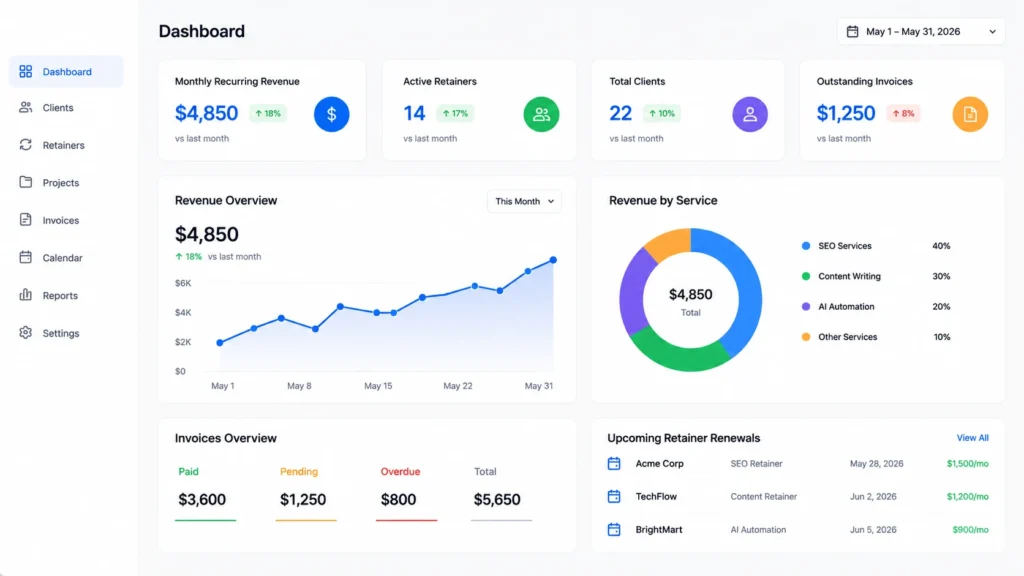
Retainers solve this problem.
A strong portfolio also makes it easier to win long-term projects and earn AI freelance repeat clients. If you haven’t built one yet, read How to Build a Strong AI Freelancing Portfolio With No Experience in 2026.
A retainer is simply an agreement where a client pays for ongoing support over a fixed period, usually monthly.
Businesses benefit because they no longer need to search for freelancers repeatedly.
Freelancers benefit because they spend less time finding work and more time delivering it.
For many AI freelance repeat clients, a retainer becomes the natural next step after a successful first project.
Examples include:
AI Content Writing
- Four blog articles every month.
- Content updates.
- Internal linking improvements.
- SEO recommendations.
AI Social Media Management
- Monthly content calendars.
- Weekly post creation.
- Caption writing.
- Performance reviews.
AI Research Services
- Competitor monitoring.
- Industry trend reports.
- Monthly research summaries.
AI Automation
- Workflow monitoring.
- Process improvements.
- Automation maintenance.
- New integrations.
Notice something important.
Every package solves an ongoing business need.
That is why businesses continue paying.
Make It Easy for Clients to Say Yes Again
Many freelancers unintentionally make future collaboration feel complicated.
Instead of offering one clear recommendation, they present five different services.
Clients become overwhelmed.
Decision fatigue increases.
Nothing happens.
A much better approach is offering one logical next step.
For example:
“Now that we’ve improved your blog content, the next area I’d recommend is refreshing older articles so they continue attracting search traffic.”
Or:
“Since your LinkedIn content is now consistent, the next opportunity is building a weekly newsletter using the same content strategy.”
Simple recommendations reduce friction.
Clients appreciate freelancers who remove complexity instead of creating it.
A Simple Conversation That Leads to Repeat Business
You don’t need complicated sales techniques.
Often, one professional question is enough.
Near the end of every successful project, ask:
“Now that we’ve completed this project, what’s the next challenge your business is trying to solve?”
This question changes the conversation completely.
Instead of discussing invoices or deadlines, the client begins talking about future goals.
Those goals frequently create your next project.
Sometimes they even reveal larger opportunities than the original assignment.
Don’t Wait for Clients to Contact You
Many freelancers assume satisfied clients will automatically return.
Sometimes they do.
Often they don’t.
Not because they were unhappy.
Because they became busy.
Business owners manage dozens of priorities every day.
Your project may simply no longer be at the top of their mind.
Professional follow-up keeps the relationship active without becoming intrusive.
LinkedIn is one of the best places to stay connected with previous clients and generate more AI freelance repeat clients through consistent professional networking. Learn practical relationship-building strategies in How to Get AI Freelance Clients on LinkedIn in 2026.
A simple check-in after project completion demonstrates genuine interest.
For example:
Hi [Client Name],
I hope everything is going well.
I wanted to check how the project has been performing over the past few weeks. If you’ve noticed any new priorities or areas where I can continue supporting the business, I’d be happy to discuss them.
This message doesn’t pressure the client.
It opens the door.
Many AI freelance repeat clients begin with conversations exactly like this.
Continue Providing Value Even When You’re Not Being Paid
One of the easiest ways to stay memorable is occasionally sharing something genuinely useful.
Perhaps you discover:
- a new AI tool,
- an industry trend,
- an SEO update,
- a productivity improvement,
- or a workflow idea relevant to the client’s business.
Send it.
Without asking for work.
Without attaching a proposal.
Without trying to sell anything.
These small interactions reinforce one important message:
“I’m still thinking about helping your business succeed.”
Very few freelancers do this consistently.
Those who do often remain the first person clients think about whenever a new project appears.
That is how long-term AI freelance repeat clients are built—not through constant selling, but through consistent value, professional communication, and a genuine commitment to helping businesses grow.
A Simple Follow-Up System That Brings Clients Back
Many freelancers assume that once a project ends, their work is finished.
Professionals think differently.
The project may be complete, but the relationship is just beginning.
One of the simplest ways to increase AI freelance repeat clients is by following a structured follow-up process instead of waiting for clients to contact you again.
You don’t need complicated CRM software.
You simply need consistency.
After 7 Days
Check whether the client has implemented your work.
Ask if they need help with anything else.
Example:
Hi [Client Name],
I hope everything is going well. I just wanted to check whether you’ve had a chance to implement the work we completed. If you have any questions or need further improvements, I’m always happy to help.
After 30 Days
Review progress.
Offer one practical suggestion.
Do not sell.
Simply provide value.
Example:
I noticed a few opportunities that could further improve the work we completed last month. If you’re interested, I’d be happy to share a few recommendations.
After 60–90 Days
Reconnect naturally.
Ask about new business priorities.
Many businesses have completely different needs after two or three months.
This timing often creates new freelance opportunities.
When Should You Ask for a Testimonial?
Many beginners ask for testimonials immediately after delivering the files.
A better approach is waiting until the client has actually experienced the value of your work.
If the client expresses satisfaction, says the project exceeded expectations, or mentions positive business results, that is usually the ideal moment.
A simple message works well.
I’m really glad the project has been helpful. If you have a few minutes, I’d genuinely appreciate a short testimonial about your experience working together. It helps future clients understand the type of results I aim to deliver.
Professional.
Simple.
No pressure.
When Should You Ask for Referrals?
Referral requests should never feel forced.
Instead of asking,
“Do you know anyone who needs my services?”
Try something more natural.
If you know another business facing similar challenges, I’d really appreciate an introduction. Most of my work comes through recommendations from satisfied clients.
This feels conversational rather than promotional.
Many referrals happen because clients simply remember your professionalism.
Realistic Client Retention Expectations
One of the biggest mistakes beginners make is expecting every client to become a long-term customer.
That isn’t realistic.
Some projects are naturally one-time assignments.
Others end because the client’s priorities change, budgets shift, or internal teams take over.
Losing a client doesn’t automatically mean you did something wrong.
The goal is not 100% retention.
The goal is improving your retention rate over time.
A realistic progression often looks like this.
| Freelancing Stage | Typical Repeat Client Rate* |
|---|---|
| First 3 Months | 10–20% |
| 3–6 Months | 20–35% |
| 6–12 Months | 30–50% |
| Established Freelancers | 50%+ |
*These figures are general observations rather than guaranteed outcomes. Actual results depend on your niche, communication, service quality, pricing, and client acquisition strategy.
The freelancers who consistently improve their systems usually see higher retention rates every year.
Building AI freelance repeat clients is one of the fastest ways to create predictable monthly income. For a practical roadmap, read How I’d Make My First $1000 with AI Freelancing in 30 Days.
Common Mistakes That Prevent Repeat Clients
Many freelancers lose repeat business for reasons that have nothing to do with technical ability.
Some of the most common mistakes include:
Treating Every Project Like a Transaction
Clients remember relationships.
Not invoices.
Focus on long-term trust instead of short-term revenue.
Disappearing After Delivery
Once the project ends, many freelancers completely stop communicating.
Simple follow-ups often create future opportunities.
Trying to Sell Too Much
Offering five different services at once often overwhelms clients.
Recommend one logical next step instead.
Many beginners attempt to offer every AI service at once. A better approach is mastering one specialization and the tools that support it before expanding. That approach makes it much easier to earn AI freelance repeat clients over time. Explore AI Tools Freelancers Are Actually Using in 2026 to build a more efficient workflow.
Ignoring Business Outcomes
Businesses rarely care which AI tools you used.
They care whether you helped them save time, increase traffic, improve productivity, or generate more revenue.
Keep every conversation focused on business outcomes.
Forgetting Existing Clients
Many beginners spend all their time searching for new work while completely ignoring satisfied clients.
Existing relationships often become the fastest source of future income.
A Practical 30–60 Day Client Retention Plan
After completing your first successful project, follow a simple system.
Days 1–7
Deliver the project professionally.
Answer revision requests promptly.
Ensure the client is completely satisfied.
Days 7–30
Check whether the client has implemented your work.
Offer practical recommendations based on their results.
Days 30–60
Suggest one logical next project.
If appropriate, introduce a monthly retainer or ongoing support package.
Beyond 60 Days
Continue checking in periodically.
Share useful industry insights.
Celebrate client milestones.
Maintain the relationship without constantly trying to sell.
Over time, this process creates trust that naturally leads to AI freelance repeat clients, referrals, and recurring revenue.
Frequently Asked Questions
How do AI freelancers get repeat clients?
Repeat clients are built through consistent delivery, professional communication, proactive follow-ups, and solving ongoing business problems instead of treating every project as a one-time transaction.
Should beginners offer retainers?
Yes.
Simple monthly retainers often provide more predictable income than relying entirely on one-off projects.
Start with small recurring services before expanding into larger retainers.
How long does it take to build repeat clients?
Many freelancers begin receiving repeat work within the first three to six months, although results vary depending on service quality, communication, and client satisfaction.
Is it okay to follow up with previous clients?
Absolutely.
Professional follow-ups demonstrate reliability and remind clients that you’re available to help with future projects.
The key is providing value rather than sending constant sales messages.
Can repeat clients eliminate the need for constant outreach?
Not entirely.
However, a growing base of repeat clients significantly reduces the amount of time spent searching for new work and creates a more stable freelance business.

Strategic Closing
Finding your first client proves that someone is willing to pay for your skills.
Keeping that client proves that your business delivers lasting value.
The freelancers who build sustainable businesses rarely rely on constant client hunting alone.
They develop systems that strengthen relationships, solve ongoing business problems, and create natural opportunities for future collaboration.
Every satisfied client represents more than a completed project.
They represent future work.
Future referrals.
Future testimonials.
And sometimes, years of recurring income.
Rather than asking yourself,
“Where can I find my next client?”
Start asking,
“How can I become the freelancer this client never wants to replace?”
That single mindset shift often separates inconsistent freelancing from a stable, long-term business.
Many beginners attempt to offer every AI service at once. Focusing on one specialization makes it easier to earn AI freelance repeat clients. If you’re still deciding which path fits your skills, read How to Choose the Right Online Income Model in 2026.