By Omar Yousaf, Founder of Digital Solo Hub
Learning how to get your first AI freelance client in 2026 is usually harder than learning the AI tools themselves.
Most beginners spend weeks experimenting with ChatGPT, Claude, or other platforms, yet never earn their first dollar—not because the tools failed them, but because they never built a reliable way to find and contact people who might hire them.
The first client rarely goes to the freelancer with the longest prompt library. It usually goes to the person who shows up in the right place, sends a clear message, and makes it easy for a busy owner to reply.
That is encouraging news.
You do not need a huge following or a perfect brand to start getting conversations. You need a practical acquisition system: one channel, a simple pitch, proof you can attach or link, and enough volume that silence on day one does not end the week.
What this guide covers (and what it does not): This page is your find-and-contact playbook. You will learn where first AI freelance clients actually come from, which method to start with, how to structure outreach and proposals, how many attempts to send daily, and how to track replies. It is not a from-zero skills course—if you still need to pick a service, build a workflow, and assemble portfolio samples before you chase leads, start with Start AI Freelancing With No Experience and come back here when you are client-ready. It is also not a deep closing manual—when someone replies, use How to Close Your First AI Freelance Client for proposals, pricing talk, and follow-up. And it is not a day-by-day earnings calendar aimed at first ~$1000—that lives on Make Money with AI Freelancing in 30 Days.
This guide walks through a step-by-step framework for getting in front of your first AI freelance client in 2026: clarifying the pitch line you use in outreach, choosing one acquisition channel, writing messages that start conversations, running daily volume without burning out, and turning early replies into paid work by handing off to the right next step.
Whether you offer AI content writing, research, light automation, design support, or another outcome-based service, the acquisition principles stay the same: clarity beats cleverness, volume beats waiting, and one focused channel beats dabbling on three.
Table of Contents
- Why Most Beginners Fail to Get Replies
- How Clients Actually Think When They Scan You
- How to Stand Out in Outreach (Not Just on a Profile)
- The Shift That Changes Your Pitch
- Where Your First Client Actually Comes From
- Which Method Should You Choose First?
- Step-by-Step: Find and Contact Your First Client
- Why Volume Matters More Than Perfection
- Real Example: Outreach Volume to First Paid Project
- Fastest Methods Ranked
- Realistic Outreach Timeline (No Hype)
- What to Say About Price in Early Conversations
- Common Mistakes That Delay Your First Reply
- Acquisition Cadence: A Focused Outreach Plan
- Daily Routine for Getting Your First Client
- After the First Reply (and After the First Paid Job)
- Frequently Asked Questions
- Strategic Conclusion
If you’re still building skills and samples from zero, use the no-experience setup guide first—then return here for outreach.
Why Most Beginners Fail to Get Replies (Not “Fail Freelancing”)
The failure pattern is predictable—and it is usually an acquisition failure, not a talent failure.
Beginners:
- Learn tools instead of putting a clear offer in front of real businesses
- Publish a generic profile and wait for inbound that never comes
- Send long, vague messages that explain AI instead of naming an outcome
- Try three platforms for two days each, then conclude “nothing works”
- Treat one ignored proposal as proof the market is dead
The biggest mistake is this:
Waiting to be discovered instead of running a contact system.
A business does not wake up looking for “someone who uses AI.”
They respond to:
- A specific problem they already feel
- A short message that shows you noticed their situation
- A low-risk next step (a sample, a short call, a clear deliverable)
The freelancer who understands this gets conversations.
The one who doesn’t keeps refreshing an empty inbox.
Many beginners also explore broader earning strategies before they commit to outreach—this guide on how to make money with ChatGPT in 2026 breaks down practical income paths. When you choose freelancing as the path, this page is where you learn how to get in front of the first buyer.
This is why understanding how to get your first AI freelance client—through find, reach, and follow-up—matters more than collecting another tool.
How Clients Actually Think When Hiring Freelancers
Most beginners assume clients are analyzing skills in detail.
They are not.
Clients are usually making fast decisions based on three simple factors:
1. Clarity
Can this person clearly explain what they do?
If your offer is vague, you are ignored immediately.
2. Relevance
Does this service match my problem?
A business owner is not looking for “AI services.”
According to trends on platforms like Fiverr, businesses are increasingly hiring freelancers for specific outcomes rather than generic AI skills.
They are looking for:
- better content
- more leads
- improved visibility
3. Risk Reduction
Can I trust this person?
This is why:
- samples matter
- clear communication matters
- simple offers convert better
Key Insight
Clients are not looking for the most skilled freelancer.
They are looking for the safest and clearest choice.
How to Stand Out in a Saturated Freelance Market
Many beginners believe the market is too competitive.
It is not.
It is crowded — but not differentiated.
Why Most Freelancers Look the Same
- same offers
- same wording
- same generic services
This creates an opportunity.
How to Stand Out Instantly
You do not need to be better.
You need to be clearer.
Instead of:
“I provide content services”
Say:
“I write SEO blog posts for real estate websites”
Add One Simple Edge
- faster delivery
- niche focus
- better communication
Clarity beats skill in the beginning.
Pro Tip
Many beginners first explore different earning options before committing to freelancing — this breakdown of the best AI side hustles for beginners in 2026 helps you understand where freelancing fits in the bigger picture.
The Shift That Changes Everything
The turning point is simple but powerful:
Stop offering services. Start offering outcomes.
Instead of saying:
“I do AI writing”
Say:
“I write SEO blog posts for small businesses”
Instead of:
“I create AI content”
Say:
“I create 30 days of social media content for local brands”
This shift immediately separates you from 90% of beginners.
Where Your First Client Actually Comes From
Most people assume clients will “find them.”
That rarely happens.
Your first client usually comes from one of three places:
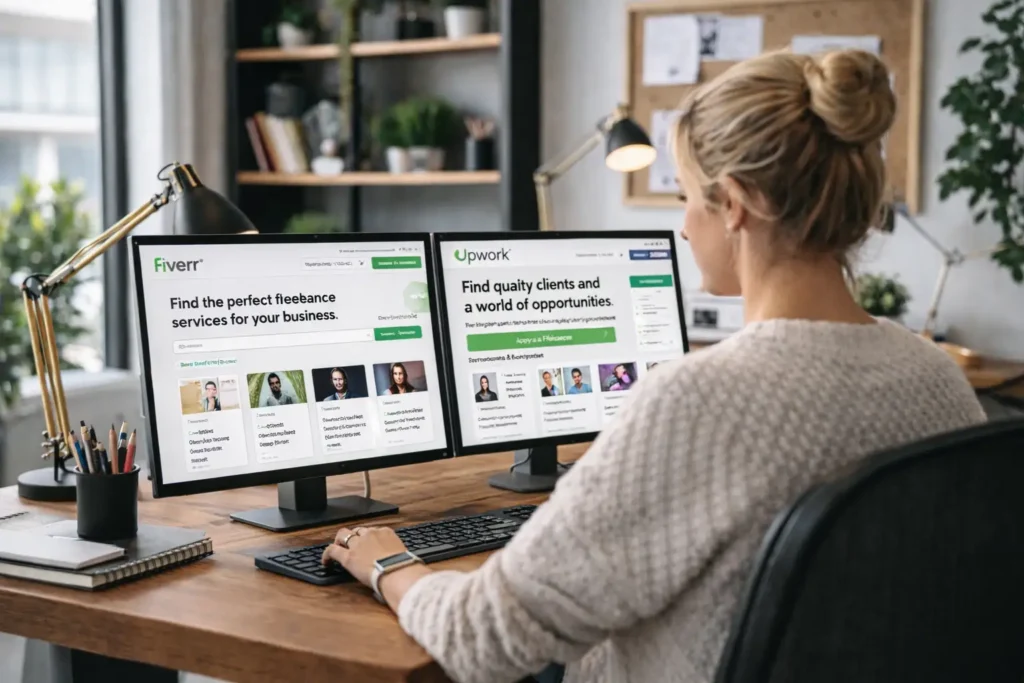
1. Freelance Platforms (Fiverr / Upwork)
These platforms work — but only when positioned correctly.
Generic gigs fail.
Specific outcome-based gigs get attention.
2. Direct Outreach (Underrated)
This is the fastest method most beginners ignore.
Small businesses already need help.
They just haven’t been approached correctly.
3. Portfolio-Based Pitching
Clients trust proof, not claims.
A simple sample project can outperform a long message.
Which Method Should You Choose First?
If you want the fastest result:
→ Start with direct outreach
If you prefer structured platforms:
→ Use Upwork
If you want passive growth:
→ Use Fiverr
Insight
Do not try all three at once.
Focus increases results.
Step-by-Step: Find and Contact Your First Client
This is the exact process beginners can follow.
Step 1: Lock a Pitch Line Before You Send Anything
Do not open this guide by debating every AI service on the internet. That debate belongs in setup—not in acquisition.
If you have not yet chosen one beginner-friendly service, built one workflow, and made a few samples, pause and complete Start AI Freelancing With No Experience. Coming back here without a clear offer usually produces vague outreach that gets ignored.
For this page, assume you already picked one micro-outcome (for example: SEO blog posts for a niche, social content batches for local brands, research briefs, or a simple content/automation deliverable). Your acquisition job is to turn that outcome into a pitch line—the one sentence you will reuse in proposals, DMs, and cold emails.
The pitch line formula (use this in every channel)
“I help [type of business] get [specific result] with [your deliverable]—here’s a quick example.”
Examples that work better in outreach than “I do AI”:
- “I write SEO blog posts for local service businesses so their site has fresh pages that target real search questions.”
- “I create a month of short social posts for clinics and coaches who post inconsistently.”
- “I turn messy notes into clean research briefs founders can use before a launch.”
Why this step sits inside acquisition (not a service catalog)
Choosing a service deeply is a setup decision. Writing the pitch line is an outreach decision. The same freelancer can have a decent skill and still fail because every message sounds like:
“Hi, I’m an AI freelancer available for hire.”
That message asks the client to invent the job for you. Busy owners will not do that work.
Pre-outreach checklist (10 minutes)
Before you send your first batch:
- Write your pitch line on paper. If it needs more than two commas, it is too wide.
- Name three places you will look for matching businesses (platform keywords, Google Maps niche, LinkedIn titles, local directories).
- Prepare one “proof asset” you can attach or link (sample URL, PDF, or Doc)—details in the next step.
- Decide your daily attempt number (start with 10 focused sends; build toward 15–20 if quality holds).
Do not spend this step ranking “beginner vs medium vs high-value services.” That catalog slows outreach. If you need help picking what to sell first, return to the no-experience setup guide or the services/niche posts on Digital Solo Hub—then come back with one pitch line and start contacting.
Step 2: Prepare Bait Samples for Outreach (Not a Full Portfolio Course)
Acquisition needs proof you can show inside a pitch, not a museum of unfinished experiments.
If you still have zero samples, build them properly in the no-experience portfolio path. Here, the goal is narrower: create 2–3 bait pieces designed to travel with outreach.
What a bait sample is
A bait sample is a short, realistic deliverable that:
- Matches the niche you are messaging (or is obviously adaptable)
- Looks like client work (title, headings, clean formatting)
- Can be skimmed in under two minutes
- Supports one clear next step (“Want me to do this for your site weekly?”)
Examples:
- One 800–1,200 word blog draft aimed at a niche you will pitch
- One week of social captions for a fictional local brand in that niche
- One before/after rewrite of a weak About or service page
How bait samples help you get the first client
- Platforms: Attach or link samples in Upwork proposals so you are not “just another applicant.”
- Direct outreach: “I made a quick example for businesses like yours” beats “Are you hiring?”
- Follow-ups: A second sample on a different angle gives you a reason to message again without begging.
Outreach-ready packaging (do this once)
- Put samples in Google Docs or a simple public page with clear titles.
- Name files like a professional would:
seo-blog-sample-local-dentists.pdf, notfinal-final-ai.docx. - Write a two-sentence caption you paste under every link: what it is + who it helps.
- Keep a “swipe file” folder so you never hunt for links mid-proposal.
To speed production after you already know your workflow, you can use ideas from best AI tools for freelancers in 2026—but tools are support, not the acquisition system.
Rule: Do not delay all outreach for a perfect portfolio. Two clean bait samples plus daily contact beats ten drafts nobody ever sees.
Step 3: Define a Clear Offer Line for Messages
Avoid vague services in the subject line and first paragraph.
Instead of:
“I do content writing”
Say:
“I will write SEO blog posts for your business—here is a sample in your niche.”
Clarity increases replies because the reader can accept or reject a concrete ask. Save longer packaging and pricing architecture for the close guide once someone engages.
Step 4: Choose ONE Acquisition Channel (Then Work It Hard)
Do not spread yourself thin across Fiverr, Upwork, LinkedIn, email, and Instagram in week one. Split attention is the quiet killer of first-client timelines.
Pick one primary channel for 14 days:
- Upwork (active proposals) — best when you can send tailored proposals daily to posted jobs.
- Direct outreach (fastest conversations) — email, contact forms, or polite LinkedIn messages to small businesses that already need the outcome you sell.
- Fiverr (slower / more passive) — fine as a secondary later; weak as your only move if you need momentum now.
How to work each channel (acquisition lens)
Upwork
- Search jobs with specific outcome keywords, not just “AI.”
- Open with their problem in sentence one; put your pitch line in sentence two; link one bait sample in sentence three.
- Track which job types reply. Double down on those keywords.
Direct outreach
- Build a short list from Google Maps, directories, or niche sites (20–50 names is enough to start).
- Personalize one concrete observation (stale blog, thin service pages, irregular posting).
- Offer a small, clear deliverable—not a “full AI transformation.”
Fiverr
- Use a specific gig title that matches your pitch line.
- Treat the gig as a storefront while your daily energy still goes to active outreach elsewhere until orders appear.
For a deeper platform comparison when you are ready to expand beyond one channel, see Fiverr vs Upwork vs LinkedIn 2026. For LinkedIn-only tactics after your primary channel is working, see AI freelance clients on LinkedIn.
Insight
Do not try all three at once.
Focus increases replies. Replies create your first client.
Step 5: Send 10–20 Focused Attempts Daily
This is where most people fail—not at learning AI, but at consistent contact.
Consistency matters more than perfect wording on day one.
- Send proposals on your chosen platform or
- Reach out to businesses on your list or
- Do both only if quality stays high (usually: pick one)
Improve the message from real replies (and non-replies), not from rewriting in a vacuum.
What to say when reaching out
Most beginners fail not because they don’t try—but because they say the wrong thing.
Avoid long messages.
Avoid explaining your entire background.
Avoid leading with “I use ChatGPT.”
Use this simple structure:
- Notice — one specific observation about their site, offer, or content gap
- Offer — your pitch line in plain language
- Proof — one sample link or attachment
- Ask — one easy yes/no question
Basic outreach message (direct)
Hi [Name], I noticed [specific gap—e.g. your blog hasn’t had a new post in months / your service pages are thin].
I help [type of business] with [outcome]. I put together a short sample so you can see the style: [link].
Would you like me to do this for you on a weekly or monthly basis?
Basic Upwork-style proposal opener
Hi [Name], you mentioned you need [their stated need].
I deliver [your outcome] for [similar businesses]. Here’s a relevant sample: [link].
I can deliver [scope] in [timeframe]. Happy to adjust to your brief—what’s the priority for this project?
Why this works
- Short
- Direct
- Focused on their situation
- Shows initiative with proof
- Asks for a small next step
Three variants worth testing (keep length similar)
Variant A — Sample-first: Lead with “I made a quick example for businesses like yours.”
Variant B — Problem-first: Lead with the gap you noticed, then the offer.
Variant C — Specific deliverable: “I can draft two SEO posts for [topic cluster] this week—want the outline first?”
Log which variant gets replies. Do not change all three variables at once (channel + message + niche). Change one, measure for a few days, then adjust.
Key insight
Clients respond to clear action, not long explanation.
For longer proposal structures once a job is serious, borrow templates from AI freelance proposal templates 2026—then finish the conversation with the close guide.
Why Volume Matters More Than Perfection
Most beginners fail because they try to perfect everything before taking action.
They:
- rewrite proposals multiple times and send none
- hesitate to message “real” businesses
- wait for the “right moment” or a perfect niche insight
This slows everything down.
The reality
Getting your first AI freelance client is a contact numbers game wrapped in a clarity game.
- More focused outreach → more chances to be seen
- More chances → more replies
- More replies → more opportunities to do paid work
Simple math (illustrative, not a guarantee)
If you send:
- 10 careful proposals or messages → you might get a reply
- 20 careful attempts → you might get a few conversations
Exact reply rates vary by niche, channel, and message quality. The point is not a magic percentage. The point is that zero sends guarantee zero clients.
How to raise volume without becoming spam
- Use a list and a tracker (date, name, channel, variant, result).
- Personalize one line; template the rest.
- Stop after your daily number—then improve tomorrow’s batch from today’s notes.
- Never copy-paste the same message to twenty people with zero edits.
Key insight
Perfection delays progress.
Volume with a clear pitch creates momentum.
Step 6: When Someone Replies — Hand Off to Closing (Don’t Invent Sales Scripts Here)
Your first paid project will often be small. That is normal. Validation matters more than a perfect first invoice.
What you should not do on this page is turn every reply into a full negotiation course. Closing has its own system: proposal structure, discovery questions, pricing conversation, and follow-up sequences.
When you get:
- A “sounds interesting”
- A request for price
- A “send a proposal”
- A short call invite
…switch to How to Close Your First AI Freelance Client. That guide owns convert-interest-into-yes. This guide owns getting the interest in the first place.
Acquisition-side habits that make closing easier
- Reply the same day while context is fresh
- Restate their problem in one sentence before you talk deliverables
- Point back to the sample you already sent
- Suggest one clear next step (scope outline, short call, or fixed starter package)
Then let the close playbook handle objections, pricing psychology, and follow-up timing.
Real Example: From Outreach Volume to First Paid Project
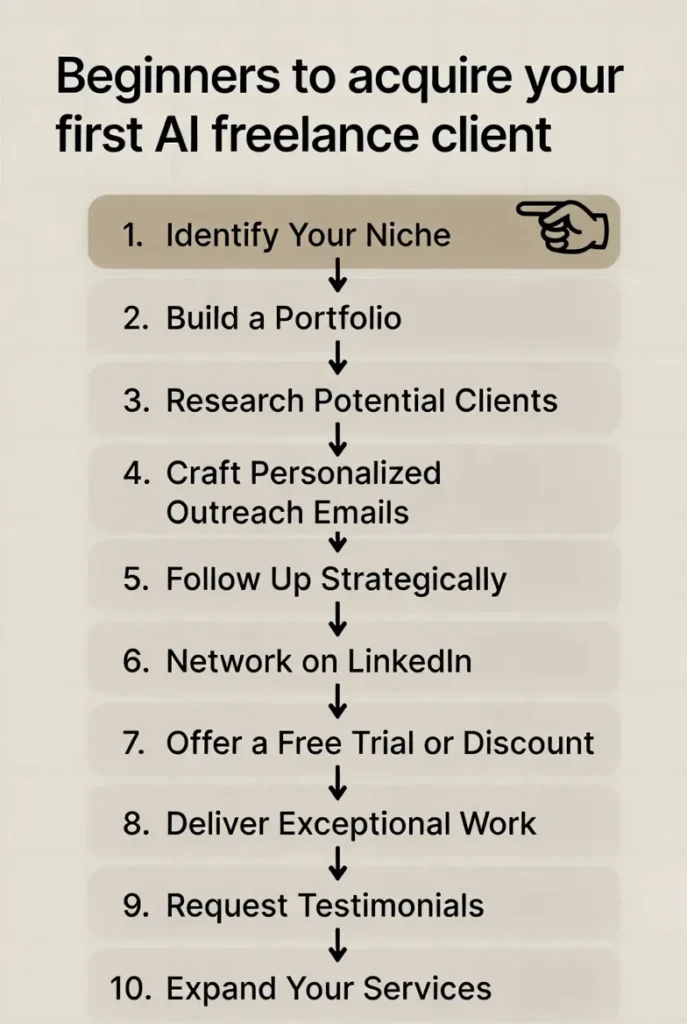
Here is a realistic acquisition path—not a promise, a pattern.
A beginner already chose blog writing as the micro-service and prepared two sample articles (setup done elsewhere).
Then the acquisition week looked like this:
- Picked Upwork as the single channel for 14 days
- Searched jobs that asked for blog posts, website content, or SEO articles—not vague “AI expert” gigs
- Sent about 15 tailored proposals per day using the notice → offer → proof → ask structure
- Logged every send and noted which job descriptions got clicks or replies
Within a stretch of consistent days (often inside two to three weeks of real volume, not two to three days of dabbling), a small project appeared—something like a single post in the $20–$40 range.
Example first project shape (illustrative):
- Title brief from the client’s niche
- ~1,000–1,200 words with clear headings
- Delivered on an agreed timeline
- Opened the door to asking about a monthly content cadence after delivery—using closing/retention skills, not more cold spam
Insight
The first payment is not mainly about the dollar amount.
It proves your find-and-contact system works. Once proven, you improve the message, tighten the niche keywords, and raise volume quality—not random activity.

Fastest Methods Ranked (Speed, Difficulty, Results)
Fastest Results
Direct Outreach
- Speed: High
- Difficulty: Medium
- Result: Fast responses
Balanced Approach
Upwork Proposals
- Speed: Medium
- Difficulty: Medium
- Result: Consistent opportunities
Slow but Passive
Fiverr Gigs
- Speed: Slow
- Difficulty: Low
- Result: Passive leads
Important Note
Start with outreach or proposals.
Do not rely on passive platforms in the beginning.
Realistic Outreach Timeline (No Hype)
Most beginners who actually send messages follow a pattern like this:
- Days 1–2 → Finalize pitch line, bait sample links, tracker spreadsheet
- Days 3–7 → Daily outreach on one channel; improve personalization from non-replies
- Days 8–14 → Steady 10–20 attempts/day; first conversations often appear in this window if quality is real
- Weeks 2–4 → Continue volume; convert replies using the close guide; do not abandon outreach after one yes
Reality
If you stay consistent on contact, your first client often shows up within a few weeks of real outreach—not after months of tool tutorials.
This is an outreach timeline, not a $0→$1000 earnings calendar. For a dated money-and-execution month plan, use Make Money with AI Freelancing in 30 Days. Use this page to keep the top of that funnel full of conversations.
What to Say About Price in Early Conversations (Without Owning the Full Pricing Guide)
Pricing is where many beginners freeze—and freezing kills acquisition momentum.
You will eventually need a clear rate logic. Deep beginner pricing, when to raise rates, and how to run the money conversation live in a call belong with closing and rates content—not as a second pricing manual here.
Acquisition-safe price framing
Until you have a few conversations under your belt:
- Offer a small starter scope you can describe in one sentence
- Prefer a fixed starter (“one blog post,” “one week of captions”) over vague hourly debates in the first message
- Expect early projects to land in a modest range while you collect proof—illustrative starter bands many beginners use are roughly $10–$40 for a small writing task or $20–$50 for a small content batch. Those are starting points, not laws.
What to avoid in cold outreach
- Leading with “cheap AI content” as your only angle
- Writing a novel about your rates before they asked
- Apologizing for charging anything
When price comes up
If they ask “how much?” early:
- Restate the deliverable
- Give a clear starter number or range for that scope
- Offer to adjust after you see their brief
- Move the detailed negotiation into the close guide process
For broader rate education after you have traction, use Digital Solo Hub’s rates guidance—but do not pause all outreach until you have a perfect price list.
Key insight
Your first quoted number is temporary.
Your daily contact habit is what you are really building.
Common Mistakes That Delay Your First Reply
- Offering vague “AI services” in the first line of a message
- Overthinking copy instead of sending today’s batch
- Waiting for “perfect skills” before contacting anyone (finish setup on the no-experience page, then return)
- Switching platforms every other day
- Sending five huge messages instead of fifteen clear ones
- Ignoring tracking—so you never learn which pitch variant works
- Trying to close, price, and prospect in one panicked paragraph when a simple reply handoff would do better
The biggest issue:
Lack of focused volume on one channel.
Acquisition Cadence: A Focused Outreach Plan (Not an Earnings Calendar)
Use this as a contact cadence. It keeps you shipping messages. It is not a promise of a specific income by day 30—that calendar lives on Make Money with AI Freelancing in 30 Days.
Week 1 — Outreach foundation
- Confirm pitch line and one primary channel
- Finalize 2 bait sample links and captions
- Build a starter list (jobs to apply to or 30–50 businesses to contact)
- Create a simple tracker: date / target / variant / result / next step
- Send a lighter volume while you tighten personalization (for example 8–12 quality attempts/day)
Week 2 — Volume on one channel
- Raise toward 10–20 focused attempts daily
- Kill weak message variants; keep the one that earns replies or profile views
- Block calendar time for outreach the way you would block a shift
- Still one channel—resist “maybe I should also start Fiverr today”
Week 3 — Improve from feedback
- Read every reply and non-reply pattern
- Sharpen the “notice” line (specificity usually lifts response more than bigger adjectives)
- Prepare a short follow-up bump for warm silence (3–5 days later, new angle or second sample)
- When conversations appear, route them through How to Close Your First AI Freelance Client
Week 4 — Stabilize the system
- Keep outreach going even if one small project lands (feast-or-famine starts when you stop contacting)
- Document what won: niche keywords, message variant, channel habits
- Add a second channel only after the first is habitual
- If you want week-by-week money targets layered on top of this cadence, switch to the 30-day earnings plan while keeping this page’s contact habits
Outcome to aim for
A repeatable find-and-contact habit—and, with consistency, early conversations that can become your first paid AI freelance client.
Daily Routine for Getting Your First Client
Most beginners fail due to inconsistency. A simple daily structure fixes that.
Daily plan (2–4 hours) — acquisition centered
- 20–30 min → warm up: review yesterday’s tracker notes; tweak one line of the pitch
- 60–90 min → send proposals / outreach (this is the non-negotiable block)
- 20–30 min → update tracker; save promising threads; schedule follow-ups
- 20–30 min → optional skill polish only after the send block (so learning never replaces contacting)
Why this works
- Consistent action in the market
- Continuous improvement from real data
- Fast feedback loop on what people actually answer
Important note
Freelancing acquisition success is not mainly about talent.
It is about repetition with a clear offer in front of the right people.
After the First Reply (and After the First Paid Job)
This is where beginners either build a system—or return to waiting.
After the first reply
Do not improvise a full sales methodology in the chat box. Use the close guide for proposals, calls, pricing talk, and follow-up. Your acquisition job in that moment is simple: respond promptly, stay clear, and keep one next step on the calendar.
After the first paid project
Treat delivery as fuel for the next outreach wave:
- Ask for a short testimonial line you can paste into proposals
- Turn the job into a one-paragraph case note (“Problem → what I delivered → result”)
- Add that proof near the top of your next 20 attempts
- Keep the daily contact habit; one client is not a full pipeline
For LinkedIn-specific outreach many beginners add after they have a primary channel working, see How to Get AI Freelance Clients on LinkedIn in 2026.
What Is the Fastest Way to Get Your First AI Freelance Client in 2026?
The fastest path for most beginners is direct outreach or active proposals on one platform—contact small businesses or relevant job posts, offer a specific improvement, and show a simple example of your work.
Waiting for passive discovery alone is usually the slowest path at the start.
How do beginners get freelance clients with AI?
By combining a clear offer line, bait samples, and consistent outreach or proposals. Learning tools helps you deliver; contact volume helps you get found.
Do I need experience to start outreach?
You need enough skill to deliver a small first job and at least a couple of samples. You do not need years of freelancing history. If you are still building that foundation, use Start AI Freelancing With No Experience first, then return here to find and contact clients.
How many proposals or messages should I send daily?
Start with a number you can personalize—often around 10—and build toward 15–20 focused attempts if quality stays high. Random spam at high volume backfires.
How much might the first client pay?
Often a small starter project (illustrative ranges like $10–$50 for a limited deliverable). The goal of acquisition is a real yes and a completed job; deeper pricing strategy belongs in the close guide.
Is this the same as a 30-day $1000 plan?
No. This page is the find-and-contact system. For a week-by-week earnings calendar, use Make Money with AI Freelancing in 30 Days.
Why Getting Your First Client Is Easier Than You Think
Most people overestimate the difficulty of getting a first conversation.
Not because outreach is magic—but because they hesitate to send the tenth message.
The reality is:
- businesses already need help with content, research, and simple digital tasks
- freelancers are already earning with clear offers
- opportunities already exist on platforms and in local/online niches
The difference is execution: a pitch line, a channel, and daily attempts.
The real barrier
Not skill alone.
Not tools alone.
Not “the market is full.”
It is taking consistent contact action without overthinking every sentence.
Insight
The market is not only saturated with skilled freelancers.
It is crowded with people who rarely message anyone.
How to Reuse One Client Win to Get the Next One
Getting the first client matters.
Turning that win into better acquisition is how you avoid starting from zero every week.
Why this sits on the acquisition page
Full retention systems (retainers, weekly retain rhythms, long-term account growth) deserve their own focus elsewhere. Here, reuse the win as proof and list fuel.
Simple reuse strategy
- Deliver on time and communicate clearly (so you earn the right to ask)
- Request a two-sentence testimonial while the result is fresh
- Write a short case blurb you can paste into the next 20 proposals
- Ask: “Anyone else in your network who needs this monthly?”—one polite referral ask
- Keep outreach running so one project never becomes your only lead source
Instead of finishing one task and going quiet, say:
“If this helped, I can continue weekly—and if you know another owner with the same gap, I’m happy to introduce what I do in one short message.”
What this creates
- Stronger proposals (proof beats claims)
- Occasional warm introductions
- A pipeline habit that survives quiet weeks
Pro tip
One documented client result can outperform ten generic “I use AI” pitches—because acquisition is easier when every message carries evidence.
Strategic Conclusion
The opportunity in AI freelancing in 2026 is real—but only for people who treat finding and contacting clients as a skill, not a wish.
Start today:
- Lock your one-sentence pitch line (setup first if needed via the no-experience guide)
- Pick one channel for 14 days
- Send your first 10 focused outreaches with a bait sample
Your first client begins with a conversation.
Once someone is willing to talk or hire you, use How to Close Your First AI Freelance Client to turn interest into a yes. When you want a dated month plan aimed at early earnings targets, follow Make Money with AI Freelancing in 30 Days—and keep this page’s outreach cadence underneath it.
Written by Omar Yousaf
I help beginners build practical AI freelancing skills through structured learning, clear offers, and realistic acquisition habits. My focus is on helping new freelancers create sustainable income by combining AI tools with professional execution—finding real conversations instead of waiting for perfect conditions or unrealistic promises.