
Most freelancers don’t lose money on the first draft.
They lose it on the seventh “tiny tweak.”
The client says the work looks great. Then Slack lights up. One more pass. Then another. Then a cofounder joins the thread with a brand-new direction, and somehow you’re still inside the original fee.
A freelance revision policy is the fix. It tells everyone, in writing, what a revision is, how many rounds are included, what counts as new work, and what extra rounds cost. Not as a threat. As operating rules, the same way you’d state payment terms.
What this guide covers (and what it doesn’t): this page answers one question: how do you write and use a freelance revision policy that protects your margin without killing the relationship? It deliberately does not cover:
- How to write the full scope of work line by line. Use the automation scope of work template.
- How to price the project in the first place. See AI freelancing rates and the rate calculator.
- How to package tiers and retainers. See how to package AI freelance services.
- How to run discovery before you quote. Use the automation discovery call checklist.
This is practical guidance from a working freelancer’s point of view, not legal advice. If a contract is high-stakes, have a lawyer in your country read the clause before you sign.
Key Takeaways
- Write the number. “Reasonable revisions” means unlimited. Two rounds per deliverable is the practical default for most AI freelance work.
- Define a round. One consolidated written list from one named reviewer, inside a fixed window. Trickle feedback is not one round.
- Sort every ask into three buckets: owed fix (free), revision (uses a round), or change request (new quote, approval first).
- AI regenerations are not free by default. Same brief = revision. New audience, new offer, new model, or new integration = change request.
- Put the policy in the proposal and the contract. Friendly language for the client. Formal clause for the signature page.
- Platforms already price extras. Fiverr lets you sell extra revisions as Gig extras. Upwork lets you propose new milestones when scope grows.
- Log rounds. Date, request, bucket, round number. Memory is not a system.
Table of Contents
- What Is a Freelance Revision Policy? (Short Answer)
- Hard Truth: Unlimited Revisions Is a Pricing Decision
- The Revision Triangle: Fix, Revise, or Requote
- Which Bucket? Decision Table for AI Freelancers
- How Many Rounds Should You Include?
- Copy-Paste Templates
- Word-for-Word Scripts for “Can You Just…”
- Platform Notes: Fiverr and Upwork
- Illustrative Example: One Project, Three Asks
- Common Revision Mistakes (and the Fix for Each)
- The 45-Minute Revision Policy Setup
- Frequently Asked Questions
What Is a Freelance Revision Policy? (Short Answer)
A freelance revision policy is a short written rule set that states how many revision rounds are included, what counts as one round, what counts as new work, how long the client has to send feedback, and what extra rounds cost. Put the friendly version in your proposal. Put the formal clause in your contract or scope of work. Use a one-page change request when something falls outside the included rounds.
That’s the snippet answer. Here’s why it matters in 2026.
AI freelancing makes revision chaos worse, not better. Clients see how fast a first draft appears and assume every regeneration is free. Automation clients treat “one more Zapier step” like a typo fix. Video and UGC clients ask for another avatar take after the brief already closed.
Without a policy, every “can you just…” becomes a negotiation you’re too tired to win.
If you’re still setting up your offer from scratch, start AI freelancing with no experience covers the foundation. This page assumes you already sell project work and need the feedback rules.
Hard Truth: Unlimited Revisions Is a Pricing Decision
People treat “unlimited revisions” like hospitality.
It’s not.
It’s a price. You’re either charging enough to absorb every extra pass, or you’re donating hours.
Contrarian Insight: clients don’t hate revision caps. They hate surprise fees. A clear policy is kinder than a soft yes followed by resentment at invoice time.
AIGA’s guidance on design proposals is blunt on this point. A solid proposal should spell out, for each phase, what is included and what is not, including the number of creative directions you will show and the number of revisions or refinements that are included (AIGA, Proposals). The association’s Standard Form of Agreement for Design Services goes further: when a client asks for work outside the original scope, you respond with a change order that describes the extra time and money, gets a signature, and is invoiced separately.
You don’t need a 40-page design contract to borrow that idea. You need three numbers and one sorting rule.
The Revision Triangle: Fix, Revise, or Requote
Every client request falls into one of three buckets. Sort first. Reply second.
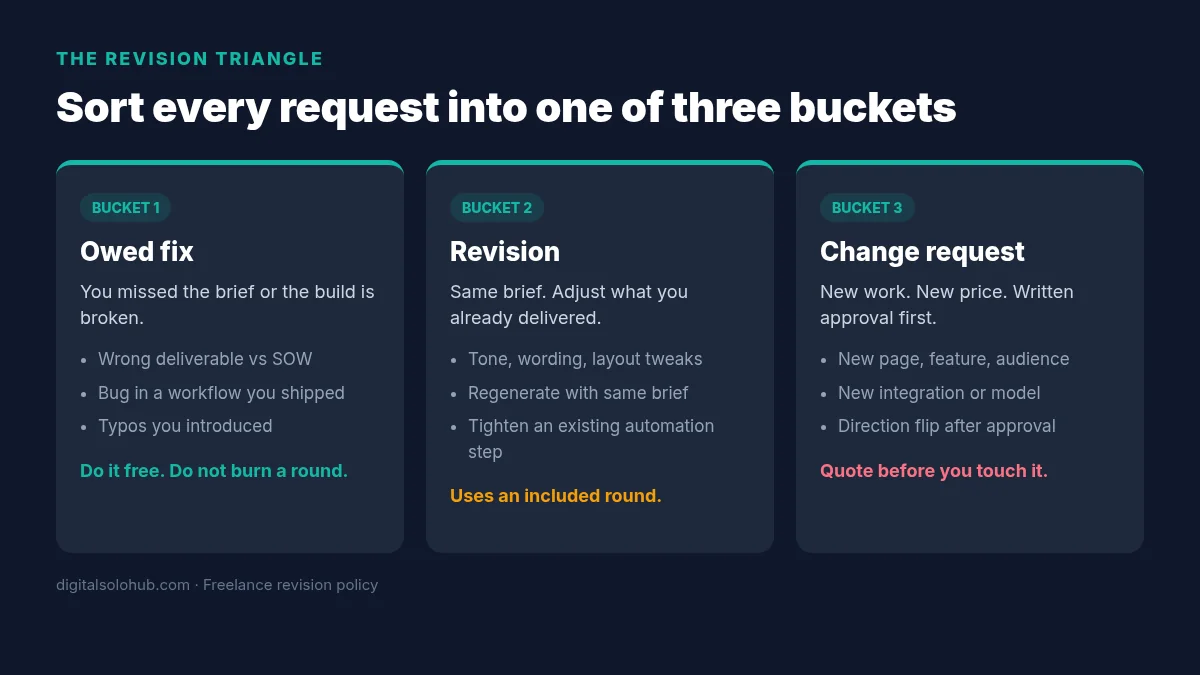
Bucket 1: Owed fix (free, does not burn a round).
Something you delivered does not match the agreed brief or does not work. Wrong length. Broken automation path. Missing field you promised. Typos you introduced.
You fix it. You don’t argue. You don’t count it as a revision round.
Bucket 2: Revision (uses an included round).
The deliverable matches the brief, and the client wants adjustments inside that brief. Warmer tone. Different headline options within the same offer. Swap two images. Tighten a prompt and regenerate against the same brief. Move a filter in an existing workflow without adding systems.
Bucket 3: Change request (new quote, written approval before work).
The ask adds scope. New audience. New deliverable. New integration. New AI model with new cost. New brand direction after they already approved a direction. “Also can you build a chatbot while you’re in there?”
AIGA calls this a change order: a mini-proposal for work outside the original scope, signed before you start, invoiced on its own (AIGA Standard Form).
The rule: if you can’t point to the original brief and say “this was already in,” it’s Bucket 3 until proven otherwise.
Which Bucket? Decision Table for AI Freelancers
Use this when you’re unsure. Adjust the examples to your services.
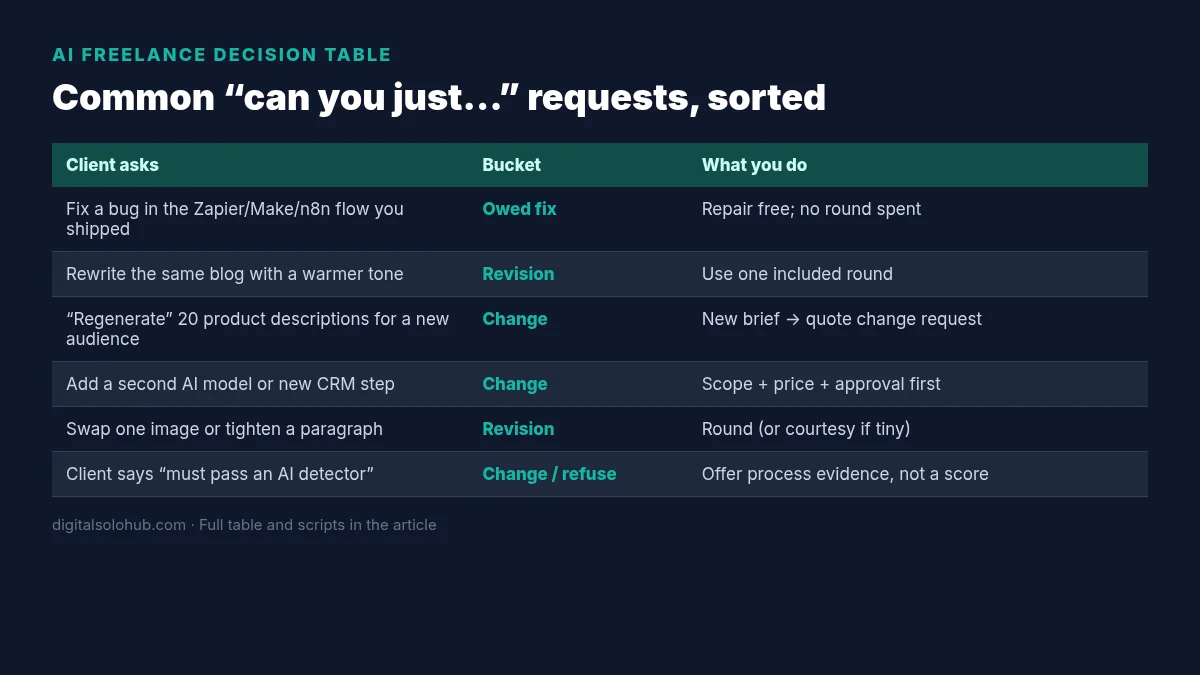
| Client asks | Bucket | What you send |
|---|---|---|
| Bug in a Zapier, Make or n8n flow you shipped | Owed fix | Repair note; no round spent |
| Typos or formatting you introduced | Owed fix | Correct and redeliver |
| Same blog post, warmer tone, same audience | Revision | Round 1 or 2 |
| Same product descriptions, swap 3 adjectives | Revision | Round (or courtesy if tiny and rounds remain) |
| Regenerate copy for a new audience or offer | Change | Change request with price + days |
| Add a second CRM, inbox or payment step | Change | Quote; update SOW |
| Swap the LLM provider mid-build | Change | Quote tool cost + rebuild time |
| “Make it pass an AI detector” | Don’t accept as written | Offer process evidence / no-AI clause instead |
| New avatar, voice or face after approval | Change | Quote + consent check |
| Client wants unlimited regenerations in a fixed fee | Change / renegotiate | Hourly add-on or regen pack |
That “AI detector” row matters. Detector scores are not a reliable acceptance test. Don’t let a score become your revision policy. Agree to a workflow and a human checkpoint instead. If you disclose AI use at all, keep that conversation separate; how to tell clients you use AI has the disclosure ladder and clauses.
How Many Rounds Should You Include?
There is no law that says “two.”
There is a pattern that works.
Default for most AI freelance projects: two revision rounds per deliverable.
- One round for short, tightly scoped work (a single landing section, a small prompt pack, a one-step automation tweak).
- Two rounds for standard content, research, decks, and most automation builds.
- Three rounds only when multiple stakeholders are named up front and the fee already prices the chaos.
What counts as one round:
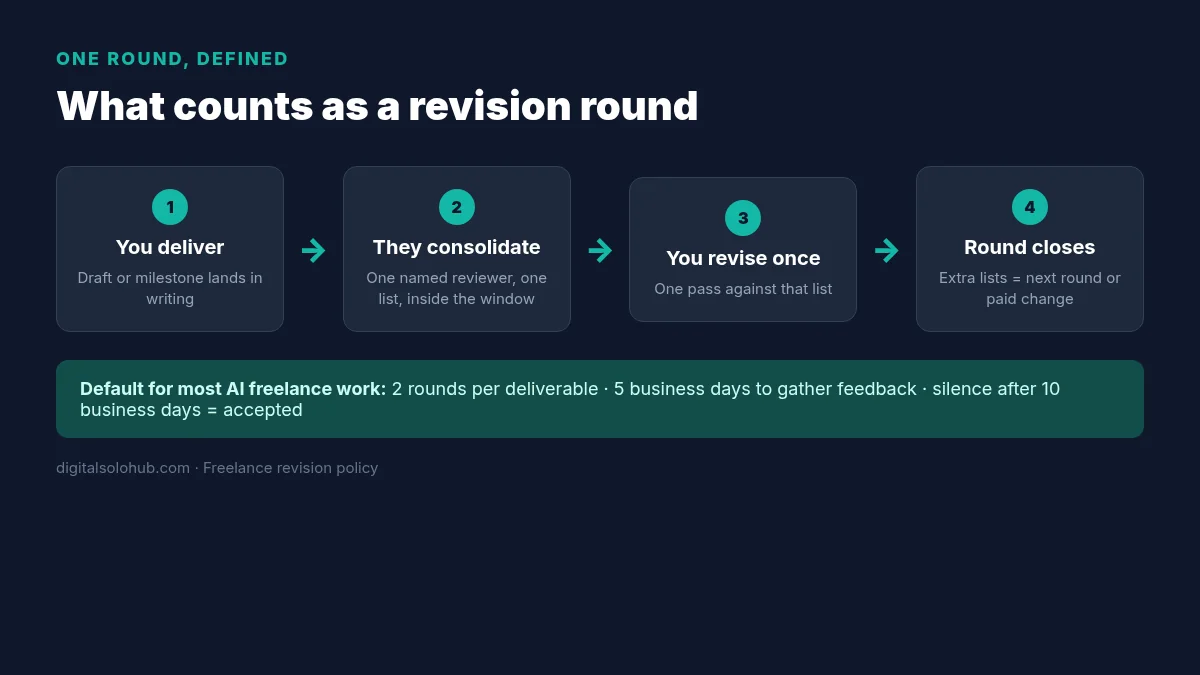
- You deliver a draft or milestone in writing.
- One named reviewer gathers all stakeholder comments into one list within the feedback window (I use 5 business days).
- You make one revision pass against that list.
- The round closes. A second list starts the next round, or becomes a paid change if rounds are gone.
Feedback that does not stay inside one round:
- Separate emails from three people across a week
- Slack voice notes that reverse yesterday’s written notes
- “Quick thoughts” after they already approved the phase
- A new brief disguised as comments
Silence rule: if you hear nothing for 10 business days after delivery, treat the deliverable as accepted and move on. State that in the policy so silence has a meaning.
Per deliverable, not per project. Two rounds on a twelve-page site is not the same as two rounds per page template. Attach the count to each deliverable or each milestone listed in your scope.
If you’re still deciding what to sell, the ranked list in AI freelance services helps you pick an offer before you invent revision math for five services at once. For the toolchain itself, see the AI tools freelancers are actually using. Tools don’t replace a revision policy; they just make unpaid regenerations faster.
Copy-Paste Templates
Copy these. Fill every bracket. Keep them next to your proposal and SOW templates.
1. Formal revision clause (contract / SOW)
Revisions

1. Each Deliverable listed in Schedule A includes two (2) revision rounds at no additional cost.
2. A "revision round" is one consolidated set of written feedback on one Deliverable, submitted by [Named Approver / Role] within five (5) business days of delivery. Feedback from other stakeholders, or feedback sent after the window, is treated as a new round.
3. Revisions adjust work performed against the agreed brief. Requests that add new deliverables, audiences, features, integrations, models, formats, or strategic direction are Change Requests, priced separately, even if revision rounds remain.
4. Additional revision rounds beyond those included are billed at $[rate]/hour or $[flat]/round (whichever is stated in Schedule A), estimated in writing and approved by Client before work begins.
5. If no feedback is received within ten (10) business days of delivery, the Deliverable is deemed accepted and the project proceeds to the next milestone.
6. Corrections required because a Deliverable does not conform to Schedule A are owed fixes and do not consume a revision round.
7. Revision rounds apply per Deliverable and do not transfer between Deliverables or phases.
Drop this beside access and acceptance in your automation scope of work template so change control and revisions sit in one place.
2. Friendly policy (proposal / kickoff email)
How feedback works on this project

Every delivery includes two revision rounds, and I want you to use them well.

- After each delivery, you'll have 5 business days to collect everyone's comments into one list. One list = one round.
- I'll turn each round around within [X] business days.
- "Make this warmer" is a revision. "Also write a second landing page for a new audience" is new work, and I'll quote it separately so it never eats your included rounds.
- Need a third round? I'll estimate the hours (or a flat round fee) before I start.
- If I don't hear back within 10 business days, I'll treat that delivery as approved so your deadline stays honest.

Your named reviewer for feedback is: [Name / Role].
3. One-page change request
CHANGE REQUEST
Project: [name]
Client: [name]
Date: [date]
Request title: [short label]

Requested change
[Plain-language description]

Why this is outside the current scope
[Point to the original brief / Schedule A line]

Deliverables in this change
- [item]
- [exclusions]

Additional fee: $[amount] ([currency])
Schedule impact: [none / +N business days / new date: ____]
Payment: [due on approval / added to next invoice / 50% to start]

No work on this change begins until you approve below.

Decision: ☐ Approved  ☐ Approved with notes  ☐ Declined  ☐ Deferred to [date]
Client name: ____________  Date: ____________
4. Revision log (keep privately, share the count)
Project: [name]
Deliverable: [name]
Included rounds: 2

| # | Date | Request (1 line) | Bucket | Round used? | Status |
|---|---|---|---|---|---|
| 1 |  |  | fix / rev / change | n/a or 1 | done |
| 2 |  |  |  |  |  |
Word-for-Word Scripts for “Can You Just…”
Keep the tone of a project manager. Calm. Specific. Not defensive.
1. Still inside included rounds
“Happy to. That falls inside round [1/2]. Please send one consolidated list by [date], and I’ll turn the full pass around by [date].”
2. Rounds are used up
“We’ve used both included revision rounds on [deliverable]. I can do another pass as a paid round at $[amount] (about [N] hours). Want me to send a short change request to approve before I start?”
3. It’s new scope, not a revision
“That’s a strong add. It’s outside the current brief, so I’ll treat it as a change request rather than burning a revision round. Here’s the fee, timeline impact, and what you’d get. No work starts until you approve.”
4. Trickle feedback from three people
“To keep this as one round, please have [Named Approver] gather everyone’s notes into a single list. Separate threads count as separate rounds under our agreement.”
5. They want unlimited regenerations on a fixed fee
“I can regenerate freely inside the two included rounds against the approved brief. Open-ended regenerations for new angles need either an hourly add-on or a regen pack. Which do you prefer?”
6. They reverse a prior approval
“Got it. Because [direction/version] was already approved on [date], flipping it now is a change request, not a polish pass. I can quote the rebuild before touching files.”
If the money conversation keeps stalling, your pricing model may be the real issue. Project and package pricing handle revision math better than open hourly; see AI freelancing rates.
Platform Notes: Fiverr and Upwork
Your contract still matters on marketplaces. The platform just adds its own mechanics.
Fiverr. Sellers can include a set number of revisions in a Gig package and sell additional revisions as a Gig extra from the Pricing tab. Fiverr’s help docs describe revisions extras as a way to set clear expectations and limits on how many revisions you provide (Managing Gig extras, source files, and shipping). After you deliver, the client has a review window to accept, request revisions, or extend review time; requesting revisions moves the order to In Revision and you re-deliver (Managing your orders). Drafts shared through Share Draft are not revisions. If included rounds are gone, offer a paid extra or custom offer before you keep editing for free.
Upwork. On fixed-price contracts, scope growth should become a new or edited milestone, not a silent favor. Freelancers can propose new milestones or request changes to future milestones; the client accepts or declines (How to propose or respond to milestone changes). Don’t start unpaid change work on a milestone that isn’t accepted and funded. For how fixed-price milestones work in general, see Upwork’s milestones overview.
If you’re choosing a channel for acquisition rather than revision mechanics, Fiverr vs Upwork vs LinkedIn compares them.
Illustrative Example: One Project, Three Asks
Hypothetical example, not a real client. It shows how the triangle works on one job.
A freelancer sells an AI product-description package: 40 SKUs, brand voice doc, two revision rounds, five-day feedback window. Fee is fixed.
Ask A. Client: “Three titles still have the old brand name.”
Bucket: owed fix. Freelancer corrects same day. No round spent.
Ask B. Client sends one Google Doc with tone notes from marketing and the founder.
Bucket: revision. Round 1. Freelancer regenerates only the flagged SKUs against the same brief, rewrites by hand, redelivers.
Ask C. Client: “Actually, can you rewrite all 40 for our wholesale buyers too? Different tone, different benefits.”
Bucket: change request. New audience = new brief. Freelancer sends the one-page change request: +$[illustrative amount], +4 business days, wholesale voice add-on. Work waits for a yes.
Three asks. Three different replies. Same policy.
The same sorting helps if you sell video. Extra avatar takes, new hooks, or a longer cut after approval are change requests, not free polish. If you’re building that offer, the AI video editing side hustle guide covers the service shape; this page covers the feedback rules around it. To put a price on those extra cuts and rounds, see how much to charge for video editing.
For automation builds, the same sorting sits on top of your discovery notes and your handoff. Discovery catches the brief early (automation discovery call checklist). Handoff closes ownership cleanly (automation handoff checklist). The revision policy protects the middle.
Common Revision Mistakes (and the Fix for Each)
1. Writing “unlimited revisions” to sound premium.
You’re pricing a blank check.
Fix: two rounds, defined. Sell a paid round pack if you want flexibility.
2. Counting rounds without defining a round.
Monday email + Wednesday Slack + Friday cofounder voice note becomes “one round” forever.
Fix: one consolidated list, one named reviewer, one window.
3. Letting new work hide inside a feedback doc.
“Also add a pricing page” lands in the same PDF as “make the header darker.”
Fix: line 3 of the formal clause. Quote it out loud if you have to.
4. Starting the change before the signature.
You build goodwill. Then they delay approval. You’ve worked free.
Fix: “No work on this change begins until you approve” on every change request.
5. No price for round three.
You invent a number while everyone is annoyed.
Fix: put the overflow rate in the clause on day one.
6. No revision log.
Six months later nobody remembers how many passes happened.
Fix: a five-column table. Date, ask, bucket, round, status.
7. Burning rounds on owed fixes.
The client broke nothing. You did.
Fix: Bucket 1 is free. Say so. It builds trust.
8. Softening the policy mid-project without writing it down.
A free “extra” becomes the new normal.
Fix: if you gift a courtesy pass, label it courtesy in writing, once.
9. Using AI speed as an excuse to skip the policy.
Fast drafts invite more asks. The policy matters more, not less.
Fix: same triangle. Regenerations still need a brief.
The 45-Minute Revision Policy Setup
Do this once. Then every project inherits it.
- Minutes 0-10: paste the formal clause into your contract or SOW template. Fill the rate and the named-approver placeholder.
- Minutes 10-20: paste the friendly policy into your proposal template and kickoff email snippet.
- Minutes 20-30: save the change request as a one-page doc or form. Test filling it once with fake numbers.
- Minutes 30-40: create the revision log template in your notes app. Add it to your project checklist.
- Minutes 40-45: if you sell on Fiverr, set an extra-revisions Gig extra with a real price. If you sell on Upwork, write a two-line note to yourself: “scope growth = new milestone request.”
From then on, each new project takes about a minute: confirm two rounds, name the reviewer, paste the friendly blurb.
Frequently Asked Questions
How many revision rounds should a freelance contract include?
Two rounds per deliverable is the practical default for most AI freelance work. Use one round for tiny, tightly scoped jobs and three only when multiple stakeholders are named up front and the fee already prices the extra passes. What matters more than the number is the definition of a round.
What counts as one revision round?
One consolidated written feedback list from one named reviewer, sent within your feedback window (often five business days), followed by one revision pass from you. Separate emails, Slack threads or late comments from other stakeholders start a new round.
What is the difference between a revision and a change request?
A revision adjusts work already delivered against the agreed brief. A change request adds new scope: a new deliverable, audience, feature, integration, model or strategic direction. Change requests need a written quote and approval before work starts, even if revision rounds remain.
Do bug fixes count as revision rounds?
No. If the deliverable does not match the agreed brief or does not work, that is an owed fix. Repair it without burning a round. Rounds are for adjustments inside a correct delivery, not for repairing your own misses.
How should AI freelancers treat regenerations?
Regenerating against the same brief is usually a revision. Regenerating for a new audience, offer, model or integration is a change request. AI speed does not make open-ended regenerations free on a fixed fee.
Does Fiverr let me charge for extra revisions?
Yes. Fiverr lets sellers include revisions in a Gig package and offer additional revisions as a paid Gig extra from the Pricing tab. After delivery, clients can request revisions inside the review window; drafts shared with Share Draft are not revisions.
How do I handle scope changes on Upwork?
On fixed-price jobs, propose a new milestone or request changes to a future milestone and wait for the client to accept and fund it before you start the extra work. Do not absorb unpaid scope growth inside an active milestone.
Final Thoughts
Revision chaos is rarely a client personality problem.
It’s a missing rule set.
A freelance revision policy turns “can you just…” into a sorting exercise: fix it free, burn a round, or send a change request. Two rounds per deliverable, one consolidated list, a silence rule, and a price for overflow will out-earn most of the marketing tips on this site.
Your next action:
- Paste the formal clause into your next contract today.
- Add the friendly policy to your proposal template.
- On your current project, start the revision log even if the policy was never signed. Enforce forward, not backward.
If you still need the first client to send this to, how to get your first AI freelance client covers channels and daily outreach. If the offer itself is fuzzy, tighten packaging before you argue about rounds: how to package AI freelance services.
Write the rule once. Then get back to the work.
Sources
- AIGA: Proposals (Shel Perkins) – include the number of revisions or refinements per phase
- AIGA: Standard Form of Agreement for Design Services (2022 update PDF) – change orders and out-of-scope changes
- Fiverr Help: Managing Gig extras, source files, and shipping – extra revisions as a Gig extra
- Fiverr Help: Managing your orders – revisions, review window, Share Draft vs delivery
- Upwork Help: How to propose or respond to milestone changes as a freelancer
- Upwork Help: How to use milestones in fixed-price jobs
Platform rules and contract norms change. Check the sources above before you rely on a clause, and have a lawyer review anything high-stakes. Sources checked October 15, 2026.
About the Author
Omar Yousaf
Founder of Digital Solo Hub
I help beginners build practical AI freelancing skills through structured learning, portfolio development, and realistic business strategies. My focus is on helping new freelancers create sustainable income by combining AI tools with professional execution rather than shortcuts or unrealistic promises.