AI agents for freelancers are creating a new opportunity to build and sell AI-powered services to businesses in 2026. Instead of simply using ChatGPT or other AI tools to complete individual tasks, freelancers can build AI agents that handle complete workflows such as lead qualification, customer support, research, document processing, reporting, and follow-ups.
This guide explains how AI agents work, which services freelancers can sell, which tools to learn, how to price AI agent projects, and how to find your first clients—even if you don’t have advanced programming experience.
The opportunity is bigger than simply learning another AI tool. Businesses are increasingly looking for people who can connect AI with real business processes and turn repetitive work into systems that operate with far less human intervention.
The Reality of the AI Market in 2026
There is a lot of noise around artificial intelligence.
Every day, social media is full of people claiming AI will either eliminate every job or make everyone rich overnight.
Neither extreme is true.
What is actually happening is more interesting — and more useful.
Businesses are becoming increasingly comfortable with AI. But most business owners still lack the technical knowledge to implement these systems properly.
This creates a clear gap in the market:
- Business owners understand the problem.
- Freelancers understand the tools.
The freelancers who connect those two worlds will become increasingly valuable.
That is exactly why AI agents matter.
Unlike traditional automation, an AI agent can analyze information, make decisions, take actions, and adapt as situations change. Instead of automating a single step, it can automate an entire process.
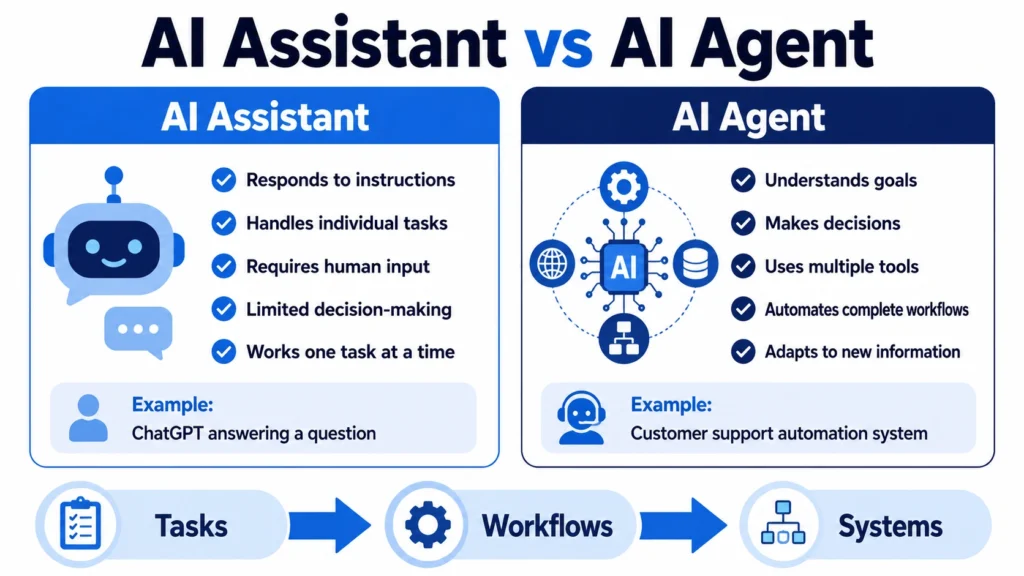
AI assistants respond to instructions, while AI agents can make decisions, use multiple tools, and automate complete workflows.
What Exactly Is an AI Agent?
An AI assistant responds to commands. An AI agent performs tasks on its own.
That distinction changes everything.
Imagine a business receives one hundred customer inquiries every day.
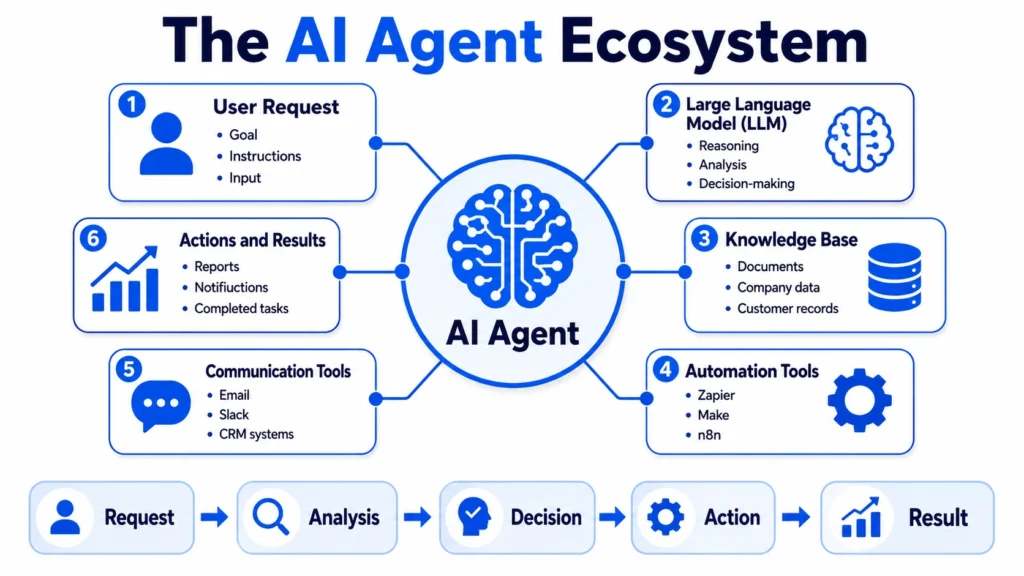
A traditional chatbot can answer basic questions. An AI agent can go much further. It can:
- Analyze the customer’s request
- Search internal databases
- Draft a personalized response
- Update records
- Schedule meetings
- Notify the right team members
- Generate a summary report
Many modern AI agents rely on large language models (LLMs). The OpenAI API allows these systems to analyze information, make decisions, and interact with external tools.
The system handles the entire workflow while requiring far less human intervention.
This shift — from individual tasks to complete systems — is why businesses are starting to invest seriously in AI agents. They are no longer just buying software. They are buying efficiency.
Why Most Freelancers Are Ignoring This Opportunity
The reason is simple.
Most freelancers prefer familiar territory.
Learning to write content with ChatGPT feels easier than learning how multiple systems work together. Building an AI agent looks intimidating because it involves workflows, integrations, databases, automation platforms, and large language models.
The learning curve appears steep, so many freelancers simply avoid it.
That hesitation creates opportunity.
When a market looks complicated, competition drops. The barrier to entry rises. Prices go up. And the people who take the time to understand it become more valuable.
The Contrarian View: Businesses Don’t Care About AI Agents
Here’s an uncomfortable truth: Businesses don’t actually care about AI agents.
They care about outcomes.
A law firm wants faster document analysis. An e-commerce store wants better customer support. A marketing agency wants more qualified leads. A consulting firm wants better research.
The technology itself is almost irrelevant.
This is one of the biggest mistakes freelancers make. They sell technology. Successful operators sell results.
That distinction alone can decide whether someone earns a few hundred dollars or builds a real business.
Another hard truth: most people entering the AI market will fail.
Not because they lack intelligence. Not because the opportunity isn’t real. They fail because they keep chasing the next trend instead of building real expertise.
Last year it was prompt engineering. This year it’s automation. Next year it will be something else.
Constantly switching directions creates the illusion of progress while producing very little real value. Businesses pay specialists. They rarely pay people who are still experimenting with the latest trend.
If you decide to enter the AI agent space, commit to understanding the business problems behind the technology. That is where the real opportunity sits.
Why Businesses Are Willing to Pay Thousands
Many freelancers underestimate the value of efficiency.
Suppose an employee spends three hours every day processing emails, qualifying leads, updating spreadsheets, and organizing information. That adds up to roughly sixty hours a month.
Now imagine an AI agent reduces those sixty hours to ten.
The company just recovered fifty hours of work every month.
Businesses are not paying for software. They are paying for time. They are paying for speed, consistency, and scalability.
A business owner does not care whether a solution uses ten prompts or ten thousand lines of code. They care about whether it saves time, reduces costs, and increases revenue.
The Fastest Way to Enter the Market
Many beginners immediately try to learn advanced programming languages.
In most cases, that is unnecessary.
The no-code ecosystem has already lowered the technical barrier. Tools like ChatGPT, Claude, Make, Zapier, n8n, Airtable, and Notion now allow freelancers to build useful systems without deep coding knowledge.
The goal is not to become an AI researcher. The goal is to solve real business problems.
You do not need to master every tool. You only need to become competent at connecting a few of them into systems that deliver clear results.
Quick-Win Method: Start With Existing Problems
Instead of looking for complex or futuristic projects, start with problems businesses already have.
Look for repetitive work such as:
- Lead qualification
- Email management and follow-ups
- Appointment scheduling
- Document processing
- Customer support triage
- Weekly reporting
These problems already exist. You are not creating demand — you are responding to it.
The simplest way to begin is to pick one common process and build a basic AI agent around it. If you are completely new to the industry, our guide on AI Freelancing for Beginners: Get Your First Client in 30 Days explains how to build experience quickly.
Once you can clearly explain the outcome and show how it works, selling becomes much easier.
Focus on solving one painful task well. That single result is more valuable than a half-finished complex system.
External Resources
- OpenAI
- Anthropic
The Best AI Agent Business Models for Freelancers in 2026
One reason this opportunity is expanding so quickly is that there isn’t just one business model.
Different businesses have different problems, budgets, and objectives. A law firm has needs that are completely different from those of an e-commerce store, a marketing agency, or a real estate company.
That creates opportunities for freelancers with different skill sets.
Choosing the right specialization is equally important, which is why understanding the right niche can dramatically accelerate your progress. See Most AI Freelancers Choose the Wrong Niche in 2026 — Here’s What Actually Works.
Instead of competing with everyone, you can specialize in a particular industry and develop expertise within that niche.
Model 1: Lead Generation Agents
Lead generation remains one of the easiest entry points because almost every business depends on a predictable flow of new customers.
These systems can identify prospects, collect information, qualify leads, update databases, and notify sales teams automatically.
Difficulty: Low to moderate
Scalability: High
Demand: Very high
Model 2: Customer Service Agents
Many businesses spend countless hours answering repetitive questions. AI agents can dramatically reduce that workload by responding to inquiries, retrieving information, updating records, and routing requests to the appropriate department.
Difficulty: Moderate
Scalability: High
Demand: Extremely high
Model 3: Research Agents
Consultants, lawyers, financial analysts, and marketing professionals spend enormous amounts of time collecting and organizing information.
AI agents can accelerate that process while improving consistency and efficiency.
Difficulty: Moderate
Scalability: Moderate
Demand: Growing rapidly
Model 4: Content and Marketing Agents
Content creation has evolved far beyond simple text generation.
Modern AI agents can perform keyword research, analyze competitors, organize information, generate ideas, schedule content, and monitor performance metrics.
This model aligns particularly well with the Digital Solo Hub ecosystem because it combines artificial intelligence, automation, content strategy, and SEO.
Difficulty: Moderate
Scalability: High
Demand: High
Ranking the Opportunities
| Service | Difficulty | Demand | Competition | Scalability |
|---|---|---|---|---|
| Lead generation | Low | High | Moderate | High |
| Customer support | Moderate | High | Moderate | High |
| Research agents | Moderate | High | Low | Moderate |
| Content systems | Moderate | High | High | High |
| Workflow automation | High | Very high | Moderate | Very high |
How Much Can Freelancers Charge?
One of the biggest misconceptions in the AI industry is that greater complexity automatically leads to greater profits.
That simply isn’t true.
Businesses rarely care about complexity.
If you want a deeper breakdown of pricing strategies, read AI Freelancing Rates for Beginners in 2026: How Much Should You Charge?
They care about results.
Suppose a business spends twenty hours every week performing repetitive administrative work. If an AI agent reduces that workload to five hours, the company immediately saves fifteen hours every week.
Even if the owner’s time is worth only twenty dollars per hour, that translates into more than fifteen thousand dollars of recovered productivity every year.
From that perspective, a two-thousand-dollar solution suddenly appears very affordable.
A business owner does not care whether you spend three hours or thirty hours building the system. They care about the value the system creates.
Realistic Pricing Framework
Beginner Level
Suitable for straightforward workflows involving a single agent and limited integrations.
Typical range: $300–$800
Intermediate Level
Suitable for more advanced systems involving multiple workflows, reporting tools, and database integration.
Typical range: $1,000–$3,000
Advanced Level
Suitable for complex systems requiring customization, long-term maintenance, and deeper integrations.
Typical range: $3,000–$10,000+
The exact figures will vary from one industry to another, but the underlying principle remains the same:
Always sell value instead of time.
The Tools Worth Learning
One of the most common mistakes beginners make is attempting to learn too many platforms simultaneously.
A far more effective approach is to master a small collection of powerful tools.
Workflow automation platforms such as n8n have become extremely popular because they allow freelancers to connect multiple applications, create automated workflows, and build powerful AI agents with minimal coding experience.
Core AI platforms
- ChatGPT
- Claude
Automation platforms
- Make
- Zapier
- n8n
Not sure which automation platform should run your agents? See which automation tool freelancers should learn first.
Knowledge and data platforms
- Notion
- Airtable
- Google Sheets
A strong foundation will always outperform a scattered strategy.
You can also read AI Tools Freelancers Are Actually Using in 2026 (Tested for Real Work) for a more detailed overview.
How to Find Your First AI Agent Client
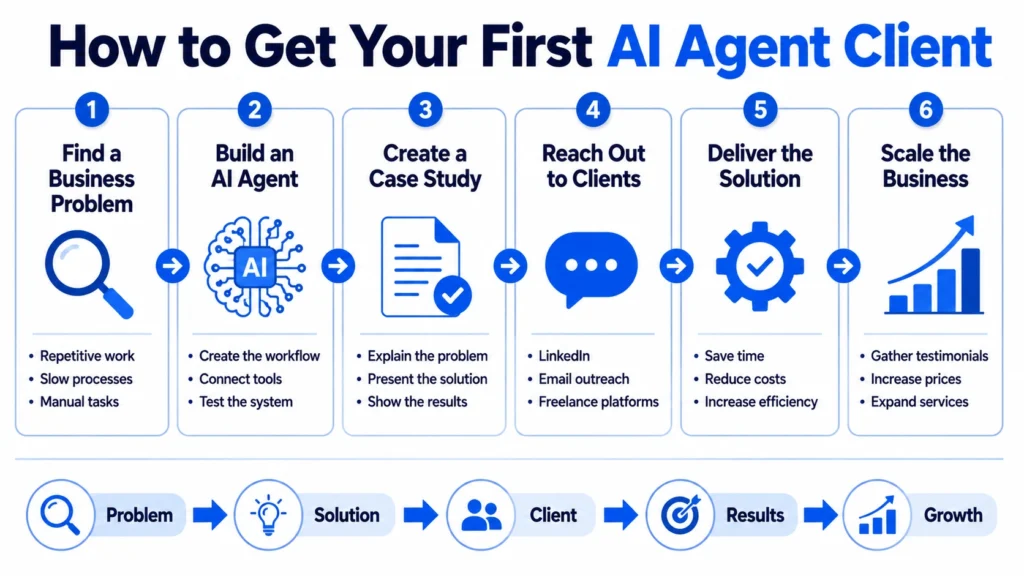
Many freelancers assume that sophisticated technology automatically attracts buyers.
Unfortunately, that is rarely the case.
Businesses are not searching for artificial intelligence.
They are searching for solutions.
If LinkedIn is your preferred platform, read How to Get AI Freelance Clients on LinkedIn in 2026 (Even If You Have Zero Experience).
Some of the best opportunities can be found in industries already overwhelmed by repetitive work, including law firms, real estate agencies, accounting firms, marketing agencies, recruitment companies, and e-commerce businesses.
Your goal is not to convince people that artificial intelligence exists. Your goal is to demonstrate how it solves an expensive problem.
A Simple Outreach Framework
Keep your message simple.
Do not say this:
I build AI agents.
Say this instead:
I noticed that your team handles a large number of customer inquiries every day. I believe an automated system could reduce response times while saving several hours every week.
This small change shifts the conversation away from technology and toward results.
That distinction is extremely important.
The Thirty-Day Execution Blueprint
Week One
Learn the fundamentals of artificial intelligence, workflows, automation, databases, prompting strategies, and integrations.
Week Two
Build simple projects involving lead qualification, customer support, and content workflows.
Focus on experience rather than perfection.
Week Three
Develop two or three portfolio projects and document the process carefully.
Clients trust evidence far more than promises.
Week Four
Begin approaching potential clients consistently.
Momentum matters more than intensity.
Our article How to Scale an AI Freelancing Business from $1K to $10K+/Month in 2026 explains what happens after you land your first few clients.
Common Mistakes Beginners Make
Many freelancers enter the market with unrealistic expectations.
Some try to master dozens of tools simultaneously. Others become obsessed with technology while ignoring the business problems they are trying to solve.
Many expect immediate results and abandon their efforts before they develop meaningful expertise.
The reality is much simpler.
Expertise compounds over time.
The people who remain consistent usually achieve the best results.
Why AI Agents Are Different From Traditional Automation
Traditional automation follows rules.
AI agents make decisions.
Traditional automation performs isolated tasks.
AI agents coordinate entire workflows.
Traditional automation reacts to instructions.
AI agents analyze information, adapt to changing conditions, and take action.
This is precisely why businesses are investing heavily in them. They are no longer searching for isolated tools. They are searching for complete systems.
Frequently Asked Questions
Are AI agents replacing freelancers?
No.
They are transforming the nature of freelance work. The market is gradually shifting away from simple task execution and toward system design, implementation, and optimization.
Do I need programming experience?
Not necessarily.
Many powerful solutions can be built using no-code tools. However, understanding fundamental technical concepts remains a significant advantage.
Which industries currently offer the greatest opportunity?
Professional services, finance, consulting, marketing, real estate, and e-commerce continue to show exceptionally strong demand.
How long does it take to become proficient?
Most people can learn the fundamentals within a few weeks.
Developing genuine expertise usually requires several months of focused practice.
Is the market already saturated?
Not yet.
Competition is increasing rapidly, but demand continues to expand.
The people who combine technical knowledge with a deep understanding of business problems will probably remain in the strongest position.
The Strategic Bottom Line
The most successful freelancers of the coming years will not be the people creating the largest number of prompts.
They will be the people building the most valuable systems.
That is the real shift taking place in 2026.
Businesses are overwhelmed by complexity. They are drowning in information and searching for leverage.
AI agents provide that leverage.
Most freelancers are still learning how to use AI tools.
The next generation of successful freelancers will learn how to build systems around them.
The question is not whether AI agents will become more important.
The question is whether you will position yourself early enough to benefit from that transition.
About the Author

Omar Yousaf is the founder of Digital Solo Hub, where he writes practical, research-driven guides on AI freelancing, AI automation, online business, and digital income strategies. His work focuses on helping beginners build real skills, understand emerging AI trends, and create sustainable online businesses through realistic, step-by-step frameworks instead of hype.
Connect with Omar on LinkedIn for insights on AI, freelancing, and digital entrepreneurship, or follow him on Medium for additional articles and practical guides.
Website: https://digitalsolohub.com
Email: hello@digitalsolohub.com
LinkedIn: https://www.linkedin.com/in/omar-yousaf-049b20425/
Medium: https://medium.com/@hello_23522/